
A Comprehensive Guide to Investment Property Insurance in Ohio
A Comprehensive Guide to Investment Property Insurance in Ohio - Learn about investment property insurance Ohio
What Investment Property Insurance in Ohio Covers
Investment property insurance Ohio is specialized coverage for rental homes, apartment buildings, vacant properties, and renovation projects. It generally helps protect the building, your liability as an owner, and lost rent after a covered claim. Standard homeowners insurance may not cover a property once tenants move in or when the property is used as a business investment.
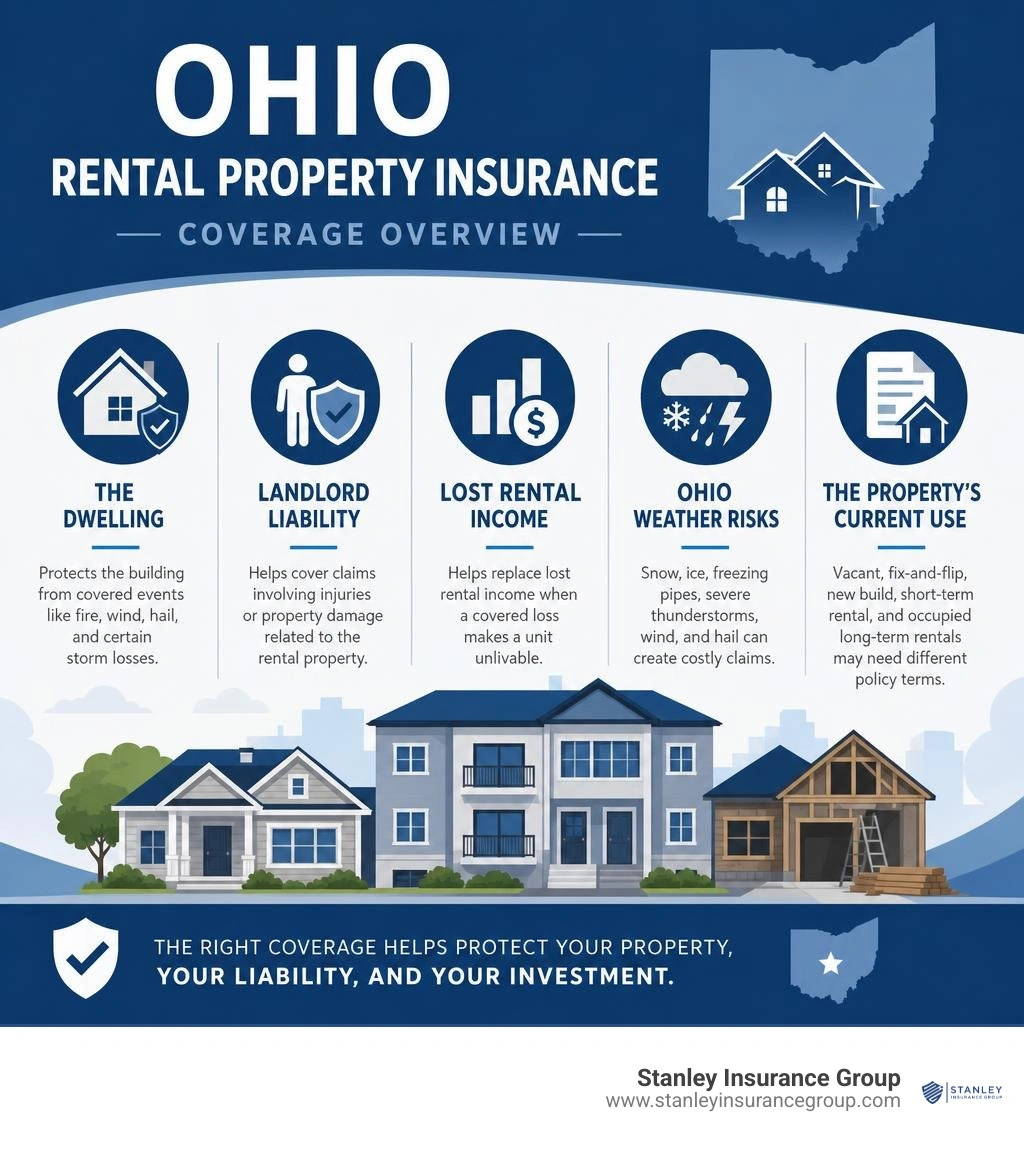
For a quick answer, Ohio investors usually need coverage for:
- The dwelling: Damage from covered events such as fire, wind, hail, and certain storm losses.
- Landlord liability: Claims involving injuries or property damage tied to the rental property.
- Lost rental income: Income you may lose when a covered loss makes a unit unlivable.
- Ohio weather risks: Snow, ice, freezing pipes, severe thunderstorms, wind, and hail can create costly claims.
- The property's current use: A vacant home, fix-and-flip, new build, short-term rental, and occupied long-term rental can require different policy terms.
Ohio's relatively landlord-friendly environment can support property ownership, but it does not remove the need to manage tenant injuries, building damage, or gaps created by a changing occupancy. The right policy should match both the property and the investment plan.
I am Brandon Stanley, President of Stanley Insurance Group, a family-owned Hilliard agency serving clients since 1984, and I help owners understand how investment property insurance Ohio fits alongside home, auto, life, and business coverage. Our team includes Amy in Commercial Lines; Ana and Sandra, Spanish-speaking Account Specialists; and Associate Agents Kaisen, Ethan, and Chase, with Spanish-speaking help available and a concierge-style approach built around lasting relationships; we are also among only 100 independent agents in the country with a partnership with Geico.
Core Coverage Options for Investment Property Insurance Ohio
When building a sound strategy for investment property insurance Ohio, understanding what core protections do—and do not—cover is essential. Whether you own a single-family house in Hilliard, a duplex in Columbus, or a growing residential portfolio in Dublin, real estate assets require direct physical protection and legal safeguards.
At the center of every landlord policy is dwelling coverage. This protects the physical structure of your building, including walls, roofs, foundations, and permanently attached fixtures. However, how that building is insured depends heavily on the policy form you select.
Insurance policies typically fall under different form levels, primarily DP-1 (Basic Form) and DP-3 (Special Form):
- DP-1 (Basic Form): Operates on a named-peril basis, meaning it only covers specific named risks such as fire, lightning, or internal explosion. Furthermore, basic form policies often payout on an Actual Cash Value (ACV) basis, which deducts depreciation from your payout.
- DP-3 (Special Form): Offers broad, open-peril protection for the structure. Anything is covered unless specifically excluded in the policy contract. DP-3 policies settle losses using Replacement Cost Value (RCV), paying what it actually costs to rebuild or repair the dwelling with similar materials at today's labor and supply rates—without deducting for age or wear and tear.
To ensure property owners maintain adequate financial protection, standard insurance guidelines require minimum valuation baselines. For instance, insuring a property dwelling to a minimum of $75 per square foot helps eliminate coinsurance penalties, ensuring full replacement support after a major loss. Conducting a periodic replacement cost analysis ensures your building limits keep pace with changing construction costs in Central Ohio.
Another vital pillar is premises liability protection. As a landlord, you face exposure if a tenant or visitor is injured on your premises—whether from an icy walkway, a structural defect, or an unexpected accident. A typical investment protection package includes landlord liability limits starting at $1,000,000 per occurrence and $2,000,000 aggregate, shielding your personal assets and business equity against legal claims.
Finally, Loss of Rental Income (also known as Loss of Use or Fair Rental Value) protects your cash flow. If a kitchen fire or severe windstorm leaves your property temporarily uninhabitable, this protection replaces the rental revenue you would have collected while repairs are underway. Learn more about structure options in our detailed guide on Property Insurance Coverage and explore state-specific investor insights at Landlord Insurance Ohio | Property Coverage for Real Estate Investors .
Landlord Policies Versus Standard Homeowners Insurance
A frequent misunderstanding among new real estate investors is assuming a personal homeowners insurance policy can simply be maintained after moving out and converting a primary residence into a rental home. In reality, personal homeowners insurance policies contain strict owner-occupied requirements.
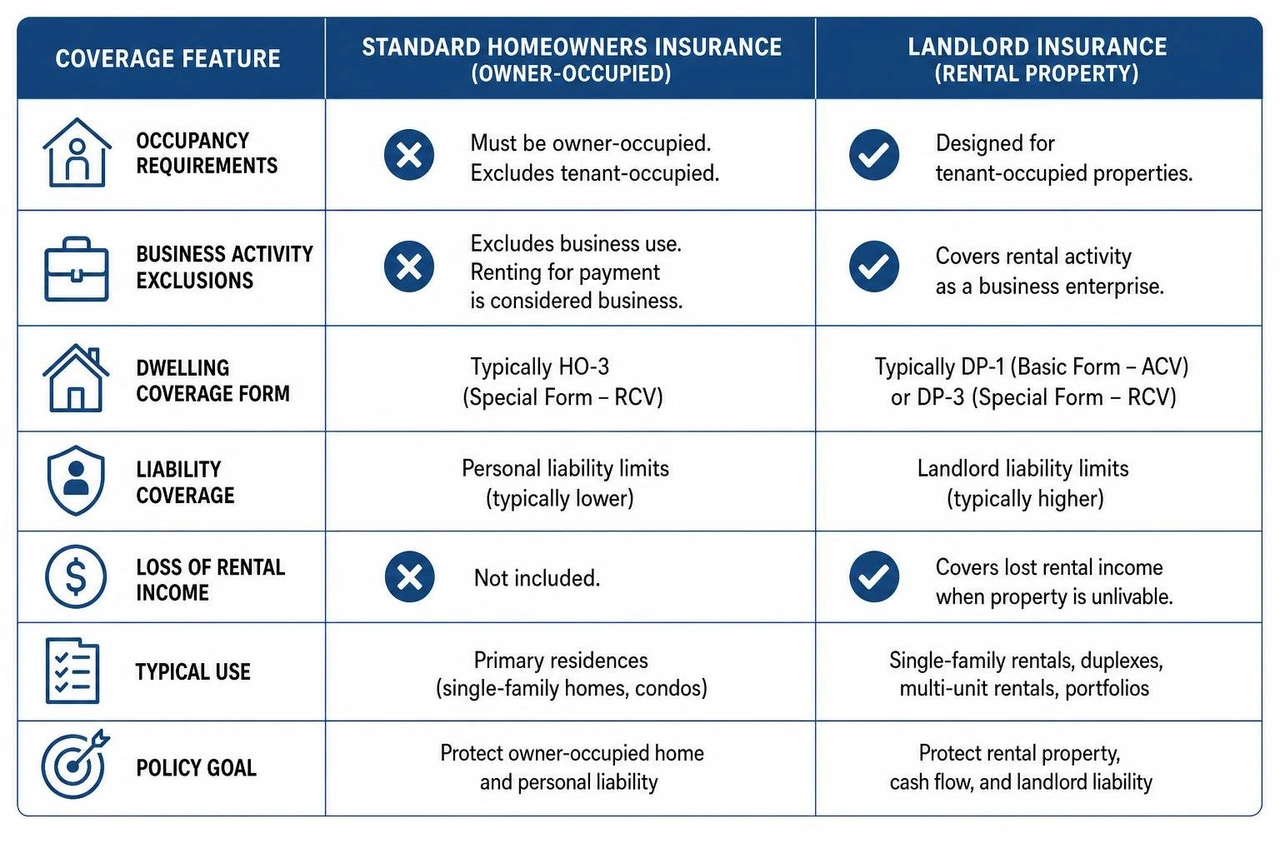
When a home transitions from owner-occupied to a tenant-occupied investment, the risk profile shifts completely. Standard homeowner policies exclude commercial business activities and tenant-related liabilities. If a fire occurs and the carrier discovers the property is occupied by paying tenants without a landlord endorsement, claims can be denied, or the policy may be voided entirely.
Key differences include:
- Occupancy Requirements: Homeowner policies require the owner to live on site; landlord policies are tailored for non-owner occupied properties.
- Business Activity Exclusions: Renting property in exchange for payment is considered a business enterprise, which standard homeowners policies exclude.
- Liability Coverage: Landlord coverage protects against tenant-related premises claims, whereas homeowner liability is built around personal acts of family members living in the home.
For an in-depth breakdown of managing multiple residential dwellings, review our Homeowners Insurance Multiple Properties Guide.
Policy Types for Investment Property Insurance Ohio Properties
Real estate investors use diverse acquisition methods and business models. Fortunately, Ohio landlords have access to tailored policy structures designed for specific investment styles.
One popular option is a standalone dwelling policy. Companies like 1859 Mutual offer standalone landlord and dwelling coverage that eliminates the requirement to purchase personal property coverage. Since tenants bring their own furniture and personal belongings, landlords rarely need extensive personal property limits—saving unnecessary premium expense.
Furthermore, dynamic real estate markets demand flexibility. For investors involved in creative strategies like Subject-To deals, Land Contracts, or short-term hold periods, annual locked-in insurance policies can be restrictive. Flexible, month-to-month property insurance programs allow investors to scale coverage up or down as properties are acquired, renovated, rented, or sold without early cancellation fees.
For more details on adapting policy terms to your portfolio strategy, visit our dedicated page on Landlord Insurance Ohio and read additional perspectives on flexible protections at Rental Property Insurance .
Navigating Ohio Weather Hazards and Endorsements
Operating rental properties in Central Ohio means preparing for severe, changing weather conditions across every season. From cold, freezing winters in Columbus to summer severe thunderstorms in Arlington, weather risks represent a significant portion of property claims.
Winter hazards pose immediate risks to residential structures. Sub-zero temperatures can freeze interior plumbing, causing burst pipes that flood rental units within hours. Accumulating snow and ice dams on roofs prevent proper drainage, forcing melting water backward beneath shingles and causing interior drywall and ceiling damage.
During warmer months, Central Ohio frequently experiences high-velocity windstorms, severe hail, and intense downpours that test roof integrity, gutter capacity, and drainage systems.
Policy Customization and Add-On Coverage Options
Because standard dwelling policies do not automatically cover every peripheral risk, customizing your investment property insurance Ohio policy with targeted endorsements is a smart way to plug potential coverage gaps.
Essential add-on endorsements for Ohio landlords include:
- Water Backup and Sump Pump Overflow: Standard property policies explicitly exclude water that backs up through sewers, drains, or sump pump failures. Adding this rider protects interior finishes, flooring, and tenant displacement expenses when heavy rains overload local drainage.
- Equipment Breakdown: Protects major mechanical systems—such as central HVAC units, hot water heaters, and electrical panels—against sudden electrical or mechanical failures not caused by wear and tear.
- Service Line Coverage: Covers repair costs for underground utility lines (water, sewer, gas, power) running between the main public utility street connection and the rental home structure. Landlords are legally responsible for these underground pipes, and repairs often require expensive excavation.
- Carbon Monoxide & Environmental Liability: Protects against tenant bodily injury claims resulting from faulty furnace combustion or carbon monoxide leaks.
To evaluate potential liability exposures across your business holdings, review our Landlord Liability Insurance Guide 2026 and execute a comprehensive Business Insurance Risk Assessment.
Strategies for Vacant, Renovated, and Creative Finance Deals
A property's insurance requirements change drastically as its use evolves. Standard landlord policies contain vacancy clauses that automatically suspend key protections—such as vandalism, glass breakage, and water damage—if a building sits unoccupied for more than 30 to 60 consecutive days.
Different strategies require tailored insurance forms:
- Fix-and-Flip & Rehab Projects: During active construction or extensive remodeling, properties need a Builder's Risk or Vacant Renovating policy. This protects building materials on site, structural framing, and liability exposures associated with construction crews and contractor activity.
- Vacant Properties & Land: Holdings undergoing permitting or awaiting tenants require dedicated vacant building or vacant land coverage to avoid coverage gaps during downtime.
- Creative Financing Structures: Real estate strategies such as Subject-To deals, Land Contracts, or Sandwich Leases require insurance policies that explicitly name both the legal owner and contract purchaser as additional insureds or loss payees, protecting all financial interests.
For a comprehensive strategic overview, consult our Investment Property Insurance Complete Guide.
Managing Portfolios with Investment Property Insurance Ohio

As real estate investors scale from a single rental home into multiple units across Dublin, Hilliard, or Columbus, managing individual insurance policies becomes inefficient. Streamlining your investment property insurance Ohio strategy into a structured portfolio program reduces administrative overhead and provides consistent, master-policy protection.
Ohio offers a relatively landlord-friendly legal environment with clear statutory guidelines regarding lease enforcement, eviction procedures, and property maintenance obligations. While this balanced regulatory climate supports property owners, managing portfolio risk still requires disciplined cash flow protection and liability structuring.
To discover master policy strategies for expanding real estate portfolios, check out our Landlord Insurance Multiple Properties Guide and our updated Multi-Property Insurance Guide 2026.
Multifamily Property Insurance and NOI Optimization
For commercial real estate owners and apartment complex operators, property insurance is directly tied to Net Operating Income (NOI) and overall property asset valuation. High insurance premiums reduce monthly cash flow, directly impacting cap rates and asset values upon exit or refinancing.
Key drivers affecting commercial multifamily insurance pricing across Ohio include:
- Construction Age & Type: Older brick or wood-frame structures carry higher property risk factors than newer fire-resistive construction.
- Replacement Cost Accuracy: Conducting routine valuation re-underwriting prevents under-insurance penalties while eliminating unnecessary over-coverage expenses.
- Wind and Hail Deductible Structuring: Instead of flat dollar deductibles, many commercial carriers apply percentage deductibles (e.g., 1%, 2%, or 5%) for wind and hail damage. Structuring these deductibles effectively balances premium costs against out-of-pocket exposure during spring storm seasons.
- Lender Compliance: Ensuring master policies satisfy exact lender insurance requirements—such as Fannie Mae, Freddie Mac, or local commercial banks—prevents costly forced-placed insurance issues during refinancing or acquisition closing.
Learn how to properly insure larger residential assets by visiting our guide on Apartment Building Insurance Coverage and comparing commercial insights at Multifamily Property Insurance in Ohio | Pathfinder Insurance .
Umbrella Coverage and Deductible Structuring
While baseline landlord policies provide underlying liability limits, high-net-worth investors and portfolio managers require an additional layer of protection: a Commercial Umbrella Insurance Policy.
An umbrella policy sits on top of your primary landlord insurance policies, auto policies, and general business liability lines. In the event of a tragic accident on your property resulting in major legal judgments exceeding your $1,000,000 primary liability limit, the umbrella policy activates to pay the excess claim up to $2,000,000, $5,000,000, or more.
Additionally, smart deductible management optimizes premium outlays. Choosing higher property deductibles on multi-unit portfolios significantly lowers annual premium expenses. Those savings can then be directed into emergency cash reserves, allowing investors to self-insure small minor claims while keeping commercial policy loss histories clean.
Explore excess liability strategies in our guide on an Umbrella Policy for Investors and analyze broad pricing factors at Property Insurance Cost.
Frequently Asked Questions About Ohio Landlord Insurance
How much landlord insurance do I need in Ohio?
The required amount of landlord insurance in Ohio depends on your property's structural replacement cost and your liability exposure. As a general benchmark, your dwelling coverage limit should be calculated using standard replacement cost estimates, maintaining a minimum value of at least $75 per square foot to avoid coinsurance penalties. For liability protection, standard industry recommendations start at $1,000,000 per occurrence and $2,000,000 aggregate, alongside a dedicated loss of rental income limit equal to 12 months of gross rental earnings to survive severe seasonal weather disruptions.
Why is standard homeowners insurance insufficient for investment properties?
Standard homeowners policies are built exclusively for owner-occupied primary residences. Once a property is leased to third-party tenants, insurance carriers view it as a commercial income-generating business. Homeowner policies exclude business activities, tenant bodily injury claims, and rental loss coverage. Operating a rental under a standard homeowner policy creates major coverage gaps and risks total claim denial following a loss.
How does Ohio's landlord-friendly legal environment impact policy needs?
Ohio maintains balanced property laws that offer real estate investors efficient processes for lease enforcement and property recovery. However, statutory regulations do not shield landlords from civil liability claims involving tenant injuries, carbon monoxide exposure, slip-and-fall hazards, or structural maintenance disputes. Adequate landlord insurance guarantees legal defense support and financial safety regardless of local court conditions.
Partnering with an Independent Agency for Ohio Investment Properties
Securing the right investment property insurance Ohio coverage requires more than choosing a cookie-cutter policy online. It demands a local partner who understands Central Ohio real estate submarkets—from Hilliard and Dublin to Columbus and Arlington—and can structure coverage that matches your specific asset types and investment strategies.
At Stanley Insurance Group, we have been serving Central Ohio families and business owners since 1984. As an independent agency with over 40 years of community tenure, our strength lies in our flexibility. We are not tied to a single carrier’s products. Instead, we have the freedom to shop 20+ top-rated carriers on your behalf, comparing coverage options and pricing to deliver a custom strategy tailored to your portfolio. Furthermore, we are proud to be among only 100 independent agents in the country with a direct partnership with Geico.
Our dedicated team delivers a personal, concierge touch designed to build long-term relationships:
- Amy, Commercial Lines Specialist, helps structure complex portfolio coverages, commercial apartment policies, and landlord risk programs.
- Ana and Sandra, Spanish-speaking Account Specialists, provide complete, fluent assistance to ensure non-English and bilingual property owners receive clear guidance (Spanish-speaking help and agents are fully available across all policy lines).
- Kaisen, Ethan, and Chase, Associate Agents, provide prompt, reliable assistance for adding properties, adjusting limits, and securing quotes fast.
Whether you need comprehensive Home & Property Insurance, Auto & Vehicle Insurance, Life Insurance, or Business Insurance, our local team works directly for you—not the insurance carrier.
Protect your real estate investments, secure your cash flow, and simplify your insurance strategy today. Get a Custom Landlord Insurance Quote with Stanley Insurance Group or call our local Hilliard office to speak directly with an expert advisor!
Similar posts


