Apartment Building Insurance Coverage: Because 'Oops' Doesn't Pay the Repairs
Protect your multifamily assets with apartment building insurance coverage that shields property, liability, and income from unexpected risks.
Why Apartment Building Insurance Coverage Is One of the Most Important Decisions You'll Make as a Property Owner
Apartment building insurance coverage protects one of your largest financial assets — and getting it wrong can be devastating.
Here's a quick look at what it covers and why it matters:
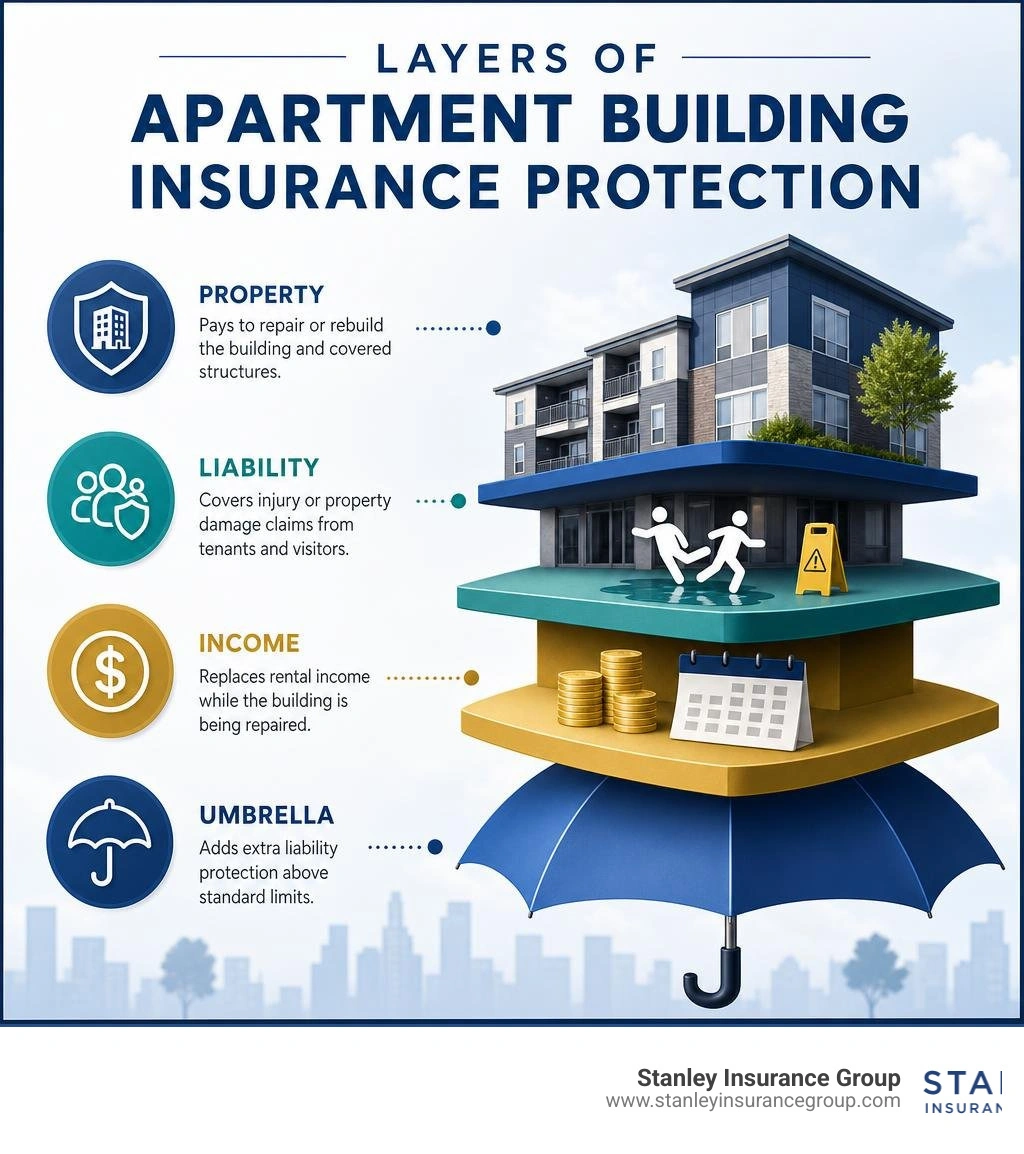
A standard apartment building policy usually combines several layers of protection:
- Property: Helps repair or rebuild the structure after covered damage, like fire, storm, or vandalism.
- General liability: Covers injury or property damage claims from tenants, guests, vendors, or visitors.
- Business income / lost rents: Replaces rental income while covered repairs make units unlivable.
- Ordinance or law: Helps pay for code-required upgrades after a covered partial loss.
- Equipment breakdown: Covers key systems like boilers, elevators, and HVAC equipment.
- Commercial umbrella: Adds extra liability protection above your standard policy limits.
Unlike renters insurance (which covers a tenant's belongings) or a basic landlord dwelling policy, apartment building insurance is a commercial program built for the full scope of risks that come with owning a multifamily property.
Those risks are real. A Seattle property owner faced a $13 million judgment from a single slip-and-fall accident. Water damage from one burst pipe can flood four to ten units at once. And in 2024, a major national insurer non-renewed roughly 42,000 commercial apartment policies in California alone — a sign of just how hard this market has become.
The good news? The right policy, structured correctly, covers all of it.
I'm Brandon Stanley, President of Stanley Insurance Group, and since 1984 our team has helped property owners across Ohio and beyond find the right apartment building insurance coverage for their investments. I'll walk you through everything you need to know to make a confident decision.
What is Apartment Building Insurance Coverage?
At its core, apartment building insurance coverage is a specialized commercial insurance program designed to safeguard your physical real estate, protect your business from liability claims, and shield your rental income from sudden disruptions.
When you own a multifamily property, you are not just maintaining a roof over people's heads—you are operating a complex commercial enterprise. A single incident, such as a localized kitchen fire or a major windstorm in Central Ohio, can instantly threaten your cash flow and your personal assets. By combining commercial property coverage with robust liability protection, this specialized insurance acts as an essential financial safety net.
To learn more about how commercial real estate protection works on a broader scale, you can explore our Investment Property Insurance Complete Guide.
Who Needs Apartment Building Insurance Coverage?
If you own or manage a residential property with five or more units, you need commercial apartment building insurance. This coverage is essential for:
- Multifamily Real Estate Investors: Whether you own a single five-unit building in Hilliard or a sprawling portfolio across Columbus and Dublin, your investment needs comprehensive asset safeguarding.
- Property Management Companies: Managers who oversee day-to-day operations need to ensure the properties they manage are fully protected to satisfy both owners and lenders.
- Single-Purpose LLCs: It is highly recommended—and often required by commercial lenders—that your apartment building be owned by a single-purpose LLC. While this structure provides legal separation to protect your personal assets, it does not replace the need for a dedicated commercial policy. The LLC itself must be the primary named insured on the policy, as detailed in this helpful Apartment Building Insurance | Zensurance resource.
Apartment vs. Renters vs. Landlord Dwelling Policies
One of the most common points of confusion for new real estate investors is the difference between personal landlord policies and commercial apartment insurance.
If your residential property has four units or fewer, you can typically purchase a personal lines landlord policy (often called a Dwelling Fire or DP-3 policy). These are simpler, more affordable policies designed for smaller properties. However, once a building reaches five units or more, standard insurance carriers classify it as a commercial habitational risk.
Furthermore, it is vital to understand that your commercial building policy does not cover your tenants’ personal belongings. If a fire damages a tenant's apartment, your policy will pay to rebuild the walls, floors, and fixtures, but the tenant's furniture, clothes, and electronics are their own responsibility. This is why smart property owners require all residents to maintain active renters insurance.
Here is a quick breakdown of how these policies compare:
Landlord Dwelling (DP-3) is usually for 1 to 4 rental units. It can help protect the building structure, the landlord's liability, and limited rental income. Think single-family rentals, duplexes, and triplexes.
Renters Insurance (HO-4) is for the tenant, not the building owner. It typically covers the renter's personal belongings and personal liability inside the rented unit.
Commercial Apartment Insurance is typically used for 5 or more units. It can cover the building, common areas, commercial general liability, lost rental income, and equipment or system breakdowns. This is the lane for garden apartments, mid-rise buildings, and mixed-use apartment properties.
Core Coverages in a Standard Policy
When structuring your commercial policy, you should think of it as a custom-built shield. A standard policy is not a single coverage but a package of essential protections tailored to the physical and operational risks of your property. For a deeper dive into commercial building protections, you can read our guide on Commercial Property Insurance.
Property and General Liability Foundations
The foundation of your program rests on two main pillars:
- Commercial Property Insurance: This covers the physical building structure, leasing offices, common areas, fences, and any landlord-owned property on-site (such as lawnmowers, snow blowers, or lobby furniture). It protects against major perils like fire, wind, hail, lightning, explosion, and vandalism.
- Commercial General Liability (CGL): This covers bodily injury or property damage claims brought by third parties. If a visitor trips on a cracked sidewalk in your courtyard or a tenant is injured by a falling light fixture in a common hallway, your CGL policy pays for legal defense fees, court settlements, and medical expenses.
Business Income and Ordinance or Law Coverage
While physical repairs are happening after a disaster, your business still has bills to pay. That is where these two critical coverages come into play:
- Business Income / Loss of Rents: If a fire renders several units uninhabitable, your tenants will stop paying rent. Business income coverage steps in to replace that lost rental revenue for a specified period—typically 12 to 24 months—allowing you to pay your mortgage, property taxes, and payroll while repairs are underway.
- Ordinance or Law Coverage: The median multifamily building age in the United States now exceeds 40 years, according to the US Census American Housing Survey. If your older building in Columbus or Arlington suffers a partial loss, local building codes may require you to upgrade the entire plumbing, electrical, or HVAC system during repairs. Standard property insurance only pays to restore the building to its original pre-loss condition. Ordinance or Law coverage pays for the extra, often staggering costs of upgrading undamaged portions of the building to meet modern codes.
Equipment Breakdown and Umbrella Liability
To ensure there are no gaps in your safety net, your policy should also feature:
- Equipment Breakdown Coverage: Standard property insurance excludes mechanical or electrical failure. If your building's central boiler fails in the middle of a freezing winter, or if an elevator motor burns out, equipment breakdown insurance covers the repair or replacement costs, as well as the lost income resulting from the outage.
- Commercial Umbrella / Excess Liability: In our litigious society, a single severe liability claim can easily exhaust your standard $1 million or $2 million general liability limits. A commercial umbrella policy sits on top of your primary liability coverages, providing an extra layer of protection (often ranging from $5 million to $10 million or more) to safeguard your entire real estate portfolio.
Common Claims and Risk Mitigation
Understanding the most common claims in the multifamily industry allows you to take proactive steps to protect your property and keep your insurance premiums manageable. As detailed in the Apartment Building Insurance: 2026 Owner & Investor Guide | Latent Insurance study, risk mitigation is the most effective tool a property owner has to maintain favorable coverage terms.
Water Damage: The Single Biggest Claim Driver
While dramatic fires make the news, sudden and accidental water damage is the most frequent and costly claim driver in multifamily housing. Because apartments feature stacked units with shared plumbing lines, a single failure on an upper floor can quickly ruin multiple units below.
- The Risk: Burst copper pipes, failed water heaters, frozen lines during Ohio winters, and tenant-caused overflows (like clogged toilets or bathtubs) can cause tens of thousands of dollars in drywall, flooring, and structural damage in a matter of minutes.
- Mitigation: Install automatic water shut-off valves and leak-detection sensors in high-risk areas like utility closets and laundry rooms. Require your maintenance team to inspect water heaters and under-sink plumbing annually.
Slip-and-Falls and Severe Weather Events
The exterior of your property presents its own set of challenges, particularly when seasonal weather strikes Central Ohio.
- The Risk: Slips, trips, and falls on icy sidewalks, wet lobby floors, or uneven stairs are the leading cause of premises liability lawsuits. Additionally, severe weather events—such as summer windstorms, heavy hail, and winter snow loads—can cause extensive roof and structural damage.
- Mitigation: Maintain a strict written log of all snow and ice removal activities during winter storms. Ensure all outdoor common areas, walkways, and stairwells are brightly lit and equipped with sturdy handrails. Regularly inspect your roofs for loose shingles and clean your gutters to prevent ice dams.
Cost Factors and the 2026 Market Landscape
The insurance market for multifamily properties in 2026 is highly sophisticated. Insurance carriers do not use a one-size-fits-all pricing model; instead, they analyze a wide range of property-specific risk factors to determine your premium. To learn more about managing these expenses, check out our practical guide on Ways to Save on Insurance.
How Building Age and Construction Class Influence Premiums
The physical characteristics of your building play a massive role in underwriting decisions:
- Construction Type: Buildings constructed of wood frame are highly combustible and carry higher premiums. Conversely, properties built with non-combustible materials, such as joisted masonry or concrete block, are much more resilient to fire and are priced accordingly.
- Building Age and Utility Updates: Older buildings present higher risks for electrical fires and plumbing failures. If your building is over 25 or 30 years old, carriers will want to see documented proof of recent updates to the roof, HVAC, plumbing, and electrical systems.
- Electrical Panels: Many carriers will outright decline to write coverage for buildings equipped with obsolete and hazardous electrical panels, such as those manufactured by Zinsco, Federal Pacific (FPE), or Stab-Lok. Replacing these outdated panels is often a mandatory requirement to secure coverage.
Geographic Location and Catastrophe Risk in 2026
Where your property sits geographically dictates its exposure to natural disasters. While coastal properties face hurricane risks and West Coast buildings face wildfire and earthquake exposures, properties in Central Ohio are primarily evaluated for severe convective storms, hail, wind, and freezing winter temperatures. Because Ohio is considered a non-catastrophe state compared to Florida or California, local property owners generally enjoy more stable capacity from admitted carriers, though global reinsurance tightening still influences local premium inflation.
Navigating the Surplus Lines (E&S) Market and Lender Requirements
As the commercial insurance market has hardened over the last several years, understanding where and how your policy is placed has become increasingly important. For more context on navigating these placements, you can review the Insurance for Apartment Building Owners (2026): Coverage & Cost | Latent Insurance framework.
Why Apartments End Up in the Surplus Lines (E&S) Market
When a property does not fit the strict underwriting guidelines of standard "admitted" insurance companies, it must be placed in the Excess & Surplus (E&S) lines market.
- Admitted vs. Non-Admitted: Admitted carriers are licensed and regulated directly by the state of Ohio, offering standardized policy forms and protection under the state's guaranty fund. Non-admitted (surplus lines) carriers are specialized insurers that write coverage for higher-risk, unique, or older properties.
- Why Properties Shift: If your apartment building has an older roof, a history of multiple water damage claims, or has not had its major utility systems updated, traditional carriers may issue a non-renewal notice. Placing your policy in the E&S market allows you to secure the necessary coverage, though it often involves specialized deductibles, customized coverage exclusions, and additional surplus lines taxes and stamping fees.
How Lender Requirements Shape Your Policy
If you have a mortgage on your apartment building, your lender will dictate a significant portion of your insurance program. Institutional lenders and government-sponsored enterprises like Fannie Mae and Freddie Mac have strict compliance guidelines to protect their financial interests, which you can read about in detail in the Multifamily Selling and guide.
Typical lender mandates include:
- Replacement Cost Valuation: Your building must be insured for 100% of its full replacement cost (the cost to rebuild it from scratch with modern materials), rather than its market value.
- Carrier Ratings: The insurance company writing your policy must maintain a strong financial rating, typically an A- or better from A.M. Best.
- Deductible Caps: Lenders often place strict limits on how high your property and wind/hail deductibles can be (for example, capping deductibles at a percentage of the building's value or a set dollar amount) to ensure you can afford to pay your portion of a claim.
Recommended Optional Coverages and Gaps to Watch
A basic commercial package policy is a great start, but it often leaves several critical exposures unaddressed. To prevent unexpected out-of-pocket losses, you should consider adding targeted endorsements to your program.
Cyber Liability and Employment Practices Liability (EPLI)
Modern property management relies heavily on digital systems, which introduces new liabilities:
- Cyber Liability: As a property owner or manager, you collect and store sensitive tenant data, including social security numbers, credit histories, bank account numbers, and payment details. If your system suffers a data breach, Cyber Liability insurance covers the costs of forensic investigations, legal compliance, credit monitoring services for affected tenants, and public relations management.
- Employment Practices Liability Insurance (EPLI): If you employ on-site leasing agents, maintenance staff, or property managers, you face potential employment-related lawsuits. EPLI protects your business against claims of wrongful termination, sexual harassment, or discrimination. Furthermore, many EPLI policies can be endorsed with third-party coverage, protecting you if a tenant or prospective applicant sues your business for housing discrimination under the Fair Housing Act or ADA Title III.
Critical Coverage Gaps and Exclusions to Watch
Standard property policies contain several built-in exclusions that property owners must watch out for:
- Water Backup of Sewers and Drains: Standard property insurance does not cover damage caused by water backing up through sewers, drains, or sump pumps. Because this is a highly common issue in basement units and garden-style apartments, adding a specific sewer backup endorsement is highly recommended.
- Flood and Earthquake: Rising surface water (overland flooding) and earth movement are universally excluded from standard commercial property policies. If your property is near a local waterway or sits in a low-lying area, you will need to secure a separate flood policy.
- Mold Sub-limits: Most policies place a strict, low limit on the amount they will pay to clean up or remediate mold growth following a covered water leak. Understanding these sub-limits is crucial for proper risk planning.
Frequently Asked Questions About Apartment Building Insurance Coverage
Is water damage covered on an apartment building policy?
Yes, but with important caveats. Sudden and accidental water damage—such as a pipe bursting inside a wall or a water heater failing—is generally covered, though it may be subject to a separate, higher water-damage deductible. However, gradual damage (like a slow leak that has been occurring behind a shower wall for months) and wear-and-tear are excluded. Damage from sewer backups and overland flooding are also excluded unless you purchase specific optional endorsements.
Do I need a separate flood policy on an apartment building?
Yes. Standard commercial property policies exclude damage caused by rising surface water, overland flooding, or mudslides. If your lender determines that your property sits within a FEMA-designated Special Flood Hazard Area (SFHA), they will mandate that you carry flood insurance. Even if your property is in a low-to-moderate risk zone, a separate policy is worth considering, as nearly 20% of all National Flood Insurance Program (NFIP) claims occur in low or moderate flood risk areas.
How much umbrella insurance should an apartment building owner carry?
While there is no single correct answer, a common industry rule of thumb is to carry at least $1 million of commercial umbrella coverage per $5 million of total asset value, or per 50 units, whichever is higher. If you have a commercial mortgage, your lender will likely dictate your minimum required umbrella limits, with agency loans typically requiring at least $5 million in excess liability, and larger institutional deals requiring $10 million or more.
Conclusion
How to Compare and Select Your Apartment Building Insurance Coverage
Choosing the right apartment building insurance coverage is not just about finding the lowest premium; it is about building a comprehensive risk management program that protects your hard-earned real estate assets for the long haul.
At Stanley Insurance Group, we have been serving Central Ohio families and businesses since '84. As a family-owned, independent agency with over 40 years of deep roots in the Hilliard, Columbus, Dublin, and Arlington communities, we pride ourselves on delivering a true concierge touch. We don't believe in automated, one-size-fits-all algorithms. Instead, we focus on genuine relationship building, taking the time to understand your unique property portfolio and investment goals.
Because we are an independent agency, we are not beholden to any single insurance company. Our team works directly for you, shopping your coverage across 20+ of the nation's top insurance carriers to find the absolute best fit for your budget and risk profile. Plus, we are proud to be part of an elite group—one of only 100 independent agencies in the entire country with a direct partnership with Geico, giving our clients access to exclusive program options.
Whether you need to review an existing policy, update your coverage limits for a new acquisition, or explore your options in a hardening market, our dedicated team is here to help:
- Amy, our Commercial Lines Specialist, can help you structure a comprehensive property and liability package.
- Ana and Sandra, our bilingual Account Specialists, are available to provide professional, Spanish-speaking assistance.
- Kaisen, Ethan, and Chase, our Associate Agents, are ready to assist with policy updates, certificates of insurance, and prompt customer service.
Ready to secure your investment with a customized commercial insurance program? Contact our local Hilliard office today to Get a Quote and experience the difference that 40 years of local expertise can make.
Similar posts