
Understanding Your Life Insurance Options: Term, Whole, and Universal
Explore Life Insurance Options to protect your family with the right coverage, features, and benefits for lasting financial security.
What Are Your Life Insurance Options? A Clear Starting Point
Understanding your life insurance options is one of the most important steps you can take to protect the people who depend on you. Whether you're a young parent in Hilliard covering a new mortgage, a professional managing multiple assets, or a retiree on a fixed income looking for stability — the right policy can make an enormous difference for your family's financial future.
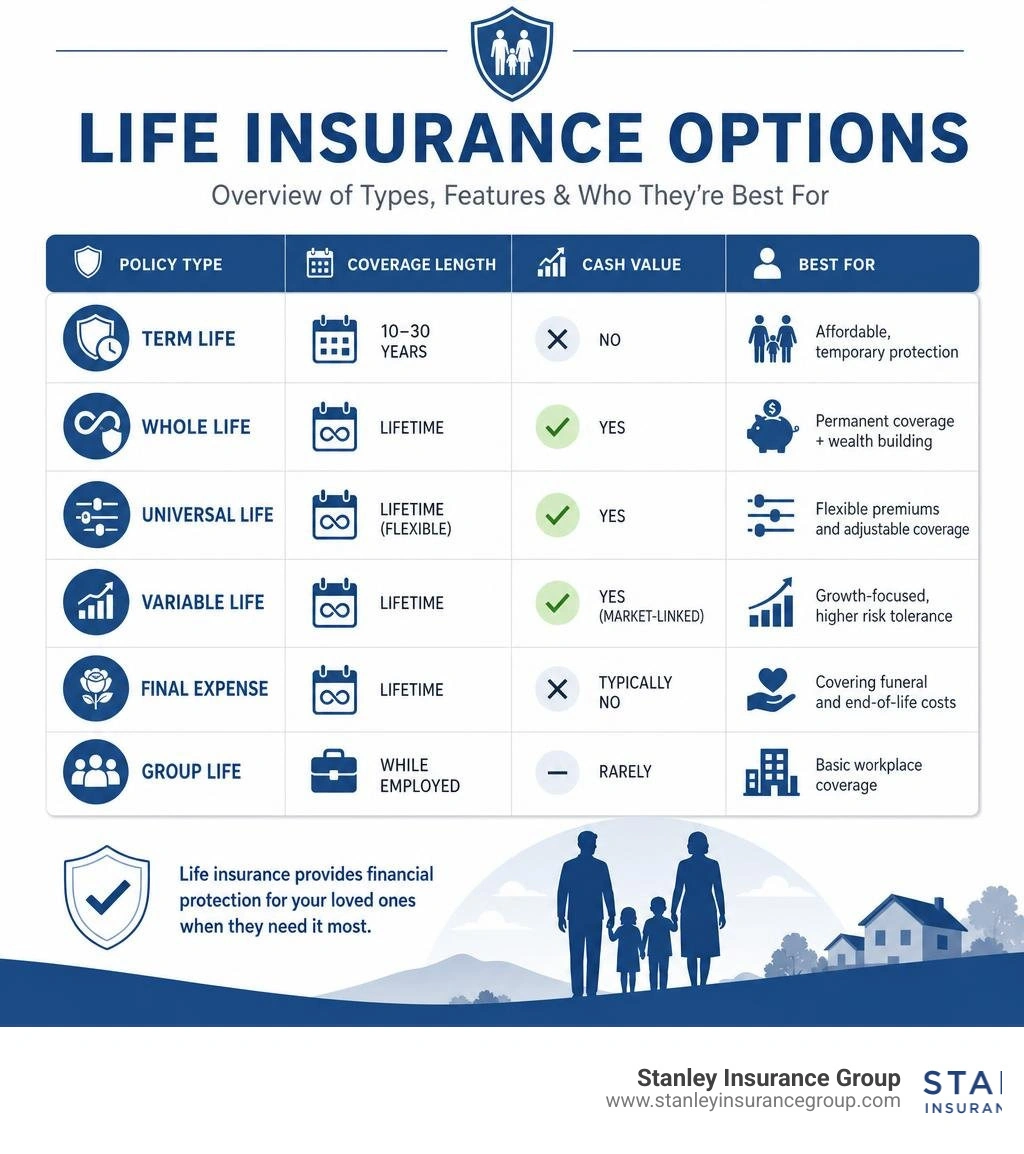
Here is a quick overview of the main life insurance options available:
- Term life insurance provides coverage for a set period, usually 10 to 30 years. It does not build cash value, which helps keep it affordable for temporary protection needs like income replacement, mortgage protection, or coverage while children are still at home.
- Whole life insurance offers lifetime coverage and includes cash value. It is often used by people who want permanent protection along with a predictable wealth-building component.
- Universal life insurance also provides lifetime coverage, but with more flexibility. Premiums and coverage amounts may be adjustable, and the policy can build cash value over time.
- Variable life insurance is a permanent policy with market-linked cash value. It may appeal to people who want growth potential and are comfortable with higher investment risk.
- Final expense insurance is typically a smaller lifetime policy designed to help cover funeral costs, medical bills, and other end-of-life expenses. It usually has little or no cash value focus.
- Group life insurance is coverage offered through an employer. It is usually basic, rarely builds cash value, and often lasts only while you remain employed with that company.
Every policy type works on the same basic idea: you pay regular premiums, and if you pass away while the policy is active, your beneficiaries receive a tax-free death benefit. The differences come down to how long coverage lasts, how much it costs, and whether the policy builds value while you're still alive.
Shopping for life insurance doesn't have to be overwhelming. I'm Brandon Stanley, President of Stanley Insurance Group — a family-owned independent agency serving Central Ohio since 1984, and I've spent decades helping families, professionals, and retirees navigate their life insurance options to find coverage that truly fits their lives. In this guide, I'll walk you through everything you need to make a confident, informed decision.
How Life Insurance Works: Key Features and Policy Basics
At its heart, life insurance is a contract between you (the policyholder) and an insurance company. In exchange for regular payments, known as premiums, the insurer promises to pay a lump sum of money to your chosen loved ones (your beneficiaries) if you pass away.
This financial safety net is designed to replace your income, clear family debts, or fund future goals like college tuition. To get a complete understanding of how these elements work together, you can read our Life Insurance Complete Guide, which breaks down the foundational structure of personal policies.
When you purchase a policy, you aren't just buying peace of mind; you are establishing a legally binding contract with specific terms. According to Life Insurance Solutions | MetLife, these contracts are highly customizable, allowing you to tailor the payout structure and premium schedule to match your household's financial rhythm.
The Core Components of a Life Insurance Policy
Every life insurance policy is built upon a few essential pillars:
- The Policyholder: The person who owns and pays for the policy.
- The Insured: The person whose life is covered by the policy (usually, but not always, the policyholder).
- The Beneficiary: The person, people, or entity (like a trust) designated to receive the death benefit.
- The Face Value: The total amount of the death benefit that the policy promises to pay out.
- The Policy Term: The duration of the coverage. For temporary policies, this is a set number of years; for permanent policies, it lasts your entire lifetime.
- Underwriting: The process the insurance company uses to assess your health, lifestyle, and risk profile to determine your eligibility and premium rates.
Choosing how these components fit your personal balance sheet is a critical step. For a deeper look at designing a policy from scratch, check out our Ultimate Life Insurance Buying Guide.
The Application and Underwriting Process
Getting a policy in place involves an application process where the insurer evaluates your risk level. Historically, this meant filling out long forms and undergoing a physical medical exam, where a technician records your height, weight, blood pressure, and takes blood samples.
However, modern life insurance options have evolved significantly. Today, many carriers offer simplified issue or guaranteed issue policies. Simplified issue policies bypass the physical exam entirely, relying instead on a detailed medical questionnaire and digital database checks to approve coverage in a fraction of the time. Guaranteed issue policies require no medical questions or exams at all, making them an excellent choice for older adults or individuals with serious health conditions who might otherwise be declined.
To explore how quick and straightforward finding coverage can be, you can look into how to Life Insurance: Find Affordable Coverage Fast | Progressive.
Evaluating Your Life Insurance Options: Term vs. Permanent
The most fundamental decision you will make when shopping for coverage is choosing between term life insurance and permanent life insurance.
To explore our primary coverage options directly, visit our dedicated page on Life Insurance. For a comprehensive breakdown of how these two structural categories operate over a lifetime, you can also review Life Insurance | Types of Life Insurance Policies | New York Life.
Understanding Term Life Insurance Options
Often referred to as "pure protection," term life insurance is designed with simplicity in mind. It provides coverage for a specific period—typically 10, 15, 20, or 30 years. If you pass away during this term, your beneficiaries receive the death benefit. If you outlive the term, the policy simply expires.
One interesting industry statistic to keep in mind is that over 97% of term life policies do not pay out a death benefit because the policyholder outlives the term. While that might sound like a downside, it is actually the reason term insurance is so highly cost-effective; it allows you to secure substantial coverage during your most financially vulnerable years (such as when you are raising children or paying off a mortgage) for a highly manageable cost.
Many high-quality term policies also include conversion features, which allow you to transition your temporary coverage into a permanent policy without undergoing a new medical exam. This is an incredibly valuable benefit if your health changes during the term. To see how these flexible policies are structured, check out Life Insurance – Get an Affordable Quote - Nationwide.
Exploring Permanent Life Insurance Options
If you want coverage that is guaranteed to last your entire life—no matter how long you live—permanent life insurance is the answer. In addition to a lifetime death benefit, permanent policies feature a cash value component that grows over time on a tax-deferred basis.
There are three primary styles of permanent insurance:
- Whole Life: The most straightforward permanent option. It features fixed premiums that never increase, a guaranteed minimum cash value growth rate, and a guaranteed death benefit. If you purchase whole life from a mutual insurance company, you may also receive annual dividends. You can learn more about these wealth-building features by reading about Whole Life Insurance | Custom Cash Value Whole Life | New York Life.
- Universal Life: This option introduces flexibility. It allows you to adjust your premium payments and even alter your death benefit amount as your financial needs change over time.
- Variable Life: Designed for those with a higher risk tolerance, variable policies allow you to invest your cash value directly into market-linked sub-accounts (similar to mutual funds), offering higher growth potential alongside market risk.
Specialized Policies: Final Expense and Group Coverage
Beyond standard term and permanent policies, there are specialized life insurance options designed for specific life stages and situations:
- Final Expense Insurance: Often called burial insurance, this is a small whole life policy (typically ranging from $2,500 to $40,000 in coverage) designed specifically to cover end-of-life costs, funeral expenses, and outstanding medical bills. It is highly popular among seniors because it requires no medical exam and has a rapid payout timeline.
- Group Life Insurance: This is coverage offered through your employer, often at little to no cost to you. While it is an excellent workplace benefit, group coverage is usually tied to your employment (meaning you lose it if you change jobs) and typically caps coverage at a basic level, such as one times your annual salary.
To help determine which of these specialized paths is right for your household, you can read the helpful guide on What Type of Life Insurance Should I Get? | Boston Mutual Life Insurance Company.
Calculating Your Coverage Needs and Policy Costs
One of the most common questions we hear at Stanley Insurance Group is: "How do I know if I have enough coverage?" The goal is to find a balance where your family is fully protected, but you aren't paying for more insurance than you actually need.
To begin mapping out your personal safety net, read our guide on How Much Life Insurance Is Enough.
Determining Your Ideal Coverage Amount
A highly effective way to calculate your coverage needs is the DIME Method, which breaks your financial obligations down into four clear areas:
- D - Debt: Calculate all outstanding personal debts, such as credit cards, car loans, and student loans.
- I - Income Replacement: Multiply your current annual salary by the number of years your family would need to rely on your income (typically 7 to 10 years).
- M - Mortgage: Add the remaining balance on your home mortgage so your family can stay in their home rent- and mortgage-free.
- E - Education: Estimate the future cost of college tuition and living expenses for your children.
By adding these four numbers together, you get a highly accurate lump-sum target for your death benefit. For a step-by-step walkthrough of this calculation, consult our Ultimate Life Insurance Buying Guide.
Key Factors That Influence Premium Rates
When insurance underwriters calculate your premium rates, they look at several risk factors:
- Age and Health: This is the single biggest factor. The younger and healthier you are when you buy a policy, the lower your rates will be.
- Lifestyle Choices: Tobacco use, high-risk hobbies (like skydiving), or a history of reckless driving will increase your premiums.
- Gender: Statistically, women have longer life expectancies than men, which generally results in lower life insurance rates.
- Face Amount Bands: Insurance companies often discount the "per thousand" cost of coverage at specific thresholds (such as $250,000, $500,000, or $1,000,000), meaning buying a slightly larger policy can sometimes yield a better overall rate.
To give you an idea of how premium structures differ across various policy types, here is a general comparison of relative costs and features:
- Term life insurance is typically the lowest-cost option and is very budget-friendly for temporary coverage needs. Premiums are usually fixed during the policy term, there is no cash value growth, and underwriting may involve a medical exam or digital health check.
- Whole life insurance generally has much higher premiums, often costing significantly more than comparable term coverage. In exchange, premiums are fixed, the policy can build guaranteed minimum cash value, and underwriting may be traditional or simplified depending on the carrier and policy.
- Universal life insurance usually falls in the moderate-to-high premium range. It offers more premium flexibility than term or whole life, may build cash value through fixed interest or market-linked crediting methods, and can use traditional or simplified underwriting.
Maximizing Your Policy: Riders, Cash Value, and Tax Benefits
Life insurance is more than just a payout for the future; it is a dynamic financial planning tool that offers unique tax advantages and "living benefits" you can use while you are still alive.
As we age, our financial priorities shift from pure income replacement to wealth preservation and retirement security. You can read about how to adapt your coverage in our article on the Benefits of Life Insurance as You Get Older.
Accessing Cash Value While You Are Alive
The cash value inside a permanent life insurance policy grows tax-deferred, meaning you don't pay taxes on the growth as long as it remains within the policy. There are several ways to access this money:
- Policy Loans: You can borrow against your policy's cash value at highly competitive interest rates. There is no credit check, and you aren't legally required to pay the loan back (though any outstanding loan balance will be deducted from the final death benefit paid to your beneficiaries).
- Withdrawals: You can withdraw cash directly from your policy up to your "cost basis" (the total amount of premiums you have paid into the policy) entirely tax-free.
- Surrender Value: If you no longer need the coverage, you can cancel (surrender) the policy and walk away with the accumulated cash value, minus any surrender fees.
Essential Riders and Additional Features to Consider
Riders are optional add-ons that allow you to customize your policy to cover specific risks. Some of the most valuable riders include:
- Disability Waiver of Premium: If you become seriously disabled and cannot work, this rider waives your premium payments entirely, keeping your policy active without cost to you. This is highly valuable considering a 20-year-old has a 1 in 4 chance of becoming disabled during their working years.
- Long-Term Care (LTC) Rider: Over 66% of 65-year-olds will need long-term care during their lifetime. An LTC rider allows you to tap into your policy's death benefit while you are still alive to pay for home health aides, assisted living, or nursing home care.
- Accelerated Death Benefits: If you are diagnosed with a terminal illness, this rider allows you to access a portion of your death benefit early to cover medical costs or comfort care.
Frequently Asked Questions About Life Insurance
What happens if I outlive my term life insurance policy?
When your term policy expires, the coverage simply ends. However, you aren't left without options. You can choose to convert the policy to a permanent plan if it has a conversion rider, renew the policy on an annual basis (though rates will increase), or shop for a new term policy that fits your current needs. To learn more about managing an expiring policy, visit our Life Insurance resource center.
Can I access the cash value of my permanent policy tax-free?
Yes, policy loans are generally tax-free, and cash withdrawals are tax-free up to the amount you have paid in premiums (your cost basis). However, if you surrender the policy entirely, any cash value that exceeds your cost basis will be taxed as ordinary income.
Is group life insurance from my employer sufficient?
For most people, employer-provided group life insurance is a fantastic starting point, but it is rarely enough on its own. Because these policies are tied to your employment, you will lose your coverage if you change jobs or retire. Additionally, a basic policy equal to one year's salary is usually far below the 7 to 10 years of income replacement recommended for growing families. Having an individual policy ensures your coverage is portable and personalized.
Conclusion
Navigating your life insurance options is a deeply personal journey, but you don't have to walk it alone. Since 1984, our team at Stanley Insurance Group has been providing Central Ohio families and businesses with the warm, concierge-style service they deserve. As a family-owned independent agency based right here in Hilliard, we don't believe in one-size-fits-all solutions. We build lasting relationships.
Because we are independent, we aren't tied to a single insurance carrier. Instead, we shop over 20 of the nation's top-rated carriers—including Progressive, Nationwide, Travelers, Grange, Safeco, and Liberty Mutual—to find the perfect blend of coverage and value for your unique life. In fact, we are one of only 100 independent agencies in the entire country to hold a direct partnership with Geico, giving our clients access to unmatched coverage combinations.
Whether you need help in English or Spanish (our incredible Account Specialists, Ana and Sandra, are here to assist our Spanish-speaking community), we are ready to guide you. From commercial lines managed by Amy to personal protection designed by our dedicated associate agents Kaisen, Ethan, and Chase, we are here to protect what matters most.
Ready to explore your options with a team that has been serving Hilliard, Columbus, Dublin, and Arlington for over 40 years? Get a Quote today, or visit our Life Insurance page to learn more about how we can help you secure your family's future.
Similar posts