
Secure Your Future: Tips for Buying Life Insurance
Discover expert tips for buying life insurance, compare policies, save money, and protect your loved ones with this practical guide.
Why Smart Tips for Buying Life Insurance Matter More Than Ever
Tips for buying life insurance can save you thousands of dollars and ensure your family gets the protection they actually need. With 44% of American families facing financial hardship within six months of losing a wage earner, getting this decision right isn't just smart—it's essential.
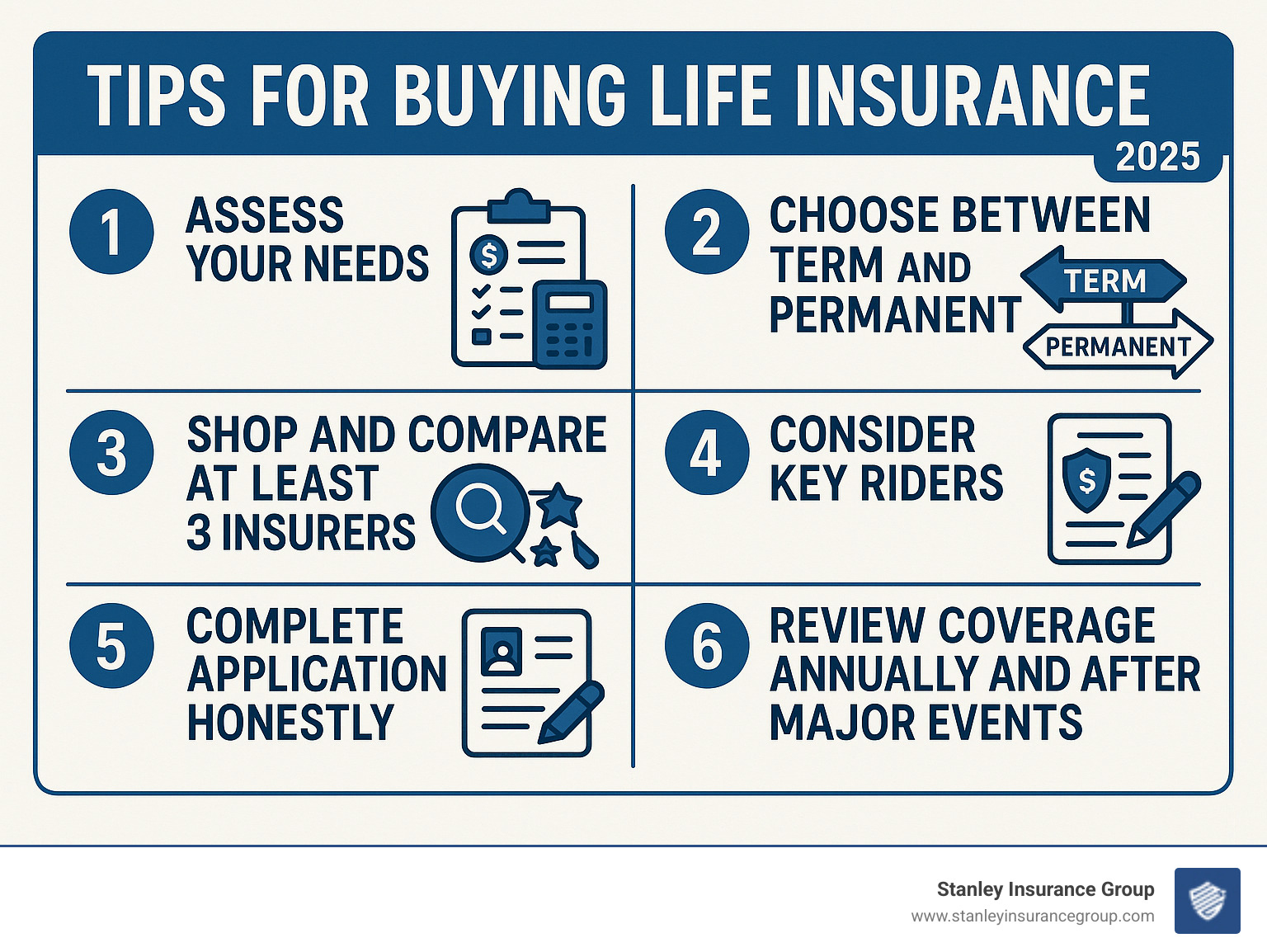
Essential Life Insurance Buying Tips:
- Buy young and healthy - Lock in lower premiums while you qualify for preferred rates
- Calculate true coverage needs - Use the DIME method (Debts, Income, Mortgage, Education) rather than guessing
- Choose the right policy type - Term for temporary needs, permanent for lifelong goals
- Compare multiple insurers - Shop at least 3 companies with A-rated financial strength
- Add key riders - Waiver of premium and accelerated death benefit protect your investment
- Review regularly - Update coverage after major life events like marriage, births, or home purchases
The good news? Life insurance costs far less than most people think. A recent LIMRA study found that 50% of people overestimate term life insurance costs by more than three times.
Many families in Hilliard and surrounding areas find they can get substantial coverage for less than their monthly coffee budget. The key is knowing what to look for and avoiding the common pitfalls that lead to overpaying or underinsuring.
I'm Brandon Stanley, and I've been helping families steer these decisions since taking over Stanley Insurance Group, which has served the Columbus area since 1984. My approach to tips for buying life insurance focuses on education first—because the right coverage protects not just your family's finances, but their future dreams too.
Related content about tips for buying life insurance:
Do You Need Life Insurance?
Here's the honest truth I share with families who walk into our Hilliard office: if someone depends on your income, you need life insurance. It's that simple. After nearly four decades of helping Ohio families steer these decisions, I've seen too many situations where the "we'll figure it out later" approach leads to real hardship.
The numbers don't lie. The Social Security Administration tells us that a 20-year-old worker has a one in four chance of becoming disabled during their career. Yet most families spend more time planning their summer vacation than protecting their financial future.
Here's what really opened my eyes: 42% of families with only employer-sponsored life insurance would face financial difficulty within six months if they lost a wage earner. That means nearly half of all working families are living one tragedy away from financial crisis.
Even funeral and burial costs range from $7,000 to $12,000 on average. That's money your grieving family shouldn't have to scramble to find while they're trying to heal.

Who Should Consider Coverage
Parents and guardians top the list every time. If you have children, life insurance isn't a luxury—it's as essential as car seats and smoke detectors. Your kids need more than love and good intentions. They need financial security for housing, food, healthcare, and education expenses that stretch for decades.
Homeowners face unique risks that renters don't. Your mortgage lender won't accept sympathy cards instead of monthly payments. Life insurance can either pay off the mortgage entirely or provide enough income replacement to keep making payments.
Business owners often have the most complex insurance needs. Your business might be your family's most valuable asset, but it could also become their biggest liability. Business debts, key person dependencies, and partnership agreements all create insurance needs that go beyond basic family protection.
Retirees find that insurance needs don't disappear at retirement. You might need coverage for estate taxes, final expenses, or to leave an inheritance. Our post on Benefits of Life Insurance as You Get Older explores how these needs evolve over time.
What If You Already Have Group Life?
Most group policies provide only one to two times your annual salary. Financial experts typically recommend 7-10 times your income for adequate family protection. If you earn $60,000 annually, your group policy might provide $120,000—but your family probably needs $400,000 to $600,000 to maintain their lifestyle.
Portability creates another problem. Group life insurance typically ends when you leave your job. If you've developed health issues during your employment, you might not qualify for individual coverage at reasonable rates.
That 42% hardship statistic I mentioned earlier? It specifically applies to families relying solely on employer coverage. Consider supplemental individual coverage to fill the gaps. This gives you portable protection that follows you between jobs and can be customized to your family's specific needs.
How Much Coverage Is Enough?
Getting your coverage amount right is one of the most important tips for buying life insurance because it determines whether your family will be truly protected or left scrambling.
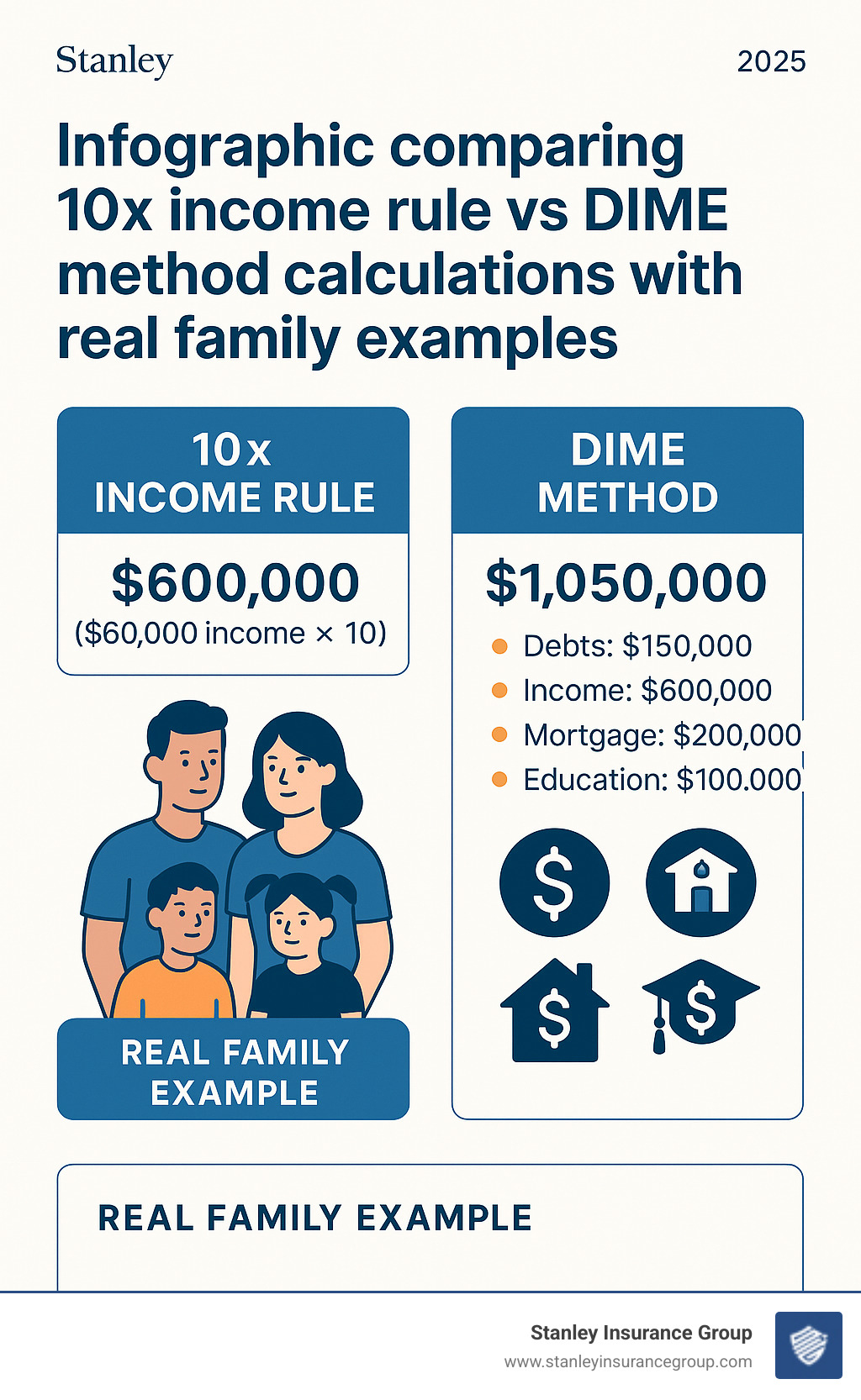
You've probably heard the "10 x your income" rule. It's a decent starting point, but it's like using a hammer for every home repair—sometimes it works, sometimes it doesn't. A teacher earning $50,000 with three young children and a mortgage might need significantly more than $500,000.
That's where the DIME method comes in. It's more thorough and gives you a clearer picture of what your family actually needs:
Debts – Mortgage, car loans, credit cards, student loans
Income – Years of income replacement your family needs
Mortgage – Outstanding balance (if not counted in debts)
Education – Future college costs for your children
Let's say you have $200,000 in debts, want to replace $75,000 of annual income for 10 years ($750,000), and need $100,000 for two children's college education. You'd need about $1.05 million in coverage. That might sound like a lot, but term life insurance makes substantial coverage surprisingly affordable.
Quick Formulas & Online Calculators
The 10 x rule assumes your family could invest the death benefit and live off the returns while preserving the principal. If you earn $60,000 annually, you'd need about $600,000 in coverage.
For the DIME method, start by listing all debts that need immediate payoff. Then calculate the annual income replacement your family needs and multiply by the years of support required. Add education costs for children, then subtract existing savings and any Social Security survivor benefits.
Social Security survivor benefits can significantly reduce the life insurance you need, but remember they're not guaranteed to continue at current levels.
Common Myths About Coverage Amounts
"I don't need much because my spouse works too." Even if your spouse works, losing your income could force major lifestyle changes, relocation, or career sacrifices to manage childcare.
"Young people don't need much coverage." Actually, young families often need the most coverage because they have decades of income to replace and limited savings.
"Life insurance is too expensive for large amounts." This myth keeps families underinsured. Term life insurance costs far less than most people think, especially for young, healthy applicants.
For more insights on separating fact from fiction, check out Common Myths About Life Insurance.
Tips for Buying Life Insurance
The best tips for buying life insurance come from real experience helping families make this important decision. After decades in the insurance business—Stanley Insurance Group has been serving families since '84—I've seen what works and what doesn't when it comes to protecting the people you love.
Understanding your options starts with knowing the two main categories. Term life insurance gives you coverage for a specific period—usually 10 to 30 years—at lower premiums. Permanent life insurance stays with you for life and builds cash value, but costs significantly more.
Your premium depends on several factors that insurance companies evaluate carefully. Age matters most—rates roughly double every 10-15 years you wait. Health comes next, followed by lifestyle choices like smoking or dangerous hobbies. Learn more about these factors at Investopedia's guide to life insurance quotes.

Tip #1: Choose the Right Policy Type
Term life insurance makes perfect sense when you have temporary needs and want to keep costs low. It's ideal for covering your mortgage, protecting young children, or replacing income during your peak earning years. Most families in Hilliard choose 20 or 30-year terms to cover their biggest financial responsibilities.
Whole life insurance provides permanent coverage with guaranteed cash value growth. Your premiums stay the same for life, and the policy builds cash you can borrow against.
Universal life insurance gives you more flexibility with permanent coverage. You can adjust premiums up or down within limits, and the cash value growth depends on current interest rates.
Tip #2: Lock In Low Premiums Early
Age is your biggest enemy when it comes to life insurance pricing. A healthy 30-year-old might pay a fraction of what a 45-year-old pays for the same coverage.
Health changes can completely derail your insurance plans. Diabetes, heart disease, or cancer can increase premiums by hundreds of percent—or make you uninsurable altogether.
The smart strategy? Buy coverage while you're young and healthy, even if you don't think you need it right away. You can always reduce coverage later, but you can't go back in time to get better rates.
Tip #3: Customize With Riders
Waiver of premium rider might be the most important add-on you've never heard of. If you become disabled and can't work, this rider pays your life insurance premiums to keep the policy active.
Accelerated death benefit rider allows you to access part of the death benefit if you're diagnosed with a terminal illness. Many companies include this rider at no extra cost.
Long-term care rider lets you use death benefit funds for long-term care expenses. Since over 66% of 65-year-olds will need long-term care at some point, this rider provides valuable flexibility.
Tip #4: Compare Companies & Ratings
Not all life insurance companies are created equal, and this is where working with an independent agent really pays off. We can show you options from multiple highly-rated companies instead of being limited to just one.
Financial strength ratings from AM Best, Moody's, and Standard & Poor's tell you about an insurer's ability to pay claims. Stick with companies rated A- or higher.
The NAIC complaint index shows how many complaints each company receives relative to their market share. Look for companies with complaint indexes below 1.0—it indicates better customer service.
Tip #5: Review and Update Regularly
Life insurance isn't something you buy once and forget about. Major life events should trigger policy reviews, and that's where having a local agent really helps.
Marriage might mean adding coverage if your spouse depends on your income. Birth or adoption definitely means increasing coverage to account for your new dependent's needs. Divorce requires updating beneficiaries and adjusting coverage based on changed financial responsibilities.
Tip #6: Avoid Common Mistakes
Lapse risk is probably the most expensive mistake people make. Don't let policies lapse due to missed payments. Set up automatic payments to avoid this costly mistake.
Naming minor beneficiaries creates problems because children can't legally receive death benefits until age 18. Instead, name a trusted adult or establish a trust.
Policy replacement gaps can leave you uninsured if health changes between applications. Never cancel existing coverage before new coverage is approved and in force.
How to Apply and Save Money
The application process is simpler than most people expect. Don't let the paperwork intimidate you—we've guided thousands of families through this process since 1984, and most applications take just 30-60 minutes to complete.
You'll start by providing basic information: your Social Security number, driver's license, employment details, and income verification. The insurer will also ask about your medical history, including any medications you take, doctors you see regularly, and recent medical tests or procedures.
Your rate class determines what you'll pay for coverage. Preferred Plus rates go to exceptionally healthy applicants. Preferred rates apply to people in good health with minor, well-controlled conditions. Standard rates cover average health situations.
Preparing for the Application
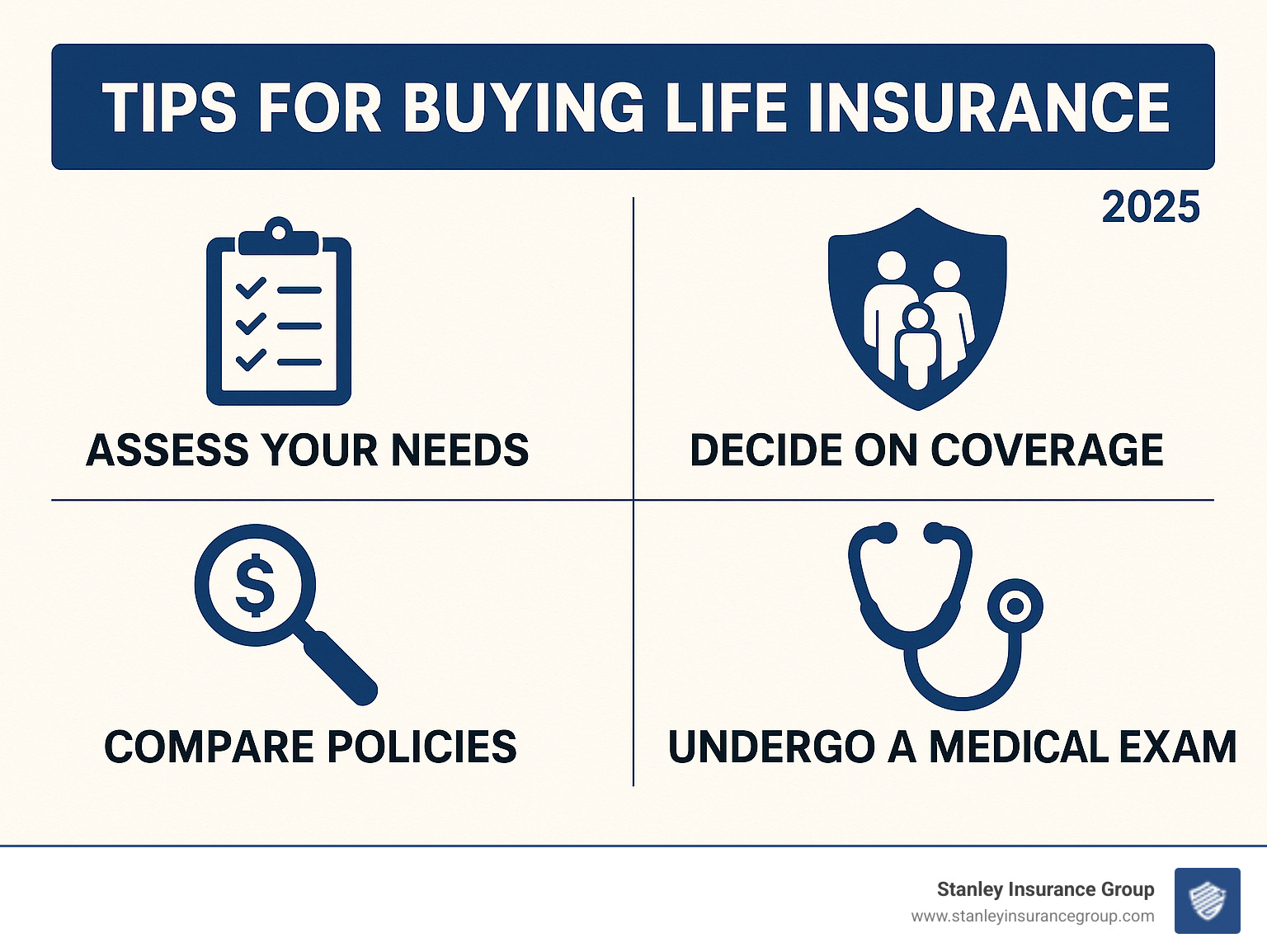
Getting organized before you start saves time and reduces stress. Gather your government-issued photo ID, Social Security card, and recent pay stubs or tax returns for income verification. You'll also need a complete list of any medications you take, including dosages, and contact information for all your doctors.
Answer every question truthfully. Insurance fraud is a serious crime, but even innocent mistakes can void your policy years later. If you're unsure about a medical question, it's better to disclose too much than too little.
Medical Exam vs No-Exam Policies
Fully underwritten policies require a medical exam and detailed health questionnaire. This process takes longer—usually 2-6 weeks—but offers the lowest premiums for healthy applicants. The medical exam typically includes basic measurements like height, weight, and blood pressure, plus a blood draw and urine sample.
Simplified issue policies skip the medical exam but still require you to answer health questions. Approval comes much faster—often within days—but you'll pay higher premiums for this convenience.
Guaranteed issue policies require no medical exam or health questions at all. Anyone can qualify regardless of their health situation, but premiums are highest and coverage is quite limited—usually $25,000 or less.
Premium Hacks & Payment Strategies
Paying annually instead of monthly can save you 5-10% each year. Insurance companies charge processing fees for monthly payments, so eliminating those fees reduces your total cost.
Coverage band discounts offer better per-unit pricing at higher coverage levels. You might actually pay less for $250,000 in coverage than $200,000 if you cross a discount threshold.
Maintaining healthy habits can help you qualify for preferred rates during underwriting. Regular exercise, healthy weight, not smoking, and moderate alcohol consumption all work in your favor.
At Stanley Insurance Group, we help you steer these strategies to find the best value for your specific situation. Our independent status means we can shop multiple highly-rated insurers to find the combination of coverage and price that works best for your family's needs.
Frequently Asked Questions about Tips for Buying Life Insurance
After helping families in Hilliard and central Ohio steer life insurance decisions since 1984, I've heard just about every question imaginable. Here are the ones that come up most often when people are following tips for buying life insurance.
Do life insurance death benefits get taxed?
Here's some good news: life insurance death benefits are generally tax-free for your beneficiaries under federal law. When your family receives that check during an already difficult time, they won't have to hand a chunk of it over to the IRS.
But like most things in life, there are a few exceptions worth knowing about. If you ever sold your policy to someone else, the tax rules change. Also, if your beneficiaries choose to receive the money in installments rather than a lump sum, any interest earned on those payments becomes taxable income.
For folks with larger estates, there's another consideration. If you own the policy when you pass away, the death benefit gets included in your estate for tax purposes. This mainly affects families subject to federal estate taxes.
The bottom line? For most families, life insurance provides exactly what it promises—tax-free money when your loved ones need it most.
How often should I review and update my policy?
Think of your life insurance like your car—it needs regular check-ups to make sure everything's running smoothly. I recommend reviewing your coverage at least once a year. Pick a date that's easy to remember, like your birthday or when you do your taxes.
But don't wait for your annual review if something major happens in your life. Marriage changes everything—suddenly you might have someone depending on your income. When babies arrive, your insurance needs often jump dramatically. You're not just protecting your spouse anymore; you're securing your child's future for the next 18-plus years.
Other times to review your coverage include when you buy a house, change jobs, pay off major debts, or unfortunately, when you go through a divorce.
How can my beneficiaries access the policy and file a claim?
This might be the most important question of all, because the best policy in the world doesn't help if your family can't access it when they need it most. The key is making sure your beneficiaries know about your coverage and can find everything they need.
Never store your policy documents in a safe deposit box. Banks often seal these boxes immediately after death, creating delays when your family needs access most. Instead, keep policies in a fireproof safe at home or give copies to a trusted family member.
Your beneficiaries will need several pieces of information to file a claim: the insurance company's contact information, your policy number, your Social Security number, and ideally, contact information for your insurance agent.
The actual claims process is straightforward but requires specific documentation. Your beneficiaries will need a certified copy of the death certificate, completed claim forms from the insurance company, and proof of their identity. Most insurers process claims within 30 days once they receive all required documents.
Here's where having a relationship with an independent agency really matters. When families are grieving, the last thing they need is to steer insurance bureaucracy alone. Our team, including our Spanish-speaking agents Ana and Sandra, walks families through every step of the process.
Conclusion
Making smart tips for buying life insurance decisions doesn't have to feel overwhelming when you have the right support. The key is understanding your family's unique needs, comparing your options thoughtfully, and partnering with experienced professionals who genuinely care about your family's future.
Since 1984, Stanley Insurance Group has been helping families throughout Ohio and beyond make these crucial decisions with confidence. Our independent agency approach gives you something special—we can shop multiple top-rated insurers to find the perfect fit for your situation, rather than being limited to just one company's products.
What makes working with an independent agent different? It's the concierge-level service and personal relationships we build. We're not just selling you a policy and disappearing. We're here for the long haul, reviewing your coverage as your life changes, helping with claims, and making sure your protection keeps pace with your growing family.
Our team brings both expertise and personal touch to every conversation. Amy handles our commercial lines for business owners who need comprehensive life insurance strategies alongside their business coverage. Ana and Sandra, our Spanish-speaking account specialists, ensure every family member fully understands their protection. Our associate agents Kaisen, Ethan, and Chase bring fresh perspectives and deep product knowledge to serve families across Ohio, Pennsylvania, Tennessee, North Carolina, South Carolina, and Florida.
Life insurance does more than protect your family's finances—it protects their dreams, their security, and their ability to stay in the home they love. When you combine proper life insurance with solid home and property insurance, auto and vehicle insurance, and business insurance, you create a comprehensive safety net that lets you focus on living rather than worrying.
The truth is, the best life insurance policy is the one you actually have when your family needs it. Waiting until tomorrow to protect what matters most today only increases the risk that health changes or other factors could make coverage more expensive or harder to obtain.
Ready to explore your options without pressure or confusion? Contact Stanley Insurance Group today for a personalized consultation. We'll help you understand your needs, compare your choices, and create a strategy that gives you real confidence in your family's financial future.
For more information about our life insurance options and how they work with your overall insurance strategy, visit More info about Life Insurance.
Remember—protecting your family's future is one of the most important gifts you can give them. Let's make sure you get it right.
Similar posts