
Home Insurance Quotes: Compare and Conquer
Compare home insurance quotes and save. Learn expert tips to find the best coverage, discounts, and insurance company for your home.
Why Comparing Home Insurance Quotes Saves You Money and Headaches
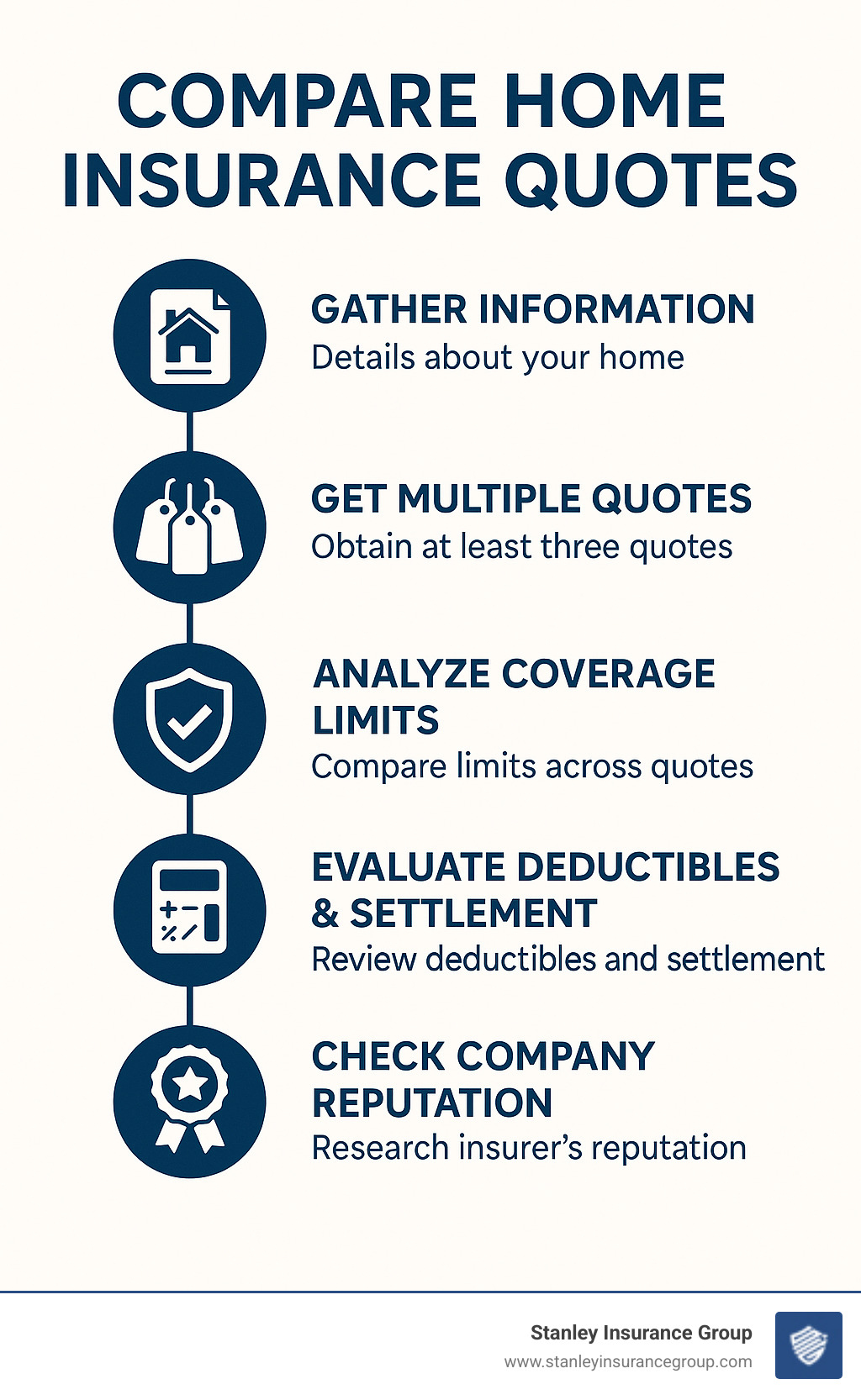
To compare home insurance quotes effectively, follow these simple steps:
- Gather information about your home (square footage, year built, roof age)
- Get at least 3 quotes from different insurers
- Ensure coverage limits match across all quotes
- Compare deductibles and settlement methods (ACV vs. replacement cost)
- Check insurer reputation using J.D. Power ratings and financial strength scores
The average homeowner can save up to $350 annually by comparing quotes from multiple providers, according to industry data. Don't settle for the first quote you receive!
When it comes to protecting your most valuable asset, finding the right home insurance policy at the right price is essential. Compare home insurance quotes to ensure you're not overpaying or underinsured. Surprisingly, more than half of U.S. homes are underinsured, leaving families vulnerable to devastating financial losses after disasters.
Home insurance premiums can vary by hundreds or even thousands of dollars between companies for identical coverage. This price difference isn't just random – insurers use different algorithms and risk assessments, meaning Company A might view your home as lower risk than Company B. That's why shopping around is so important.
I'm Brandon Stanley, president of Stanley Insurance Group, a family-owned independent agency serving Ohio homeowners since 1984. Having helped thousands of clients compare home insurance quotes over the decades, I've seen how the right comparison strategy can save families significant money while ensuring complete protection.
Easy Compare home insurance quotes word list:
- Bundle home and auto insurance
- does bundling insurance save money
- how to lower homeowners insurance premiums
Understanding Home Insurance Quotes
A home insurance quote is your first glimpse into what protecting your home might cost. Think of it as an estimate, not a final policy—it's the starting point that helps you understand what you'll likely pay based on your unique situation.
When you request quotes, insurance companies typically perform what's called a "soft credit pull"—don't worry, this won't affect your credit score. They're just gathering information to assess risk factors that influence your premium. If you're buying a home with a mortgage, your lender will absolutely require proof of insurance before closing, which is why it's smart to compare home insurance quotes early in your home-buying journey.
"Many homeowners are surprised to learn that the national average premium for home insurance runs around $1,915 per year for a standard policy," shares Amy, our Commercial Lines expert here at Stanley Insurance Group. "But that number can swing dramatically depending on where you live, what your home is like, and which insurer you choose."
You can get home insurance quotes from several sources:
- Online direct-to-consumer websites
- Independent insurance agents (like us at Stanley Insurance Group, serving Ohio families since '84)
- Captive agents who represent just one company
- Insurance comparison websites
Here's a concerning fact: industry research shows more than half of U.S. homes are underinsured. This often happens because homeowners don't take the time to compare home insurance quotes thoroughly and truly understand what coverage they need.
What Goes Into Your Quote?
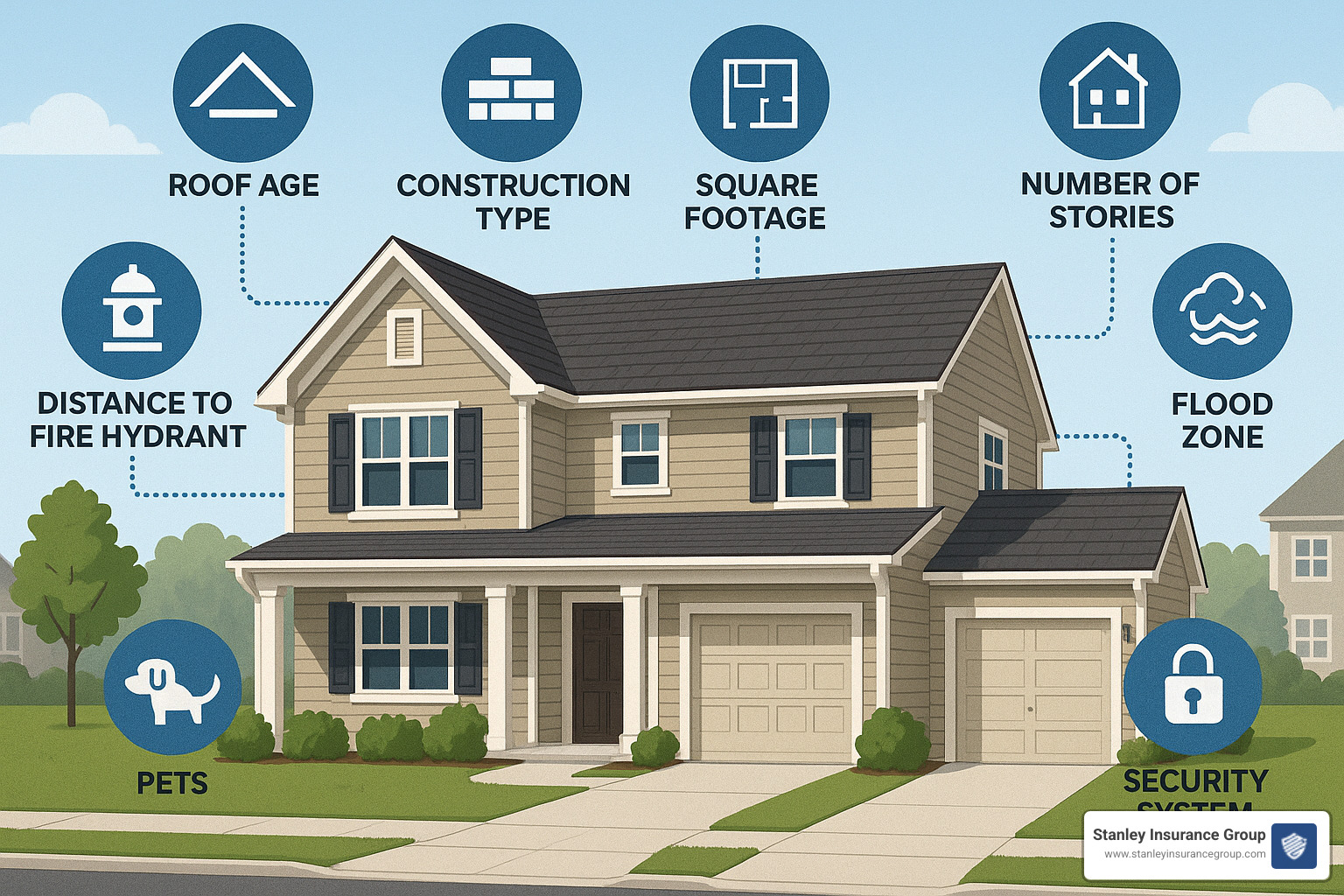
When you compare home insurance quotes, knowing what factors shape your premium helps you make smarter decisions. Insurance companies look at:
Dwelling Details: Your home's construction type matters—whether it's brick, frame, or something else. They'll consider your home's age, square footage, number of stories, and special features like fireplaces or custom woodwork.
"Roof age is particularly important," explains Chase, one of our Associate Agents. "A new roof can significantly lower your premium, while an older roof might increase it—or even make coverage hard to get in some cases."
Personal Factors: Companies look at your claims history (typically the past 3-5 years), credit tier in most states, how long you've lived there, and even your pets—certain dog breeds may affect your premium. They'll also want to know about any home-based businesses.
Location Considerations: How close is the nearest fire station or hydrant? Is your home in a flood zone? What are crime rates like in your neighborhood? Is there wildfire, hurricane or tornado risk? All these location factors play significant roles.
Coverage Selections: The dwelling coverage amount (what it would cost to rebuild), personal property limits, liability protection, deductible choices, and any optional endorsements all influence your final quote.
Why Quotes Vary So Much
When you compare home insurance quotes, the differences can be startling—sometimes varying by hundreds or even thousands of dollars for what seems like identical coverage. Here's why:
Different Rating Algorithms: Each insurance company cooks up its own secret formula for calculating risk. Some might put more weight on your credit score, while others focus more on claims history or specific home features.
"We've seen cases where one company quotes a premium twice as high as another for the exact same coverage," says Kaisen, Associate Agent at Stanley Insurance Group. "That's exactly why we always recommend comparing at least three different quotes."
Climate Change Impacts: As natural disasters get worse, insurance companies are adjusting their pricing. Extreme weather events are becoming more frequent and severe, causing some insurers to raise rates more aggressively than others, especially in high-risk areas.
Materials and Labor Inflation: The cost to rebuild homes has skyrocketed recently due to construction material and labor shortages. Different insurers update their cost models at different times, creating quote variations.
Regional Focus: Some insurance companies specialize in certain geographic areas and offer more competitive rates there. Others might charge higher premiums in areas where they have less experience or market share.
Discount Variations: Each company offers its own mix of discounts. One might give substantial savings for home security systems, while another emphasizes bundling multiple policies.
The takeaway? Never settle for the first quote you receive. Taking time to thoroughly compare home insurance quotes could save you hundreds annually while ensuring you have the right coverage. At Stanley Insurance Group, we've been helping Ohio families find the perfect balance of protection and value since 1984, with both English and Spanish-speaking agents ready to guide you through the process.
Compare Home Insurance Quotes Like a Pro
When you compare home insurance quotes, taking a thoughtful approach can save you hundreds of dollars and countless headaches. Let me share some insider wisdom we've gained at Stanley Insurance Group since 1984.
Think of quote comparison as a bit like dating – you wouldn't commit to the first person you meet without getting to know others first! The same applies to your home coverage.
"I've seen Ohio families save over $400 annually just by comparing quotes from different carriers," explains Ethan, one of our Associate Agents. "As an independent agency, we can shop multiple carriers at once, finding options many homeowners didn't know existed."
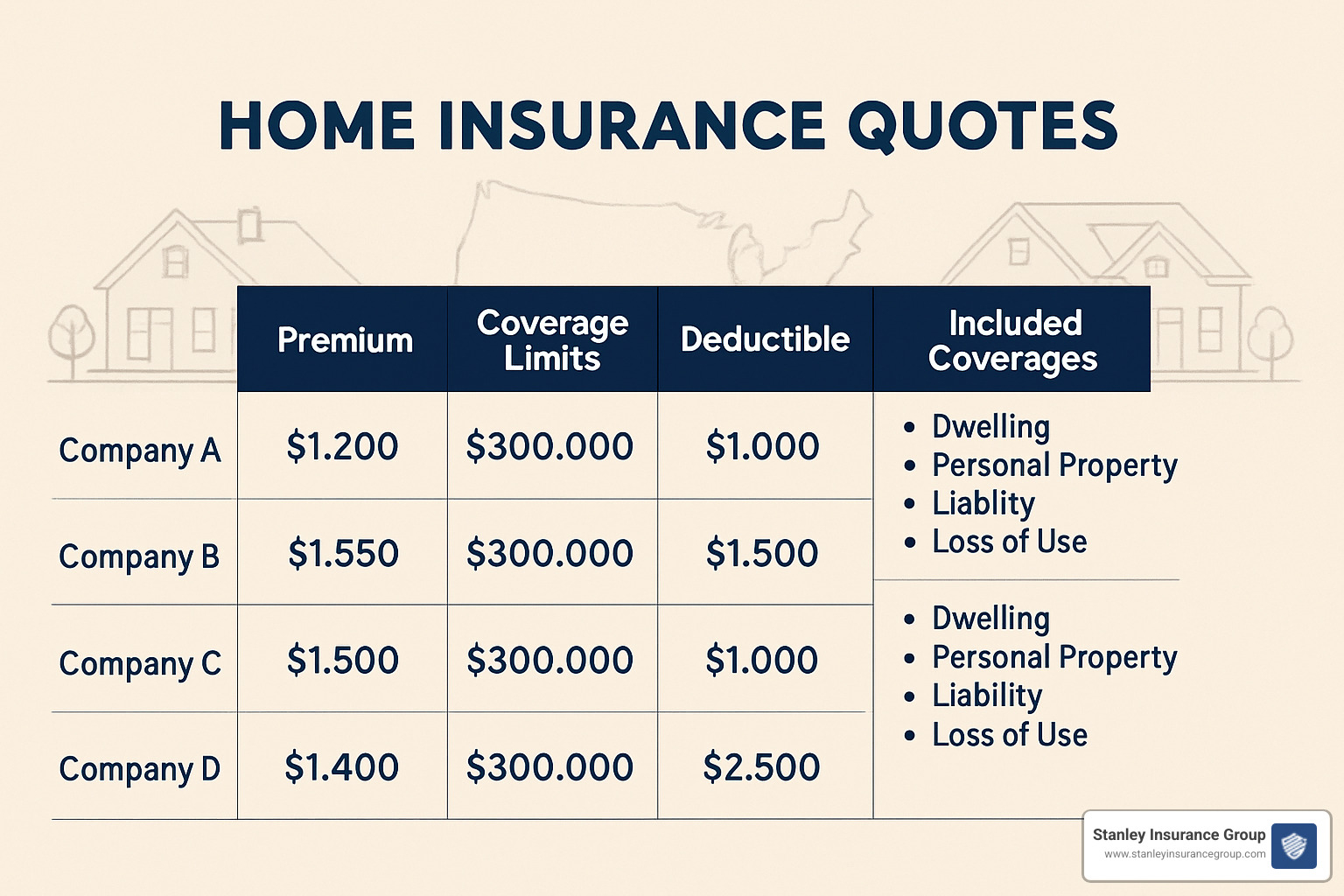
Create a simple side-by-side assessment of each quote. Whether you use a spreadsheet or just jot notes in a notebook, seeing premiums, coverage limits, and deductibles lined up makes comparison much clearer. Always get at least three different quotes – industry data shows this simple step saves shoppers about 30% on average.
While online quote tools offer convenience, independent agents provide something algorithms can't – personalized guidance based on decades of experience. We often access regional carriers with competitive rates that don't sell directly to consumers. Since '84, we've been building relationships with insurers and homeowners alike, creating that concierge-level service that makes insurance shopping less stressful.
Don't forget to check bundling opportunities! Combining your home and auto policies can knock up to 20% off your premiums with some insurers. And while price matters, reputation matters more – a slightly higher premium from a company known for hassle-free claims might save you tremendous stress later.
For Ohio-specific guidance, check out our detailed resource on How to Get Home Insurance Quotes in Ohio.
Step-by-Step: Compare home insurance quotes online
Ready to compare home insurance quotes online? Here's your roadmap to success:
First, gather all your home information – address, year built, square footage, construction materials, roof age, recent renovations, security features, and claims history. Having these details ready makes the process smoother and ensures more accurate quotes.
Next, submit applications to 3-5 different insurance companies. Be thorough and consistent with your information across all applications. Save confirmation emails and reference numbers – you'll thank yourself later if questions arise.
"El error más común que vemos es cuando los propietarios comparan cotizaciones con límites de cobertura diferentes," says Ana, one of our Spanish-speaking Account Specialists. "Make sure you're comparing apples to apples by keeping all coverage parameters consistent."
When reviewing quotes, use identical dwelling coverage amounts, match personal property percentages (typically 50-70% of dwelling value), set the same liability limits (we recommend at least $300,000), and specify consistent deductible amounts.
Document everything – premium amounts, included coverages, exclusions, available discounts, and policy form types. And critically, avoid coverage gaps by ensuring there's no lapse between policies if you're switching insurers.
Decoding the Fine Print When You Compare Home Insurance Quotes
Looking beyond the premium is where the real wisdom happens when you compare home insurance quotes. The details matter tremendously.
Every policy has exclusions – things that simply aren't covered. Common examples include flood damage, earthquakes, mold issues, and general wear and tear. But some companies exclude more than others, which is why careful review matters.
"Many Columbus and Hilliard homeowners are surprised when they find standard policies don't cover water backup or sewer line problems," explains Sandra, our bilingual Account Specialist. "These require additional endorsements, and the costs vary significantly between companies."
Pay close attention to sub-limits too – these are coverage caps for specific types of property. Your policy might limit jewelry coverage to $1,500 or electronics to $2,500, even if your overall personal property coverage is much higher. These sub-limits often differ between insurers.
The policy form matters too. Most homeowners receive an HO-3 policy, covering the structure for "open perils" but personal property only for "named perils." An HO-5 policy offers broader protection for both structure and contents but typically costs more. Knowing which form you're getting helps make fair comparisons.
Some policies also include special requirements like regular roof inspections or tree maintenance. Missing these requirements could void coverage when you need it most.
Vetting the Company Behind the Quote
Since 1984, we've learned that the company behind the quote matters as much as the quote itself. As you compare home insurance quotes, take time to evaluate the insurers too.
Check financial strength ratings from organizations like A.M. Best, Standard & Poor's, or Moody's. These ratings indicate whether a company has the financial stability to pay claims, especially after widespread disasters. Look for ratings of A or better – anything less could be risky.
The J.D. Power U.S. Home Insurance Study offers valuable insights into customer satisfaction. According to their 2024 study, the industry average score is 816 out of 1,000 points. Companies scoring significantly below this might struggle with customer service.
"At Stanley Insurance Group, we've vetted insurance carriers for four decades," says Brandon Stanley. "We've seen which companies consistently deliver on their promises and which ones leave customers frustrated during claims."
The National Association of Insurance Commissioners tracks complaint ratios, with the median being 1.0. Companies with lower ratios have fewer complaints relative to their size – a good sign for customer service quality.
Consider practical factors too – does the company offer modern conveniences like mobile apps and online policy management? Do they have local adjusters who can respond quickly after a loss? These seemingly small details can make a huge difference when you need to file a claim.
Coverage, Deductibles & Valuation Methods
When you compare home insurance quotes, understanding what you're actually buying makes all the difference. Let's break down the key parts of your policy in plain English:
Dwelling Coverage (Coverage A) protects the actual structure of your home and attached structures like your garage. This should reflect what it would cost to rebuild your home from scratch if disaster strikes—not what you paid for it or what you could sell it for today.
Personal Property (Coverage C) covers all your stuff—furniture, clothing, electronics, and more. This is typically set at 50-70% of your dwelling coverage. When you compare home insurance quotes, pay close attention to whether the policy offers actual cash value (which factors in depreciation) or replacement cost for your belongings.
"The difference between actual cash value and replacement cost can be thousands of dollars when you file a claim," explains Chase at Stanley Insurance Group. "We've been helping Ohio families understand these distinctions since '84."
Liability Protection (Coverage E) is your financial shield if someone gets hurt on your property or you accidentally damage someone else's property. Most experts suggest at least $300,000 in coverage here.
Loss of Use/Additional Living Expenses (Coverage D) pays for your temporary housing and extra costs if your home becomes uninhabitable after a covered disaster. This can be a lifesaver when you're displaced from your home.
Deductibles come in two flavors—flat dollar amounts (like $1,000) or percentage-based (common for hurricane coverage). When you compare home insurance quotes, a higher deductible means lower premiums but more out-of-pocket costs when disaster strikes.

One crucial distinction when you compare home insurance quotes is how your claims will be settled:
| Valuation Method | How It Works | Example Payout for 5-Year-Old TV | Impact on Premium |
|---|---|---|---|
| Actual Cash Value (ACV) | Original cost minus depreciation | $200 (original $1,000 with 80% depreciation) | Lower premiums |
| Replacement Cost Value (RCV) | Cost to replace with new equivalent item | $1,000 (full replacement with comparable new model) | 10-20% higher premiums |
| Extended Replacement Cost | Up to 25-50% above dwelling limit if rebuilding costs exceed expectations | N/A (applies to dwelling) | 10% higher than standard RCV |
| Guaranteed Replacement Cost | Full rebuild regardless of policy limit | N/A (applies to dwelling) | 15-25% higher than standard RCV |
"After major storms or disasters, building costs often skyrocket due to demand," says Amy from our Commercial Lines department. "We've seen this happen repeatedly since 1984. Extended or guaranteed replacement cost coverage can be a real lifesaver when construction prices surge unexpectedly."
How Deductible Choices Shape Premiums & Payouts
Your deductible is what comes out of your pocket before insurance kicks in. This simple choice has a big impact when you compare home insurance quotes.
A $500 deductible gives you the lowest out-of-pocket expense but the highest premium. Most homeowners choose $1,000 as a middle ground. If you bump up to $2,500, you'll typically save about 11% on your premium—but remember, that means you'll pay $1,500 more when you file a claim.
"We always tell our clients to make sure they have enough in savings to cover their deductible," says Kaisen at Stanley Insurance Group. "If you can comfortably pay $2,500 from your emergency fund, that higher deductible might be a smart money-saving choice."
Be particularly careful about special percentage-based deductibles for wind, hurricane, or hail damage. These are calculated as a percentage of your dwelling coverage—typically 1-5%. For a home insured at $300,000 with a 2% wind deductible, you'd pay $6,000 out of pocket before insurance helps with wind damage. These percentage deductibles are becoming more common, especially in areas prone to severe weather.
Picking the Right Limits—Not Too High, Not Too Low
Finding the sweet spot for coverage amounts requires some thought when you compare home insurance quotes. Too little coverage leaves you vulnerable; too much means you're paying unnecessarily.
For your dwelling coverage, consider local building costs per square foot, any special features like custom woodwork or high-end finishes, demolition costs, and potential code upgrade expenses for older homes.
"Since '84, we've helped thousands of Ohio homeowners determine the true rebuild cost of their homes," explains Ethan at Stanley Insurance Group. "One of the biggest mistakes we see is people insuring based on market value or purchase price, which can leave them seriously underprotected."
For personal property coverage, consider creating a home inventory with photos and receipts. Identify high-value items that might need scheduled coverage (like jewelry or collectibles), and consider replacement cost coverage instead of actual cash value for your belongings.
For liability protection, think about both your current assets and future income potential. Many homeowners find that higher liability limits are relatively inexpensive to add. While $300,000 is the minimum recommended coverage, $500,000 provides better protection, especially for homeowners with significant assets.
"Our Spanish-speaking team members Ana and Sandra often help clients understand these complex coverage decisions in the language they're most comfortable with," notes Brandon Stanley. "Having bilingual agents has been part of our concierge approach to insurance since the beginning."
Savings Strategies & Evaluating Insurers
When you compare home insurance quotes, finding ways to save money without compromising protection is like finding hidden treasure. Since 1984, we've helped Ohio families strike this perfect balance.
"Many of our clients don't realize they're leaving money on the table until we show them," explains Ana, our bilingual Account Specialist at Stanley Insurance Group. "Bundling home and auto insurance typically saves up to 20% on both policies—we've seen families save hundreds each year with this strategy alone."
Your home's safety features aren't just for peace of mind; they're also money-savers. Installing monitored security systems, smoke detectors, and deadbolt locks can trim your premium by 5-15%. The insurance industry increasingly rewards homeowners who invest in smart home technology that prevents losses before they happen.

Your claims history speaks volumes to insurers. Maintaining a claims-free record typically earns you discounts of 10-20% after five years. Sometimes, it makes financial sense to handle smaller issues out-of-pocket rather than filing claims that could cost you this valuable discount in the long run.
"The loyalty versus shopping debate is something we help clients steer all the time," says Chase, one of our Associate Agents. "While some insurers offer loyalty discounts, our experience since '84 shows that comparing quotes every 2-3 years often yields greater savings. As an independent agency, we can tell you honestly when it makes sense to stay put and when it's time to make a move."
In most states, your credit score significantly influences your premium. Even small improvements to your credit can translate into meaningful insurance savings over time. Similarly, home upgrades like a new roof, updated electrical systems, or modern plumbing not only increase your property value but can substantially reduce insurance costs.
"Nuestra capacidad de explicar estas estrategias de ahorro en español marca una gran diferencia para muchas familias," says Sandra at Stanley Insurance Group. "Our ability to explain these savings strategies in Spanish makes a big difference for many families. Our bilingual team ensures everyone understands how to maximize their insurance value."
Discount Checklist Before You Bind Coverage
Before finalizing your policy after you compare home insurance quotes, take a moment to review potential discounts with your agent. Here's what we look for with every client at Stanley Insurance Group:
Multi-policy opportunities can save you up to 20% when you bundle home and auto insurance. Don't forget about combining home and life coverage or insuring multiple properties with the same carrier. Home feature discounts reward safety and durability—a new roof (less than 10 years old), impact-resistant materials, whole-house generators, automatic water shut-off devices, and fire sprinkler systems all qualify for premium reductions.
Personal circumstances often open up savings too. Are you a senior citizen or retiree over 55? There's a discount for that. Military service member or veteran? Many insurers offer special rates. First-time homebuyer or recently purchased your home? Don't miss out on these temporary savings opportunities.
Even your payment preferences can save you money. Paying annually instead of monthly, enrolling in automatic payments, choosing paperless billing, or renewing your policy 7-10 days before expiration can all reduce your premium.
"Since '84, we've taken pride in finding every applicable discount for our neighbors throughout Ohio," says Kaisen at Stanley Insurance Group. "Our personalized approach means we understand your unique situation and can advocate for discounts you might not even know exist."
For more detailed information on saving money, check out our guide on Ways to Save Money on Homeowners Insurance.
When & How Often to Shop Again
Once you've done the work to compare home insurance quotes and select a policy, when should you revisit this process? The annual renewal is always a good time to review your coverage, looking for premium increases, coverage changes, or new discounts you might qualify for.
Significant rate hikes should trigger immediate comparison shopping. "If your premium jumps more than 10% without any claims or changes to your property, that's a clear signal to explore your options," advises Ethan, Associate Agent at Stanley Insurance Group.
Life changes should prompt insurance reviews too. Major home renovations that add square footage or value, significant life events like marriage or retirement, starting a home-based business, or acquiring valuable possessions all warrant fresh quotes.
"I often hear clients worry that shopping for quotes will hurt their credit score," explains Brandon Stanley. "I'm always happy to reassure them that insurance quote inquiries are considered 'soft pulls' and don't impact credit scores at all."
As an independent agency serving Ohio families since 1984, we handle the shopping process for you, saving you time while ensuring you get competitive rates and appropriate coverage. Our concierge approach means you get the benefit of comparison without the hassle.
Red Flags While Comparing
As you compare home insurance quotes, keep an eye out for warning signs that might indicate future headaches:
Be wary of unusually low premiums. If one quote is dramatically lower than others, scrutinize the coverage details carefully. The policy might contain major exclusions or sky-high deductibles that make it less valuable than it appears.
Research claims satisfaction before you buy. A company that's difficult to work with during claims negates any premium savings. We recommend checking J.D. Power ratings and online reviews that specifically mention claims experiences.
Financial stability matters enormously. Insurance companies rated below "A-" by A.M. Best might struggle to pay claims after widespread disasters. This is especially important for home insurance, where large-scale events like hurricanes or wildfires can strain an insurer's resources.
Watch out for ACV-only policies. Some ultra-cheap quotes only offer actual cash value coverage for both structure and contents, which can leave you significantly underprotected after a loss due to depreciation.
"Since establishing our agency in 1984, we've helped countless Ohio homeowners avoid problematic policies," says Brandon Stanley. "Our experience helps identify red flags that might not be obvious to the average consumer, and our independent status means we can steer you toward trustworthy alternatives."
The NAIC Complaint Index is another valuable tool. Companies with ratios significantly above 1.0 generate more complaints than the average insurer of similar size—a potential warning sign of customer service issues.
Conclusion
When you take the time to thoroughly compare home insurance quotes, you're not just hunting for a better price—you're ensuring your most valuable asset has the protection it truly deserves. The process might seem overwhelming at first, but the potential savings and improved coverage make it well worth your effort.
At Stanley Insurance Group, we've been helping homeowners in Columbus, Hilliard, Dublin, and throughout Ohio find the right insurance protection since 1984. Our independent status means we work for you, not the insurance companies. This gives you access to multiple carriers and personalized recommendations based on your specific needs.
"We've spent four decades building relationships, not just selling policies," explains Brandon Stanley. "That's the difference you feel when working with a family-owned independent agency with deep community roots."
Our team includes bilingual specialists Ana and Sandra, who ensure our Spanish-speaking clients receive the same exceptional service and thorough explanations in their preferred language. Together with our Associate Agents Kaisen, Ethan, and Chase, we guide you through the quote comparison process with the personal touch that only a local agency can provide.
The concierge-level service we deliver goes far beyond what you'll find with online-only options. As one of only 100 independent agencies nationwide with a special partnership with Geico, we offer unique options while maintaining our commitment to personalized service. We're your neighbors, and we're invested in protecting our community one home at a time.
Ready to see how much you could save? Schedule a personalized review with one of our experienced agents today. We'll help you compare home insurance quotes from multiple top-rated carriers and find the perfect balance of coverage and value for your unique situation.
For more information about our home insurance solutions, visit More info about our Home Insurance solutions.

Similar posts


