
A Modern Guide to Multi-Property Insurance
Protect your rental portfolio with multi property insurance. Discover how a master policy simplifies management & saves you money.
Why Multi-Property Insurance Matters for Real Estate Investors
Multi property insurance is a specialized coverage that allows landlords and real estate investors to protect multiple rental properties under a single policy, often called a master policy or portfolio insurance. This approach simplifies management while potentially reducing costs compared to insuring each property individually.
Key benefits of multi-property insurance:
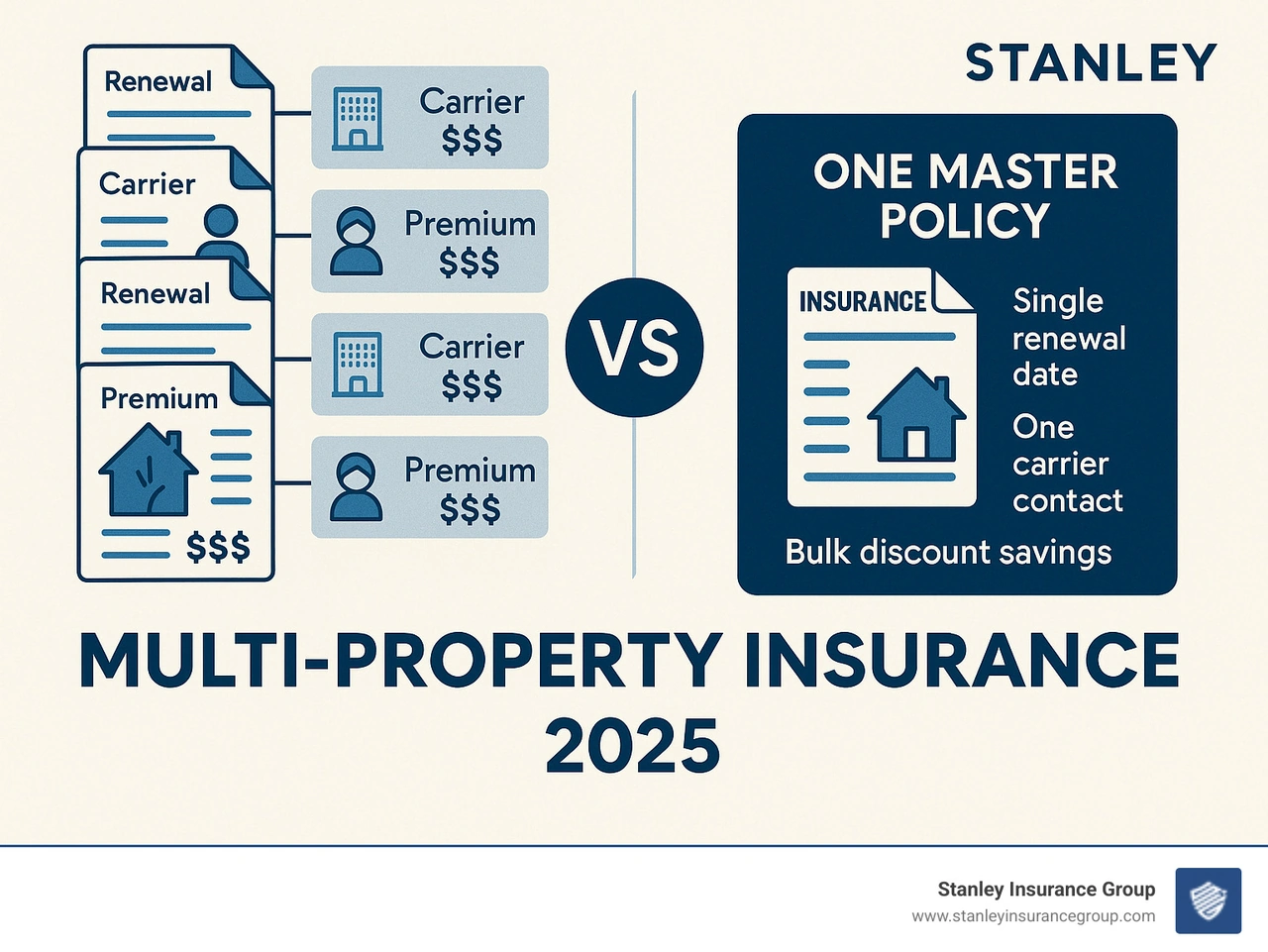
- One policy covers multiple properties - eliminates juggling different renewal dates and carriers
- Cost savings - insurers typically offer bulk discounts for multiple properties (average savings of 25% reported)
- Simplified management - single renewal date, one contact for claims and questions
- Scalability - easily add or remove properties as your portfolio grows
- Consistent coverage - same protection standards across all properties
Most insurers require a minimum of 4 properties to qualify for multi-property coverage, though some accommodate portfolios starting at 2-3 properties. For extensive portfolios of 10 or more properties, specialized master policies become essential for efficient management.
The insurance landscape can be complex when you're managing multiple rental properties. As one industry expert noted, "Combining multiple properties under a single master policy can offer many benefits" including simplified renewals and potential cost efficiencies.
I'm Brandon Stanley, President of Stanley Insurance Group, and since '84 our independent agency has helped property owners in the Columbus area steer multi property insurance solutions with the personalized, concierge-level service that only independent agents can provide. Our experience with commercial and residential property portfolios allows us to build lasting relationships while finding the right coverage for your unique investment strategy.
What is Multi-Property Insurance and Why Do You Need It?
As real estate investors, we know the excitement of growing our portfolio. With each new property we add, we gain more opportunities – and more responsibilities. One big responsibility is making sure each of our valuable assets is well-protected. This is where multi property insurance, also known as a master policy or portfolio insurance, steps in. It's not just a nice-to-have; it's a smart and necessary strategy for landlords who own several residential or commercial properties. It makes protecting your investments much simpler, all under one easy plan.
Why do we need it? Imagine trying to manage ten or even twenty different insurance policies. Each one would have its own renewal date, payment schedule, and rules. Keeping track of all that can be a huge headache! Plus, it increases the risk of missing a payment or having your coverage suddenly stop. That's why multi property insurance is so valuable – it brings everything together into one clear, efficient solution.
Defining a Master Policy for Multiple Properties
At its core, a master policy for multiple properties is a single insurance agreement that covers several different locations. Instead of buying a separate policy for each rental unit you own, all your properties are listed and covered under one main plan. Think of it like adding more cars to your existing auto insurance. You don't get a whole new policy for each car; they all go under the same umbrella.
This approach means you'll have just one renewal date to remember, one main premium payment (though we can often break down costs per property for your accounting), and one contact for all your insurance needs. This is a big change from insuring each property individually, which can be a real time-waster and often costs more in the long run.
The Key Benefits of a Consolidated Approach
The advantages of putting all your rental property insurance together are pretty compelling. They offer both financial savings and a whole lot of peace of mind.

Simplified Management: This is often the first benefit landlords notice. With just one policy, you have only one renewal date to keep in mind, one set of rules to understand, and one insurance company to talk to. This dramatically cuts down on the paperwork and time you spend managing your properties' protection. It also greatly lowers the chance of your coverage lapsing because you missed a deadline – a common problem when dealing with many individual policies.
Cost Efficiency: Insurance companies often give great discounts when you combine several properties under one policy. While the exact savings can change, many landlords save a good chunk of money compared to insuring each property separately. This is because it costs the insurer less to handle one big policy, and they pass some of those savings on to you. We've seen landlords save an average of 25% by choosing this combined approach!
Scalability: Your property portfolio isn't static. You might buy new properties or sell existing ones. A multi property insurance policy is built to be flexible. It lets you easily add or remove properties as your investments grow and change. When you add a new property, the premium is simply adjusted for the rest of your policy term, making your expansion smooth and easy.
Consistent Coverage: A master policy makes sure that all your properties get the same level and type of protection. This means you don't have to worry about comparing different policy wordings or finding unexpected gaps in coverage across your various properties. It creates a steady safety net, which is super helpful when you have properties with similar risks.
Stronger Relationship with Your Insurer: By putting all your insurance business with one provider, you build a stronger bond with them. This can lead to more personal service, a better understanding of your unique needs, and possibly even better terms over time. That's exactly the kind of relationship we aim for here at Stanley Insurance Group, where our team, including Commercial Lines expert Amy and Account Specialists Ana and Sandra, offers that special concierge touch.
For more details on how to protect your rental properties, you can visit our page about Landlord Insurance.
Core Coverages and Cost Factors for Your Portfolio
When you're building a rental property portfolio, understanding what you're actually protecting becomes crucial. Multi property insurance isn't just about having coverage—it's about having the right coverage that truly shields your investments from the unexpected. Let's break down what really matters when it comes to protecting your properties and what drives those premium costs.
Essential Coverages for Landlords
Think of your rental property insurance as a safety net with several layers. Each layer protects a different part of your investment, and together they create comprehensive protection for your portfolio.
Building structure coverage forms the foundation of your protection. This covers the physical dwelling and any detached structures like garages or sheds against perils such as fire, wind damage, lightning, and vandalism. Here's what's important: make sure this coverage reflects the full replacement cost of your property, not just its market value. Being underinsured is one of the biggest mistakes landlords make.
Landlord-owned contents coverage protects the items you own that stay with the property. We're talking about appliances like washers, dryers, and refrigerators, plus maintenance equipment and any furniture in furnished rentals. Your tenants' belongings are their responsibility, but your property investments need your protection.
Liability coverage might be the most critical protection you carry as a landlord. When someone gets hurt on your property or your property causes damage elsewhere, this coverage steps in to handle medical payments, legal defense costs, and any settlements. Slip-and-fall incidents happen more often than we'd like to think, and a burst pipe that damages a neighbor's unit can get expensive quickly.
Loss of rental income coverage keeps your cash flow protected when disaster strikes. If a fire or storm makes your rental uninhabitable, you're still facing mortgage payments and other expenses while losing rental income. This coverage replaces that lost income during repairs, helping maintain your investment's financial stability.
Beyond these basics, consider equipment breakdown coverage for those essential systems like HVAC units and water heaters that keep tenants happy and properties functional. Depending on your location, you might also need flood insurance (standard policies don't cover floods), earthquake coverage, or protection against sewer backup and water damage.
For larger portfolios, commercial umbrella insurance provides an extra layer of liability protection, often up to $10 million. It's the kind of comprehensive coverage approach we help clients steer every day at Stanley Insurance Group.
For more detailed information about protecting your rental investments, check out our comprehensive guide on Commercial Property Insurance.
What Influences Your Premium?
Your multi property insurance premium isn't pulled from thin air—insurers look at specific factors that help them understand the risk they're taking on with your portfolio.
Total insured value represents the combined replacement cost of all your properties and contents. It's straightforward math: higher values generally mean higher premiums, but the bulk discount from a master policy often offsets much of this increase.
Location plays a huge role in your costs. Properties in areas prone to natural disasters or high crime will cost more to insure. A rental property in Ohio faces different risks than one in Florida's hurricane zone. You can check your property's flood risk directly through FEMA's flood maps to understand this specific exposure.
Building age and condition significantly impact your rates. Older buildings with outdated electrical, plumbing, or roofing systems present higher risks. However, recent upgrades to these systems can actually lower your premiums—insurers reward risk reduction efforts.
Safety features and loss prevention measures can substantially reduce your costs. Security systems, sprinkler systems, water detection devices, and even something as simple as deadbolt locks show insurers you're serious about protecting your investment.
Your claims history follows you in the insurance world. Properties with frequent claims may face higher premiums or even exclusion from master policies. Clean claim records, on the other hand, often qualify for preferred rates.
Deductible choices give you some control over your premium costs. Higher deductibles lower your premium, but make sure you're comfortable with the out-of-pocket amount you'd pay when filing a claim.
The number and type of units in your portfolio also matter. A portfolio of single-family homes presents different risks than a multi-unit apartment building, and insurers price accordingly.
Understanding these factors helps us work together to find coverage that protects your investments without breaking the bank. For more insights into how these elements affect your overall insurance investment, explore our detailed guide on Property Insurance Cost.
Finding the Right Multi-Property Insurance Strategy
Navigating the complexities of multi property insurance requires a thoughtful approach. It’s not just about getting the cheapest rate, but about finding the most comprehensive and efficient coverage that truly protects our valuable assets. This involves a careful risk assessment and understanding when a consolidated policy is the best fit for our specific portfolio.
When is a single multi-Property Insurance Policy Best?
A single, consolidated multi property insurance policy truly shines in several scenarios, offering unparalleled convenience and potential savings.

If you're growing your portfolio, a master policy makes management incredibly simple. Think about it: you can easily add new properties as you acquire them, ensuring immediate and consistent coverage without the headache of setting up a brand new policy each time. This flexibility is a huge advantage for active investors.
Another great fit is when your properties share similar risk profiles. For example, if you own several single-family homes in the same general area, a master policy provides uniform coverage that aligns perfectly with their shared risks. It keeps things consistent and easy to understand.
For busy landlords and investors, the desire for simplicity is a big win. A single policy means less paperwork, fewer renewal dates to track, and a streamlined payment process. This frees up valuable time that you can spend on managing your properties, working with tenants, or even finding your next great investment. Plus, the cost efficiency from potential bulk discounts is a significant draw. Insurers are often happy to offer more favorable terms when you bring a larger group of properties under one roof.
Now, let's clear up some common thoughts about master policies. Some folks worry that if one property has a lot of claims, it'll automatically raise the rates for all properties on the policy. While an insurer might look closely at a property with too many claims, it doesn't always mean your entire portfolio will be penalized. Also, master policies are surprisingly flexible! You can add or remove buildings anytime, and premiums are adjusted fairly. Even payment terms can often be customized, sometimes allowing for separate billing per property to match your mortgage schedule.
For a deeper dive into the ins and outs of master policies and to bust more myths, we recommend checking out resources like Understanding master policies for building owners.
Ensuring Adequate Coverage for Your Portfolio
Securing the right multi property insurance is a critical step in your real estate investment journey. It’s about more than just checking a box; it’s about strategically protecting your financial future. Here’s how we can help make sure you have solid coverage for all your properties:
First, let's inventory all your properties. This means making a complete list of every property you own. Include its address, what type of property it is (like a single-family home, a duplex, or a commercial building), and if it's currently rented out. This simple step is key to getting an accurate insurance assessment.
Next, it's crucial to calculate the replacement cost, not just the market value. This is super important! You need to know how much it would truly cost to rebuild each property from the ground up if something major happened, including clearing away debris. Market value (what the property would sell for) is often very different from replacement cost. Relying on market value can leave you severely underinsured after a total loss, and nobody wants that surprise.
You'll also want to assess your liability limits. Think about the potential for someone getting hurt on your property. For larger portfolios, especially if you have common areas or lots of foot traffic, a commercial umbrella policy is a fantastic idea. It adds millions in extra protection above your main policy limits, giving you serious peace of mind.
Then, let's review your deductibles. This is the amount you pay out-of-pocket before your insurance kicks in. Choosing a higher deductible can lower your premium, but make sure it's an amount you'd be comfortable paying if you ever have a claim. It's about finding that sweet spot.
We'll also help you identify any unique risks. Are any of your properties in a flood zone? Do you have older buildings that might need special "ordinance or law" coverage for code upgrades if repairs are needed? Let's talk about these specific situations so we can tailor your policy perfectly.
Depending on your operations, you might even need to consider specialty coverages. For example, if you have employees, Employment Practices Liability Insurance (EPLI) could be important. Or, if you handle sensitive tenant data, Data and Cyber Response coverage might be something to look into.
Perhaps the most crucial step of all is to partner with an independent agent. And that's where Stanley Insurance Group comes in! Since '84, our team has been dedicated to finding the best insurance solutions for our clients. As an independent agency, we work for you, not just one insurance company. This means we can compare rates and coverage options from many different insurers to find the absolute best fit for your unique portfolio. We provide that personalized, concierge-level service that only independent agents can offer, truly building relationships with our clients. Our team, including Amy, our Commercial Lines expert, Account Specialists Ana and Sandra (who are also Spanish-speaking to better serve our diverse community), and Associate Agents Kaisen, Ethan, and Chase, are all here to provide unbiased advice and a broader range of solutions for your complex portfolio.
For a detailed guide on selecting the best coverage for your extensive property holdings, you can explore our insights on Best Landlord Insurance for Multiple Properties.
Frequently Asked Questions
It’s completely normal to have questions when you’re navigating multi-property insurance. Many real estate investors, just like you, come to us with similar concerns. We're here to help make it all crystal clear!
Can I insure different types of properties on one policy?
This is a fantastic question, and one we hear often! The good news is, yes, it's often possible to include various types of residential rental properties under a single multi property insurance policy. So, if your portfolio includes a mix of single-family homes, cozy duplexes, and even larger apartment buildings, many insurers will allow them to be bundled together.
However, things get a little different when you mix residential with commercial properties, like a retail space or an office building. While some mixed-use properties (think apartments above a ground-floor shop) might occasionally be included, it's generally recommended to keep commercial properties on a separate policy. Why? Because commercial spaces have their own unique set of risks and often require very specific coverages – like different types of business interruption insurance or specialized liability protection – that just don't quite fit a standard residential landlord policy. Don't worry, an experienced independent agent, like the team at Stanley Insurance Group, can easily help you figure out the best approach for your specific, diverse portfolio.
Can I include my primary residence on a landlord policy?
This is a common thought, but the short answer is no, you typically cannot include your primary residence on a landlord or multi property insurance policy. Think of it this way: these policies are specifically designed to cover properties that you don't live in – your non-owner-occupied rentals. Your own home, where you lay your head at night, needs a separate homeowner's insurance policy. This special policy is crafted to cover the unique risks of an owner-occupied dwelling, protecting your personal belongings and offering personal liability coverage as a homeowner. Trying to insure your primary home under a landlord policy would be like trying to fit a square peg in a round hole, and it could unfortunately lead to denied claims if something ever went wrong.
How many properties do I need to qualify for multi-property insurance?
That's a great question, and the answer can vary a bit from one insurance provider to another. As a general rule of thumb, many insurers start offering dedicated multi property insurance solutions for real estate investors who have four or more properties. This is often where the real efficiency and cost savings of a master policy truly shine.
However, don't despair if your portfolio isn't quite that large yet! Some forward-thinking providers are flexible and may offer bundled solutions for smaller portfolios, even starting with just two or three properties. And if you're a seasoned investor with a truly extensive portfolio – say, 10 or more properties – you might even qualify for a highly specialized master policy that offers even greater efficiencies and potentially unique terms custom just for you.
The very best way to find out if your specific portfolio qualifies and to explore all your options is to have a chat with an experienced independent insurance agent. At Stanley Insurance Group, since '84, we've been helping property owners like you find the right fit. We work with multiple carriers, meaning we can shop around on your behalf to find the perfect solution for your unique situation. We build relationships, offering that concierge service you deserve, and yes, we even have Spanish-speaking agents available, like Ana and Sandra, ready to assist!
Conclusion: Protect Your Portfolio with the Right Partner
As real estate investors, our portfolios represent significant investments that require robust protection. Multi property insurance offers a powerful solution, simplifying management, reducing costs, and ensuring consistent, comprehensive coverage across all our assets. From the administrative ease of a single renewal date to the financial benefits of bulk discounts, the advantages of a consolidated approach are clear.
However, navigating the nuances of property valuation, liability limits, and specialized coverages requires expertise. This is where partnering with the right insurance advisor makes all the difference. At Stanley Insurance Group, we pride ourselves on providing that personalized, concierge service. Since '84, our independent agency has been building relationships within the communities we serve, including Columbus, Hilliard, Dublin, and Arlington, Ohio, as well as Pennsylvania, Tennessee, North Carolina, South Carolina, and Florida.
We understand that the insurance industry is constantly evolving, driven by technological advancements and changing risk landscapes. Our longevity in the business, combined with our ability to represent multiple insurance companies, ensures we can adapt and find the optimal solutions for your unique needs. We believe in the power of the human touch; our dedicated team, including our Commercial Lines expert Amy, and our friendly Account Specialists Ana and Sandra (yes, they're Spanish-speaking too!), alongside our Associate Agents Kaisen, Ethan, and Chase, are here to offer expert advice and support, ensuring you understand every aspect of your coverage. In fact, we are one of only 100 independent agencies in the country with a special partnership with Geico – a true testament to our commitment to offering diverse options and truly exceptional service.
While we've focused on multi property insurance today, as a full-service agency, we're also here to help you with your homeowners, auto, life, and other business insurance needs. We invite you to experience the difference of working with an independent agency that prioritizes your success and peace of mind. Let us help you protect your real estate investments, so you can focus on what you do best: growing your portfolio.
Similar posts


