
Choosing the Right Umbrella Policy for Your Portfolio
Discover the perfect umbrella policy for investors. Protect your real estate portfolio from lawsuits with expert tips on coverage, costs & FAQs.
Why an Umbrella Policy for Investors Is Your Most Important Asset Protection Tool
An umbrella policy for investors is extra liability coverage that kicks in after your standard home, auto, or landlord policy limits run out — protecting your savings, properties, and future income from large lawsuits.
Here's what you need to know at a glance:
- What it covers: Injuries on your property, auto accidents, libel, slander, and legal defense costs beyond your primary policy limits
- Who needs it most: Landlords, high-net-worth individuals, and anyone with rental or investment properties
- Personal vs. commercial: Personal umbrella policies often exclude rental and investment properties — investors typically need a commercial umbrella
- How much: Coverage usually starts at $1 million and can scale to $5 million or more
- Key requirement: You must carry minimum underlying liability limits on your home and auto policies before an umbrella policy applies
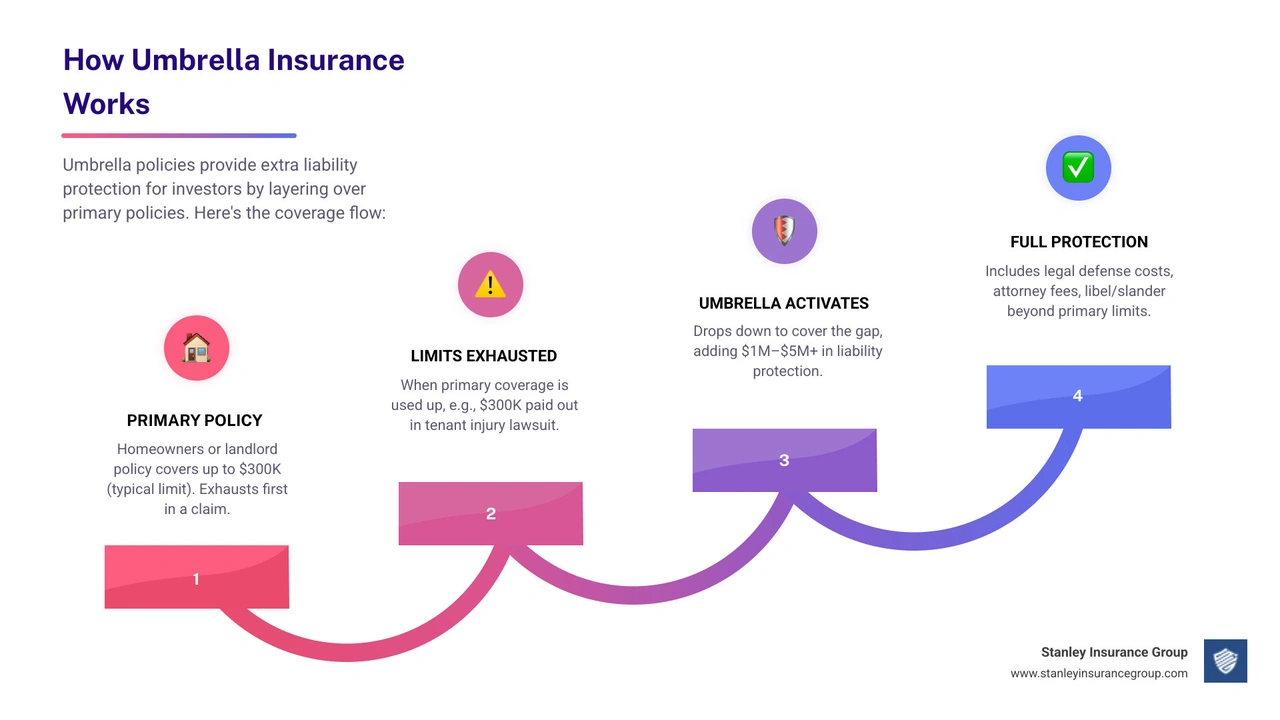
One lawsuit can change everything. A tenant slips on an icy walkway. A visitor is injured at your rental property. A court awards $1.3 million in damages — but your landlord policy only covers $300,000. That $1 million gap doesn't disappear. It comes out of your pocket, your savings, or the equity you've built in your properties.
Standard home and landlord policies were never designed to handle the scale of liability that comes with owning investment properties. Yet many investors assume they're covered — until they're not.
That's the core problem this guide addresses.
I'm Brandon Stanley, President of Stanley Insurance Group, and since 1984 we've helped property owners, landlords, and investors in the Hilliard, Ohio area find the right umbrella policy for investors to close dangerous coverage gaps. In this guide, I'll walk you through exactly how these policies work, what they miss, and how to choose the right coverage for your portfolio.
Understanding the Umbrella Policy for Investors
At its core, an umbrella policy is a fail-safe. Think of your primary liability coverage—like your homeowners, auto, or landlord insurance—as your first line of defense. These policies usually have a "cap" or a limit, often between $300,000 and $500,000. In today’s litigious world, especially in states like Ohio, Pennsylvania, or North Carolina, a single serious injury can blow through those limits in a heartbeat.
When those primary limits are exhausted, the umbrella policy for investors "drops down" to cover the rest. But it does more than just pay the settlement. One of the most significant benefits of an umbrella policy is that it typically covers defense costs and attorney fees. If you are sued, the legal bills alone can reach six figures before a judge even makes a ruling. An umbrella policy ensures those costs don't drain your bank account.
Furthermore, umbrella policies often provide "broader" coverage than your underlying policies. While a standard landlord policy focuses on bodily injury and property damage to others, an umbrella policy can protect you against "personal injury" claims. This includes:
- Libel and Slander: Protection if you are sued for something you said or wrote.
- Invasion of Privacy: Critical if a tenant claims you entered their unit illegally or mishandled their data.
- Defamation: Protection against claims of damaging someone's reputation.
For more details on how these layers work, you can explore our umbrella insurance services.
Primary Liability Limits vs. Umbrella Coverage Benefits
Primary liability coverage and umbrella coverage work together, but they play different roles:
- Typical limits: Primary home, auto, or landlord liability limits often range from $100,000 to $500,000, while umbrella coverage can add $1 million to $10 million or more in additional protection.
- Legal defense: Primary policies may include legal defense either within or outside the policy limit. Umbrella coverage can provide additional support for legal fees once the underlying policy is exhausted.
- Libel and slander: These claims are often excluded from primary liability coverage, but they are typically included under umbrella coverage.
- Worldwide coverage: Primary policies are often limited to the U.S. and Canada, while umbrella coverage may provide broader worldwide protection.
- Asset protection: Primary liability coverage protects you only up to the policy cap. Umbrella coverage helps protect your net worth, property equity, and future income when a major claim exceeds those limits.
Personal vs. Commercial: Why Your Policy Might Fail
This is where many investors get into trouble. We often see clients who have a "Personal Umbrella Policy" (PUP) and assume it covers their rental properties. Unfortunately, this is a dangerous myth.
Most personal umbrella policies contain a Business Venture Exclusion. If you own a property through an LLC or if you are generating significant revenue from multiple rentals, your personal insurer may classify this as a business. If a claim arises from one of those properties, the personal umbrella may extend zero coverage.
Underwriting for personal lines is vastly different from commercial lines. A personal policy is designed for your primary residence and your personal vehicles. A commercial policy is designed for the unique risks of being a landlord—tenant disputes, multi-unit hazards, and property management liabilities.

When to Choose a Commercial Umbrella Policy for Investors
Determining when to make the jump from personal to commercial depends on a few factors:
- Portfolio Size: If you own more than one or two single-family homes, you are likely in commercial territory.
- LLC Ownership: If your properties are deeded to an LLC, a personal umbrella will almost certainly fail to protect the entity.
- Multi-Family Units: Apartment buildings or complexes with shared spaces (hallways, stairs, parking lots) carry much higher "slip and fall" risks.
- Risk Appetite: If you want to ensure that one bad loss at a property doesn't wipe out your entire LLC's assets, a commercial umbrella is the way to go.
For investors growing their portfolio, we highly recommend reviewing our commercial umbrella insurance services to ensure your business entity is actually protected.
Common Exclusions in an Umbrella Policy for Investors
No policy covers everything. Even the best umbrella policy for investors will have exclusions. You need to watch out for:
- Intentional Acts: If you intentionally cause harm or damage, no insurance policy will bail you out.
- Property Damage to Your Own Assets: Umbrella insurance is liability insurance. It pays others for damage you caused; it does not pay to fix your own roof after a storm.
- Professional Liability: If you are a real estate agent or a property manager and you make a professional error (like a contract mistake), you need Errors & Omissions (E&O) insurance, not an umbrella policy.
- Pollution Exclusions: This is huge for older properties. Claims involving lead paint, asbestos, or even carbon monoxide can sometimes be excluded depending on the policy language.
- Dog Bites: If you allow tenants to have high-risk dog breeds, ensure your policy doesn't have a specific canine exclusion.
Umbrella vs. Excess Liability: Choosing the Right Layer
In the insurance world, people often use the terms "umbrella" and "excess liability" interchangeably, but they are technically different.
An Excess Liability Policy is like a "follow-form" policy. It adds more money to one specific primary policy. For example, if you have a $500,000 limit on a rental property, a $1 million excess policy gives you $1.5 million total for that specific property only.
A True Umbrella Policy can sit over multiple lines of coverage. It might cover your rental properties, your commercial auto, and your general business liability all at once. Furthermore, an umbrella can "drop down" to provide first-dollar coverage for certain risks that weren't even covered by the primary policy (subject to a "Self-Insured Retention" or SIR, which is like a high deductible).
According to Mass.gov, a personal umbrella provides that broader protection, whereas excess is strictly about the dollar amount. For investors with diverse portfolios, the umbrella is usually the superior choice because it fills more gaps.
Calculating Your Coverage: How Much Do You Need?
How much is your peace of mind worth? More importantly, how much are your assets worth? When calculating the right amount for an umbrella policy for investors, we look at three things:
- Your Current Net Worth: This includes your home equity, savings, and the equity in your investment properties.
- Future Earnings: In many states, including Ohio and Florida, a judgment can result in wage garnishment. You aren't just protecting what you have now; you're protecting your future.
- The "Litigiousness" Factor: Are your properties in an area where lawsuits are common? Do you have high-turnover rentals?
Most investors start with a $1 million policy. However, as your portfolio grows, it is often very cost-effective to jump to $2 million or $5 million. The cost per million actually tends to go down as you buy more coverage because the likelihood of a claim reaching the $5 million mark is statistically lower than it reaching the $1 million mark.
To help you decide, check out our post on 3 situations where umbrella insurance is necessary.
Determining the Right Umbrella Policy for Investors Based on Risk
Not all properties are created equal. You might need higher limits if your portfolio includes:
- High-Risk Amenities: Swimming pools, trampolines, or fitness centers.
- Old Construction: Properties with older electrical systems or stairs that might not be up to modern code.
- High Unit Count: A 20-unit building has 20 times the liability exposure of a single-family home.
- Student Housing: Historically, properties rented to students carry higher liability risks due to parties and higher foot traffic.
Frequently Asked Questions about Investor Liability
What are the typical costs and requirements for an umbrella policy?
While we don't quote specific prices here, umbrella insurance is widely considered one of the best values in the industry. For a relatively low annual premium, you get millions in protection. To qualify, insurers will require you to have "underlying limits" on your primary policies. Usually, this means:
- Auto Insurance: At least $250,000/$500,000 in bodily injury coverage.
- Homeowners/Landlord: At least $300,000 in liability coverage.
If your primary limits are too low, the umbrella won't "attach," or you'll be left with a massive gap you have to pay out of pocket. We often suggest bundling your policies with one agency (like us!) to ensure there are no gaps between your primary and umbrella layers.
Should I increase primary limits instead of buying an umbrella?
Some investors ask if they should just raise their landlord policy from $300k to $1 million. While you can do this, it’s often more expensive than buying an umbrella. Also, a primary policy only covers that one location. An umbrella policy provides a blanket of protection over all your properties and your personal life.
However, in some cases, increasing premises liability per location is a smart move to ensure each property has its own dedicated bucket of money. You can learn more about local requirements in our article: Is umbrella insurance required in Ohio?
How do umbrella policies handle multiple property locations?
Most umbrella policies for investors have a "shared limit." This means if you have a $2 million umbrella and five properties, that $2 million is the total available for all claims in a policy year. If a huge claim at Property A eats up $1.5 million, you only have $500,000 left for the other four properties. For larger portfolios, we can structure policies with "per-location aggregates" to ensure each property is fully protected.
Conclusion: Securing Your Financial Future
At Stanley Insurance Group, we’ve been protecting investors Since '84. We aren't just a call center; we are independent agents who believe in the "concierge touch." When you call us, you aren't getting a random operator—you're talking to people like Amy, our commercial lines expert, or Ana and Sandra, who provide dedicated Spanish-speaking help. Our associate agents Kaisen, Ethan, and Chase are here to build a relationship with you, not just sell you a policy.
We are proud to be one of the only 100 independent agents in the country with a partnership with Geico, giving us unique tools to find the best rates across Ohio, Pennsylvania, Tennessee, and the Carolinas.
Whether you’re a first-time landlord in Columbus or a seasoned pro with 50 doors across the Southeast, don't leave your hard-earned equity to chance. One slip, one fall, or one auto accident shouldn't cost you your future.
Protect your assets with an umbrella policy today and let us help you build a shield around your investments. Give us a call—we'd love to hear your story and help you find the perfect fit.
Similar posts


