
Landlord Insurance for Multiple Properties
Protect your rental portfolio with landlord insurance for multiple properties—compare coverage options and get a personalized quote today.
Why Every Landlord with Multiple Properties Needs the Right Insurance
Landlord insurance for multiple properties is a type of coverage that protects real estate investors who own more than one rental unit — often under a single consolidated policy rather than separate policies for each address.
Quick answer: Here's what you need to know about insuring multiple rental properties:
- Yes, you can cover multiple properties under one policy. This is called a portfolio or multi-property landlord policy.
- Core coverages include: property damage, liability protection, and loss of rental income.
- Three main policy structures: scheduled items, endorsements, and blanket policies.
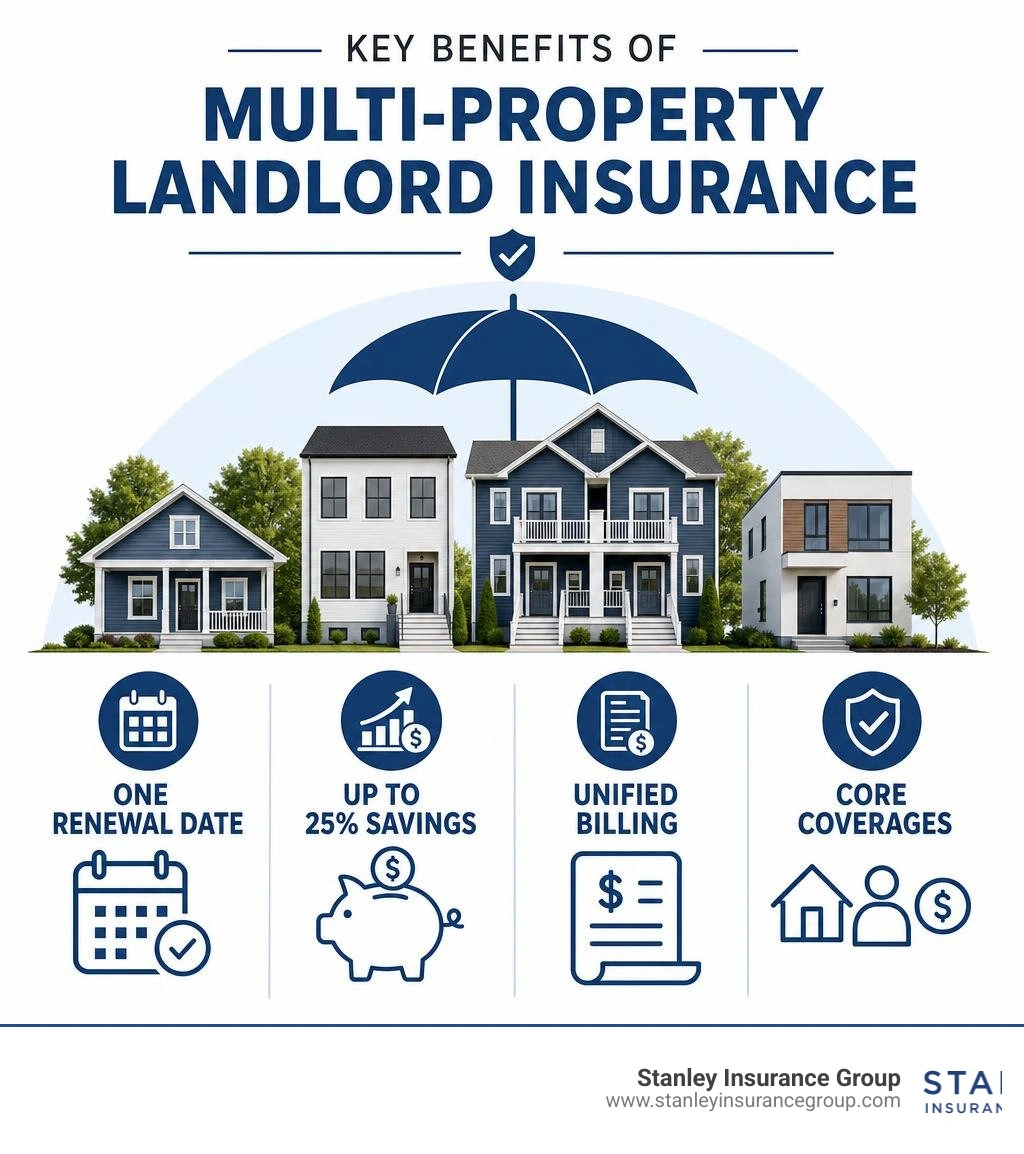
- Key benefit: Landlords can save up to 25% on premiums by bundling properties together.
- Who needs it: Any landlord with two or more rental properties — especially those with five or more.
Owning one rental property is an investment. Owning five or more is a business. And like any business, it comes with risks that standard homeowners insurance simply won't cover.
Most landlords start out with a single rental and a single policy. But as a portfolio grows, managing separate policies for each property becomes costly, confusing, and easy to let slip. A missed renewal or a coverage gap on one property can expose you to serious financial loss.
That's where multi-property landlord insurance comes in — and understanding your options can save you both money and headaches.
I'm Brandon Stanley, President of Stanley Insurance Group, and since 1984 our family-owned agency in Hilliard, Ohio has helped real estate investors find the right landlord insurance for multiple properties — from first-time landlords with a duplex to seasoned portfolio owners with a dozen rentals. As an independent agency, we shop the market on your behalf so you get the coverage that fits your portfolio, not a one-size-fits-all policy.
What is Landlord Insurance for Multiple Properties?
When you own multiple rental properties, managing individual insurance policies for each address is like trying to herd cats. Each policy has its own premium, its own deductible, and worst of all, its own renewal date. It is an administrative nightmare waiting to happen.
Multi-property landlord insurance, often called landlord portfolio insurance, is a specialized coverage solution designed to wrap several rental units under one single policy. This is not just a convenience; it is a strategic business tool. Instead of juggling ten different bills, you pay a single premium and manage one renewal date. It streamlines your overhead and ensures that no property is accidentally left uninsured due to a missed payment or overlooked piece of mail.
Whether you own single-family homes, duplexes, apartment buildings, or mixed-use commercial and residential properties across Columbus, Dublin, or Hilliard, a portfolio policy keeps your business organized. To dive deeper into how these policies protect your bottom line, check out our More info about investment property insurance.
How Multi-Property Policies Differ from Standard Landlord Insurance
A standard landlord policy is written for a single property. It is straightforward, but it scales poorly. If you try to buy ten individual policies, you will pay ten separate policy fees, deal with ten different underwriting processes, and likely miss out on scale-based discounts.
Multi-property policies completely change the game. Instead of treating each home as an isolated risk, insurers look at your entire portfolio. This reduces the administrative burden on both you and the insurance company, which often translates into significant premium savings. Additionally, unified billing means you can align your insurance payments with your business's cash flow cycles, making accounting a breeze. For a comparison of how this differs from personal home coverage, read our Guide to homeowners insurance for multiple properties.
Three Ways to Structure Landlord Insurance for Multiple Properties
When we set up landlord insurance for multiple properties, we typically use one of three main methods depending on the size of your portfolio and your future growth plans:
- Scheduled Items: This is the most common method for growing portfolios. We write one master policy, and each property is listed as an individual "scheduled item" with its own specific coverage limits. This allows you to easily add a new property in Dublin or remove a sold home in Arlington without rewriting the entire policy.
- Endorsements: If you already have a primary landlord policy that you love, we can sometimes add additional properties to that existing policy via an endorsement (also known as a rider). This is a quick way to consolidate when you are just starting to scale.
- Blanket Policies: Ideal for larger commercial portfolios, a blanket policy provides a single, massive limit of liability and property coverage that applies across all your properties. If one property suffers a catastrophic loss that exceeds its individual value, the blanket limit can step in to cover the difference.
To learn more about how these structures work in practice, you can read Obie's guide to multi-property landlord insurance.
Key Coverage Types for Rental Portfolios
Every rental property is exposed to unique risks. A tenant might leave a bathtub overflowing, a storm could drop a tree branch through a roof in Hilliard, or a guest could slip on an icy sidewalk and sue. Your portfolio insurance must be built to handle these scenarios.
To protect your investments, you need a combination of property and liability coverages. Let's break down the essential protections. If you want a comprehensive look at what these terms mean, check out our More info about property insurance coverage.
Core Coverages: Dwelling, Liability, and Loss of Income
A solid portfolio policy is built on three core pillars:
- Dwelling Coverage (Dwelling Fire Policy): This protects the physical structure of your rental properties—the walls, roofs, floors, and built-in appliances. It covers damage from perils like fire, wind, hail, lightning, and vandalism.
- Personal Liability Protection: If a tenant or guest is injured on your property due to a maintenance issue (like a loose handrail or a broken step), you could be held legally responsible. Liability coverage pays for their medical bills and your legal defense fees.
- Loss of Rental Income: If a fire or severe storm makes one of your properties uninhabitable, your tenants will move out, and your rent checks will stop. Loss of income coverage steps in to replace that lost rent while the property is being rebuilt or repaired, keeping your cash flow steady.
For a detailed look at how top-tier carriers structure these core protections, you can refer to the Hiscox UK multi-property guide.
Optional and Specialized Coverages to Consider
While core coverages handle the basics, successful real estate investors know that the devil is in the details. Depending on your properties' locations and conditions, you should consider these optional add-ons:
- Flood Insurance: Standard landlord policies do not cover flood damage. If you own properties near the Scioto River or in low-lying areas of Central Ohio, separate flood coverage is a must.
- Sewer Backup Coverage: This covers the messy and expensive damage caused when water backs up through sewers or drains.
- Builders Risk / Renovation Insurance: If you are actively remodeling a property before putting it on the market, standard landlord insurance may not cover construction-related losses. Builders risk protects the structure and materials during the renovation phase.
- Employers Liability: If you employ on-staff maintenance workers or property managers to look after your portfolio, you are legally required to carry workers' compensation and employers' liability to cover on-the-job injuries.
For more insights into tailoring these specialized coverages, see the Everywhen multi-property landlord insurance resource.
Evolving Needs: Managing 5 or More Rental Properties
As your portfolio grows to five or more properties, your risk profile changes. You are no longer just an investor; you are running a commercial enterprise. The complexity of managing multiple roofs, varied tenant types, and larger cash flows requires a more sophisticated approach to risk management.

At this scale, minor inefficiencies in your insurance coverage can add up to thousands of dollars in wasted capital. To understand how scale affects your premiums, read our More info about property insurance costs.
Transitioning from Individual Policies to Portfolio Coverage
Once you cross the five-property threshold, consolidating your coverage is no longer optional—it is a necessity for survival.
Managing five separate insurance companies, policy documents, and renewal dates is a recipe for disaster. By transitioning to a unified portfolio policy, you streamline your administrative work down to one renewal date and one point of contact. Furthermore, portfolio policies are incredibly flexible; they allow you to mix and match property types. You can have single-family homes, duplexes, and commercial spaces all on the same policy.
To explore how large-scale portfolio management works, take a look at the Endsleigh multi-property landlord insurance guide.
Determining Limits, Deductibles, and ROI
When structuring a large portfolio policy, you must balance premium costs against your tolerance for risk to protect your Return on Investment (ROI):
- Replacement Cost vs. Actual Cash Value (ACV): Always opt for Replacement Cost coverage. ACV only pays out the depreciated value of your property at the time of a loss, which will leave you writing a massive check out of pocket to rebuild. Replacement Cost ensures you can rebuild to modern standards without draining your reserves.
- Deductible Strategy: Raising your deductible is one of the fastest ways to lower your monthly premiums. However, with multiple properties, you must ensure you have enough cash on hand to cover multiple deductibles if a single severe storm damages several homes in the Columbus area simultaneously.
- Umbrella Liability: As your net worth and portfolio grow, so does your target profile for lawsuits. Adding a commercial umbrella policy provides an extra layer of liability protection (often starting at $1 million) that sits on top of your primary landlord liability limits.
For actionable strategies on balancing these costs, check out our guide on Ways to save on insurance.
Comparing Insurance Providers and Cost Factors
The cost of insuring a rental portfolio depends on several key factors: the age and construction of the buildings, their locations (e.g., flood zones or high-crime areas), your claims history, and the types of tenants occupying the units.
Fortunately, because you are insuring multiple properties, you have leverage. Most top-tier carriers offer substantial multi-property discounts. For example, some insurers offer tiered discounts of up to 20% to 25% off your premiums when you bundle multiple addresses under one policy.
To help you visualize the difference, let's compare individual policies versus a consolidated portfolio policy:
Individual landlord policies often mean multiple renewal dates, separate administrative fees, no built-in multi-property discount, several bills, and a higher risk of coverage gaps if a renewal is missed.
A consolidated portfolio policy can simplify the process with one renewal date, one policy fee, unified billing, possible multi-property savings, and lower risk because all properties are managed together.
For specialized local advice on how Ohio laws affect these policies, see More info about landlord insurance in Ohio.
Shopping for Landlord Insurance for Multiple Properties
When it comes to purchasing landlord insurance for multiple properties, you have a few paths to choose from:
- Online Brokers: Great for quick, automated quotes, but they often lack the human touch and the deep local market knowledge needed to navigate complex real estate portfolios.
- Captive Agents: These are agents who work for a single insurance brand. While they can be helpful, they can only offer you products from their specific company. If that company's rates go up, your rates go up.
- Independent Agents (Like Us!): We work for you, not the insurance companies. Since we are not tied to a single brand, we can shop your portfolio across 20+ top-rated carriers (including Nationwide, Progressive, Travelers, and Liberty Mutual) to find the absolute best rates and coverage terms.
To compare this independent approach with other direct-to-consumer options, you can read the Direct Line multiple properties guide.
Frequently Asked Questions about Portfolio Insurance
Can a landlord require renters insurance in Ohio?
Yes! In Ohio, landlords can absolutely require tenants to carry renters insurance as a condition of their lease. This is a highly recommended best practice.
When your tenants have renters insurance, their personal belongings are protected in the event of a fire or theft, which prevents them from trying to hold you responsible. More importantly, renters insurance includes liability coverage. If a tenant accidentally causes a kitchen fire or overflows a sink, their renters insurance policy can pay for the repairs, saving you from having to file a claim on your own landlord policy.
To learn more about how to structure this requirement in your leases, read our detailed article: Can a landlord require renters insurance in Ohio.
How much can I save by bundling multiple properties?
Bundling multiple rental properties under a single portfolio policy can save you up to 25% on your total insurance premiums compared to insuring each property individually. Insurance companies love large portfolios because they represent stable, long-term business, and they pass those administrative savings directly to you.
For more details on how these discounts are structured for mixed portfolios, check out the Superscript mixed portfolio guide.
What happens if one of my properties is vacant?
Vacancy is one of the highest-risk periods for any landlord. When a property sits empty during tenant transitions or renovations, risks like burst pipes, vandalism, and undetected fires skyrocket.
Most standard landlord policies have a "vacancy clause" that suspends or severely limits coverage if the property is left empty for more than 30 or 60 consecutive days. If a pipe bursts in an unoccupied home after this window, your claim could be denied. To protect your portfolio, you must notify your agent during vacancy periods so we can add a vacancy endorsement or transition that specific unit to a vacant property policy.
For a deeper dive into managing property risks, read More info about property insurance.
Secure Your Portfolio with the Concierge Touch
At Stanley Insurance Group, we believe that managing a real estate portfolio is hard enough without having to worry about the fine print of your insurance policies. Since '84, our family-owned independent agency has built lasting relationships with Central Ohio landlords, offering a true concierge service model that you simply won't find at a giant chain or online portal.
We don't believe in automated phone trees or generic support queues. When you partner with us, you work directly with named, local experts who understand the Hilliard, Columbus, Dublin, and Arlington markets. Our specialized team is here to protect your hard-earned investments:
- Amy leads our Commercial Lines division, helping seasoned investors structure complex portfolio and commercial property policies.
- Ana and Sandra, our bilingual Account Specialists, are proud to offer dedicated Spanish-speaking support to our diverse community of investors.
- Kaisen, Ethan, and Chase, our responsive Associate Agents, are always on hand to quickly add new properties to your policy, update your coverage limits, or help you navigate a claim.
As independent agents, we have the unique ability to shop your portfolio across more than 20 of the nation's top insurance carriers to find the perfect blend of coverage and cost-savings. Plus, we are proud to be one of only 100 independent agencies in the entire country with a direct partnership with Geico, giving us access to exclusive options that other local agencies can't match.
Whether you are looking to consolidate a few local duplexes or protect a massive commercial real estate portfolio, we are here to help you build a secure, profitable future. Ready to streamline your risk management and maximize your ROI? Get a personalized quote from our team today!
Similar posts


