
Multiple Properties, One Policy: Simplifying Your Homeowners Insurance
Simplify homeowners insurance for multiple properties. Learn how one policy can protect your entire real estate portfolio.
Why Homeowners Insurance for Multiple Properties Matters More Than Ever
Homeowners insurance for multiple properties requires specialized coverage that goes beyond a standard policy. If you own a vacation home, a rental, or a portfolio of investment properties, your primary homeowners policy is not enough. Each property has unique risks, like extended vacancy or tenant-related damages, that require custom protection.
Key Options for Multiple Properties:
- Master Policy: A single policy covering all properties for unified management.
- Landlord Insurance: Essential for rental properties, which are not covered by standard homeowners insurance.
- Second Home Insurance: Specialized coverage for vacation homes with extended vacancy.
- Commercial Lines: For portfolios of four or more properties, often requiring an LLC structure.
- Scheduled Properties: Individual properties listed under one umbrella policy.
While 88% of homeowners have insurance, many don't realize their additional properties may be unprotected. A vacant second home faces different risks than a primary residence, and rental properties need coverage for lost income and tenant liability that standard policies don't provide.
The good news is you don't need to juggle multiple policies. Modern insurance solutions can consolidate your portfolio under streamlined coverage that's easier to manage and often more cost-effective.
I'm Brandon Stanley of Stanley Insurance Group. Since 1984, we've helped Ohio families protect their property portfolios. Our experience with homeowners insurance for multiple properties shows that the right strategy saves money and stress. Let me walk you through how to structure insurance for your unique property mix.
Can One Insurance Policy Cover Multiple Properties?
I'm often asked, "Brandon, can my regular homeowners policy cover my rental property too?" The reality is more nuanced, and understanding it can save you from a costly surprise.
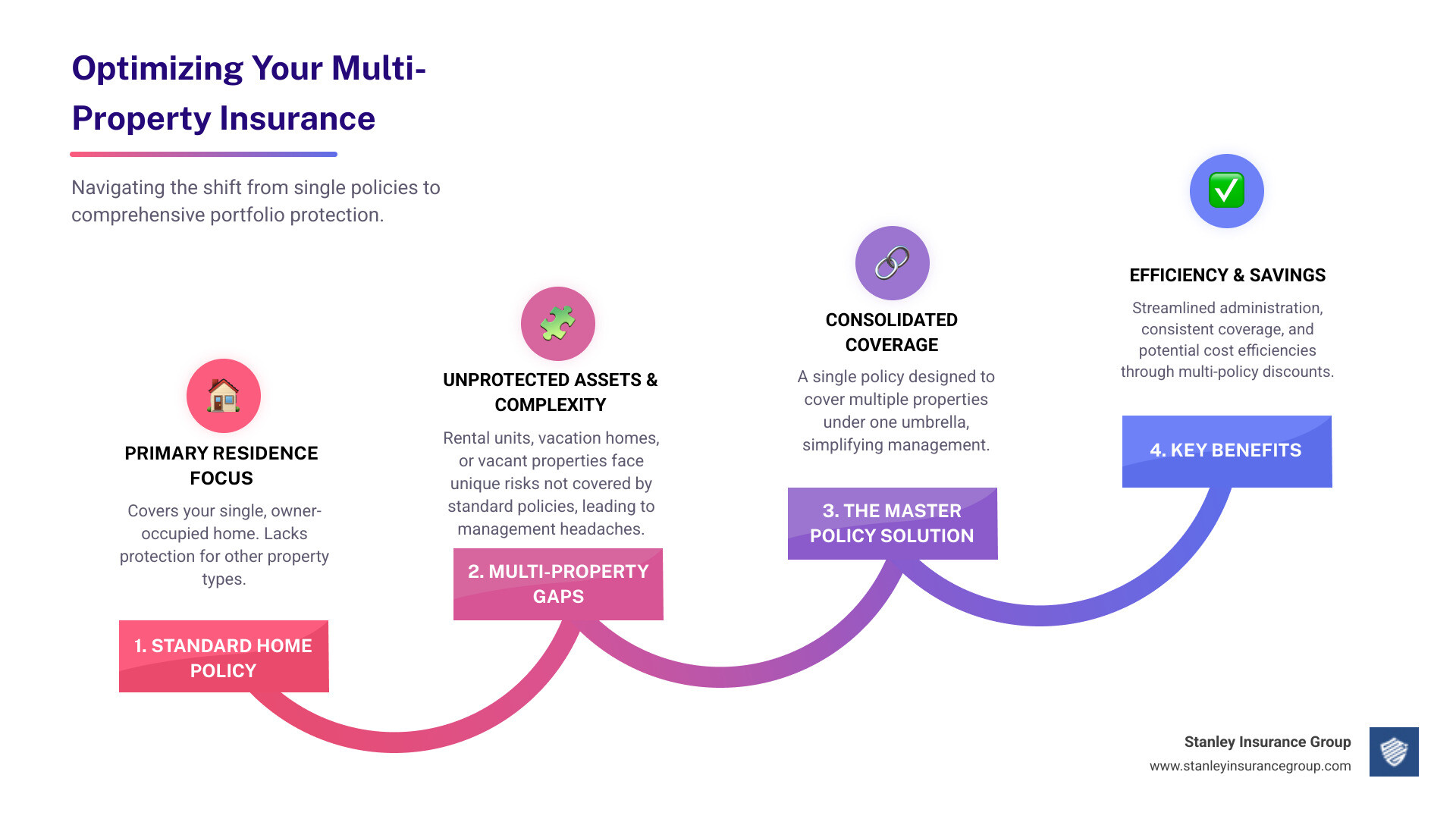
Your standard homeowners policy is built for the home you live in. It's for your primary residence, where someone is usually around to notice if something goes wrong. Once you have a vacation home, rental, or investment property, you're in different territory. A house that sits empty for months faces different risks than your everyday home, like a burst pipe going unnoticed. A tenant-related fire requires coverage your regular policy wasn't designed for.
This is why homeowners insurance for multiple properties involves having the right policies for each property's unique situation. Your lake house needs different protection than your primary residence, and both are worlds apart from a rental property. This is where options like landlord insurance, second home policies, and commercial lines come into play. Learn more about Home Insurance basics here.
Single vs. Multiple Policies
The choice between one comprehensive policy or separate individual policies depends on your needs.
| Feature | Single Multi-Property Policy | Separate Individual Policies |
|---|---|---|
| Management | One renewal date, one bill, one phone number to remember | Multiple dates, bills, and contacts to juggle |
| Cost | Often includes multi-property discounts and streamlined pricing | Individual pricing that may cost more overall but allows precise customization |
| Coverage Consistency | Same terms and conditions across all your properties | Each policy custom to specific risks but potentially creating coverage gaps |
A single policy works well when your properties are similar and in the same area, offering convenience and potential savings. However, separate policies are better when you own diverse properties (e.g., a downtown condo, a beachfront home, and a rental across state lines). Each faces different risks, and a one-size-fits-all policy might be inadequate or too expensive.
The Role of a Master Policy
A master policy for homeowners insurance for multiple properties is an umbrella approach covering your entire real estate portfolio under one plan. Think of it like having all your cars on one auto policy.
- Simplified Management: The biggest win is having one contact, one renewal, and one streamlined process. After nearly four decades in this business since '84, I can tell you this simplicity is invaluable.
- Consistent Coverage: You get the same liability limits and terms across all properties, eliminating gaps that can occur when mixing policies from different companies.
- Cost Efficiency: Insurers often reward consolidation, and we frequently see significant savings when clients bundle properties under a master policy.
- Scalability: Adding a new property to a master policy is much smoother than shopping for a new policy each time.
A master policy isn't for everyone, but when it fits, it transforms the complexity of managing insurance into something far more manageable.
Decoding Your Insurance Options for Different Properties
Think of your property portfolio like a family – each member has different needs and requires unique care. Your primary home, vacation cottage, and rental duplex all have distinct insurance requirements.
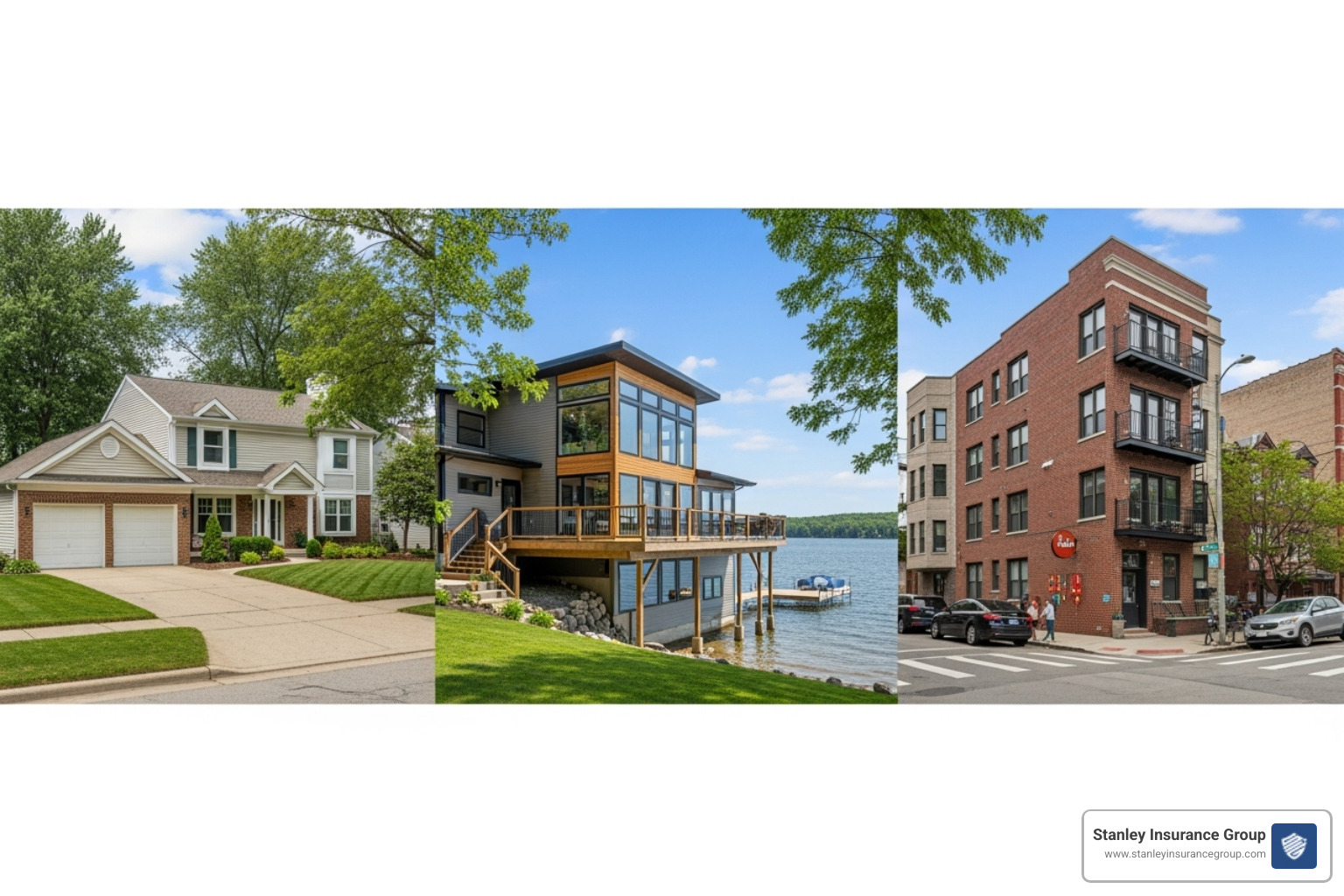
Your primary residence is covered by a standard homeowners policy (like an HO-3), which protects the dwelling, your belongings, and provides liability protection. It assumes you live there full-time.
However, that policy won't cover your weekend lake house. Second homes face different risks because they often sit empty. An undetected burst pipe or storm damage can become a major issue. Vacation rental properties add another layer of complexity, as you're running a small hospitality business with increased liability.
Multi-family properties like duplexes are another category. The right insurance depends on whether you live in one of the units or if it's purely an investment. The key is understanding that homeowners insurance for multiple properties requires matching the coverage to each property's specific use and risk. For more details, see our guide on What Are The Different Types of Home Insurance.
Insurance for Rental Properties
Once you rent out a property, your standard homeowners policy is no longer valid for it. You need Landlord Insurance, which is designed for the unique risks of rental ownership.
- Property Protection: Covers the building's structure against perils like fire, storms, and vandalism.
- Loss of Rental Income: This vital coverage replaces lost rent if a covered event (like a fire) makes your property uninhabitable during repairs. It protects your cash flow when you need it most.
- Liability Protection: Shields you from financial loss if a tenant or visitor is injured on your property and files a lawsuit.
A crucial point for landlords: your policy does not cover your tenant's personal belongings. They need their own renters insurance. Requiring tenants to have renters insurance is a smart practice that protects both parties and clarifies your financial responsibility.
Insurance for Multi-Family Homes
For multi-family properties like duplexes or triplexes, the insurance strategy depends on occupancy.
If you are owner-occupied (living in one unit and renting others), you'll need a specialized homeowners policy that combines personal residence coverage with landlord protections.
If the property is non-owner-occupied, you'll need a dedicated landlord insurance policy (often a Dwelling Fire or DP policy) that focuses on the investment aspects: the structure, landlord liability, and loss of rental income.
Properties with more than four units typically require commercial property insurance. At this scale, you're running a business, and many investors form an LLC for asset protection. Factors like newer construction, modern electrical systems, and security features can help lower your premiums.
The Ultimate Guide to Homeowners Insurance for Multiple Properties
Managing insurance for several properties doesn't have to be overwhelming. Think of homeowners insurance for multiple properties as building blocks that can be arranged to create the perfect protection for your portfolio.

Two main approaches can streamline your coverage: scheduled policies and blanket coverage. A scheduled policy lists each property individually under one master policy, with specific coverage amounts for each. Blanket coverage provides one large limit that applies across all your properties combined, offering flexibility for claims.
The best choice depends on your portfolio. If you own three similar rental homes, blanket coverage might be ideal. But for a mix of a lake cottage, a duplex, and a suburban rental, scheduled coverage might better address each property's unique needs. Learn more about Property Insurance Coverage here.
What a Multi-Property Policy Covers
A well-designed multi-property policy provides consistent protection across your entire portfolio.
- Dwelling Protection: Covers the physical structures against fire, wind, hail, vandalism, and other events. This includes attached structures like garages and decks.
- Liability Coverage: This is crucial when you own multiple properties, as it protects you from lawsuits if someone is injured on any of your properties.
- Medical Payments to Others: Pays for immediate medical expenses if someone is hurt on your property, regardless of fault, which can help prevent lawsuits.
- Loss of Rental Income: For rental properties, this replaces the rent you lose if a covered event makes the property uninhabitable during repairs, keeping your cash flow steady.
Common Exclusions and Endorsements
Understanding what's not covered is just as important as knowing what is.
- Flood Damage: Standard policies do not cover floods. If any of your properties are in a flood-prone area, you need separate flood insurance.
- Earthquake Coverage: This is another common exclusion that requires a separate policy or endorsement.
- Vacancy Clauses: Most policies limit coverage if a property is vacant for more than 30-60 days. This is a key consideration for second homes or rentals between tenants, and you may need a special endorsement.
- Tenant-Caused Damage: Accidental damage is usually covered, but intentional damage or excessive wear and tear may not be. This is why requiring tenants to have renters insurance is so important.
An Umbrella Insurance policy is a smart addition for any multi-property owner. It provides an extra layer of liability protection above your regular policy limits, safeguarding your personal assets from catastrophic claims.
When to Use an LLC for Your Homeowners Insurance for Multiple Properties
As your portfolio grows, think like a business owner. Forming a Limited Liability Company (LLC) creates a legal wall between your personal assets and your rental properties. If a large lawsuit occurs at a rental, only the assets within the LLC are typically at risk, not your personal home or savings.
From an insurance standpoint, once you hold properties in an LLC—especially four or more properties—insurers usually require you to move to commercial lines insurance. This is a positive step, as commercial policies are designed for real estate investors and often provide broader coverage.
Our commercial lines expert, Amy, can guide you through this transition. An LLC also offers simplified tax reporting and professional credibility. It's a natural evolution for successful property investors that centralizes risk management.
Cost and Savings: Getting the Best Rates
Understanding what drives the cost of homeowners insurance for multiple properties is the first step toward saving money.

Several key factors influence your premiums:
- Location and Risk: A property's location is the biggest factor. A lake house may have flood risk, while a mountain cabin could be in wildfire territory. Properties in areas prone to severe weather or high crime will cost more to insure.
- Property Value and Replacement Cost: A more expensive home costs more to insure. Insurers calculate the cost to rebuild from scratch, including modern labor and material costs.
- Age and Construction: A 1950s duplex with original wiring will cost more to insure than a new build. Modern electrical systems, newer roofs, and fire-resistant materials can lower your rates.
- Occupancy and Usage: Your primary residence gets the best rates. Second homes cost more due to vacancy risks, and rental properties have the highest rates because tenants may not treat them as carefully as an owner would.
- Claims History: A history of claims signals higher risk to insurers and can increase your premiums.
Second homes cost more to insure primarily because they are vacant for long periods, and you are not nearby to address maintenance or security issues quickly.
How to Get the Best Rates on Homeowners Insurance for Multiple Properties
Getting great rates is about finding the best value, not just the cheapest price. After nearly four decades in this business since '84, we've learned what works.
- Multi-Policy Discounts: Bundling is your best friend. Insuring multiple properties with one carrier can lead to significant savings, often 15-25%. When you Bundle Home and Auto Insurance, the savings grow.
- Higher Deductibles: Increasing your deductible from $500 to $2,500 can lower your premium significantly. Just ensure you can comfortably cover the higher out-of-pocket cost.
- Safety and Security Improvements: Monitored security systems, smoke detectors, and smart home devices that detect water leaks can earn you discounts. For rentals, deadbolts and good lighting also help.
- Good Credit: In most states, a good credit score can lower your insurance premiums, as it correlates with a lower claims risk.
- Work with an Independent Agent: An independent agent like Stanley Insurance Group shops multiple carriers for you, finding the best fit for your portfolio. Our team, including Amy in Commercial Lines and our Spanish-speaking specialists Ana and Sandra, builds lasting relationships.
- Regular Policy Reviews: We regularly review your policies to see if changes like a new roof or paid-off mortgage can lead to lower rates.
Our concierge approach means we are always looking for Ways to Save Money on Homeowners Insurance for our clients, year after year.
Frequently Asked Questions about Multi-Property Insurance
Over the years helping Ohio families, I've heard the same questions about homeowners insurance for multiple properties. Here are the answers to the most common concerns we address at Stanley Insurance Group.
What's the difference between a standard homeowners policy and landlord insurance?
A standard Home Insurance Policy is for your primary, owner-occupied residence. It covers the structure, your personal belongings, and your personal liability.
Landlord insurance is for properties you rent to others. It protects the building's structure, your liability as a landlord, and can cover your loss of rental income if the property becomes uninhabitable after a covered event. Crucially, it does not cover your tenant's personal property; they need their own renters insurance. Once you rent out a home, you must switch from a homeowners policy to landlord insurance to be properly covered.
Should I get one policy for all my properties or separate ones?
This depends on your portfolio. A single multi-property policy simplifies your life with one bill and one renewal date, and you can often get a discount for bundling. This works well for similar properties in the same state.
Separate policies may be better if your properties are in different states with different regulations or have vastly different risk profiles (e.g., a beach house and a city condo). Different ownership structures, such as a mix of personal and LLC ownership, might also require separate policies. Our team, including our Spanish-speaking specialists Ana and Sandra, can help you determine the most efficient structure.
Is it a good idea to have two insurance policies on the same house?
The short answer is no. Having two policies on one property is not illegal, but it creates major problems and offers no real benefit. You cannot collect double the payout for a loss; insurance is designed to cover your actual loss, and the two insurers would simply split the payment. This process creates an administrative nightmare, involving two adjusters and two sets of paperwork, which can delay your claim for months.
If you feel your coverage is inadequate, the correct solution is to increase the limits or add endorsements to your single, existing policy. Don't create unnecessary complications with a second one. As an independent agency, we can help you find the right coverage amount with the best carrier for your needs.
Conclusion: Partner with an Expert to Protect Your Portfolio
Managing homeowners insurance for multiple properties is complex, but it doesn't have to be overwhelming. As we've covered, each property in your portfolio has unique risks, and a one-size-fits-all policy can leave you dangerously exposed. Custom coverage isn't a luxury—it's essential for protecting your investments.
This is where Stanley Insurance Group excels. Since '84, we've provided Ohio families with a concierge touch that sets us apart. We build genuine relationships, so when you call us, you're connecting with a team that knows you and understands your needs.
As independent agents, we offer true choice. We aren't tied to one company, so we can shop the market to find the best combination of coverage and value for you. In fact, we're one of a select group of independent agencies in the country with a direct partnership with one of the nation's largest insurers, giving us access to options many others can't provide.
Our dedicated team is here to help. Amy specializes in commercial lines for larger portfolios, while our account specialists Ana and Sandra (both fluent in Spanish) provide personalized attention. Our associate agents Kaisen, Ethan, and Chase are always ready to guide you.
Let us provide a personalized portfolio review to identify coverage gaps and find savings. Protecting your real estate investments should bring peace of mind, not sleepless nights.
Ready to simplify your homeowners insurance for multiple properties? Let's talk about protecting your investments so you can focus on growing them. For More info about our property insurance services, we're here to help build the protection your portfolio deserves.
Similar posts