
Adding a Teen Driver to Your Car Insurance: What Parents Need to Know
Learn how Insurance for Teenage Drivers works, why rates rise, and proven ways to cut costs for your teen.
Why Insurance for Teenage Drivers Catches Most Parents Off Guard
Insurance for teenage drivers is one of the biggest — and most unexpected — household expenses a family faces when a teen gets behind the wheel.
Here's a quick snapshot of what parents need to know:
Quick answers for parents:
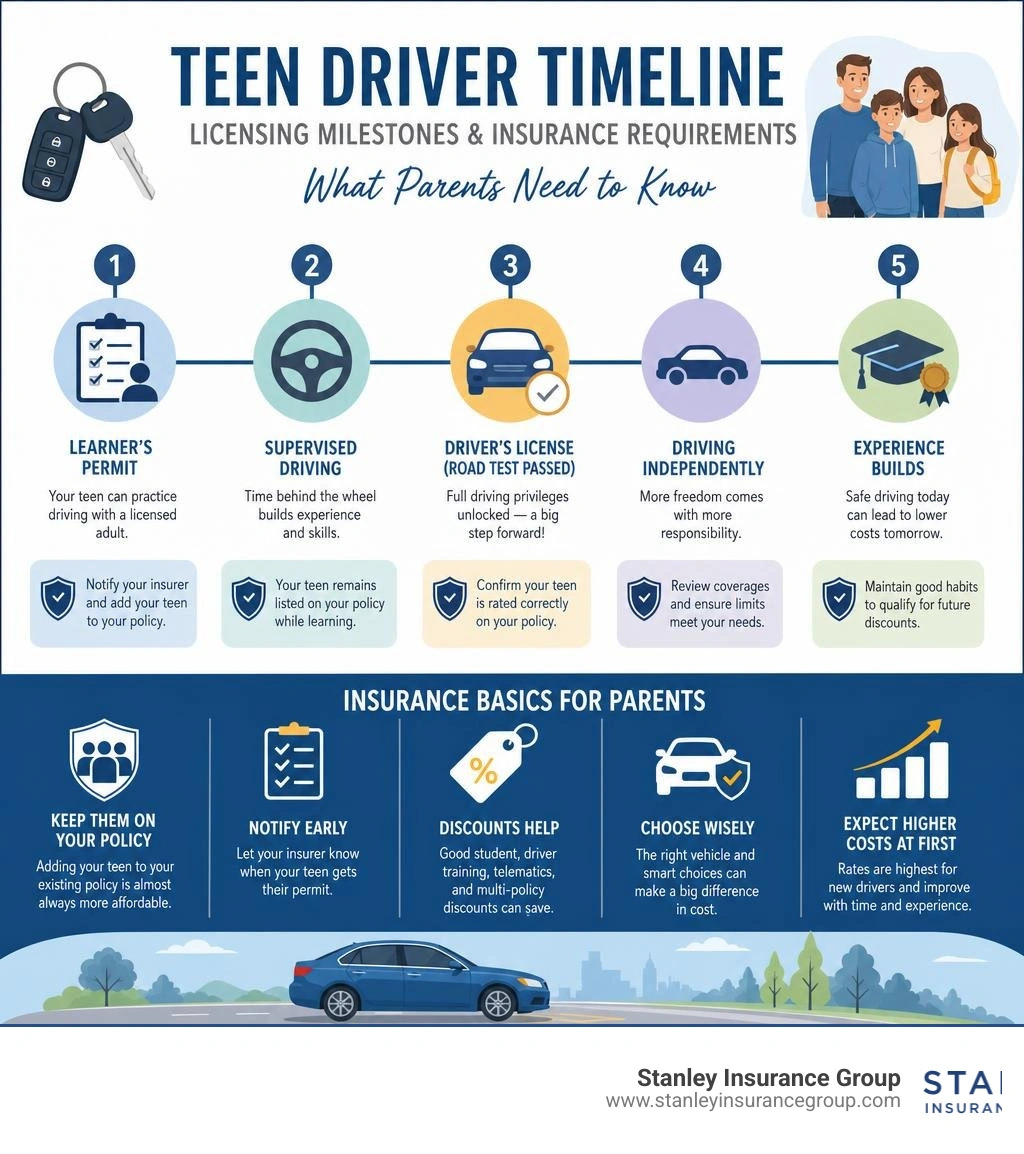
- Add your teen to your policy or get their own? Add them to your existing policy. It is almost always cheaper.
- When should you notify your insurer? When your teen gets a learner's permit, or at minimum, when they pass the road test.
- What discounts are available? Good student, driver training, telematics or usage-based programs, and multi-policy bundling.
- How much will your premium increase? Expect a significant jump. The Insurance Information Institute says premiums can rise 50 to 100 percent.
- Can you lower the cost? Yes. Stacking discounts and choosing the right vehicle can make a meaningful difference.
The moment your teen passes their road test is genuinely exciting. But for most parents, it's quickly followed by sticker shock when the insurance bill arrives. Rates for teen drivers are among the highest of any age group — not because of anything your specific child has done, but because insurers price based on the risk profile of all new drivers as a group. And statistically, that group files claims at a much higher rate than any other.
The good news is that with the right strategy — the right policy structure, the right discounts, and the right vehicle — families can meaningfully reduce what they pay.
I'm Brandon Stanley, President of Stanley Insurance Group, a family-owned independent agency serving Hilliard and the Columbus area since 1984. Over the past four decades, I've helped hundreds of local families navigate insurance for teenage drivers, and I know how confusing — and costly — it can be without the right guidance. In the sections below, I'll walk you through everything you need to know to protect your family and manage the cost.
The Real Cost of Insurance for Teenage Drivers in 2026

When we talk about the cost of adding a young driver to your household auto policy, we aren't just talking about a minor adjustment. In 2026, families across Central Ohio are experiencing a notable upward shift in auto premiums. The overall car insurance market has faced persistent rate increases over the last few years, and youthful operators bear the heaviest burden of these adjustments.
According to data analyzed by Why Teen Driver Insurance Averages $5,700 a Year | Bankrate, adding a teenager to a policy can instantly increase a family's annual auto insurance costs by hundreds or even thousands of dollars. Across the board, rate forecasts for 2025 and 2026 indicate continued double-digit growth for families with youthful operators.
Two primary factors are driving these dramatic increases:
- Claims Severity Inflation: The cost to repair modern vehicles has skyrocketed. With advanced safety sensors, cameras, and driver-assist technology embedded in bumpers and windshields, what used to be a minor fender-bender is now a complex, highly expensive repair job.
- Distracted Driving: Despite widespread awareness campaigns, distracted driving remains a significant risk. Actuarial data shows that high school students frequently admit to texting, emailing, or using social media apps while behind the wheel, which directly correlates to a spike in bodily injury and property damage claims.
Average Premiums for 16 and 17-Year-Olds
The age of your teen plays a massive role in how carriers calculate risk. A 16-year-old driver represents the absolute peak of premium pricing. Statistically, this is the period when a driver is most likely to be involved in a collision due to a pure lack of experience on the road.
As a teen transitions to 17, rates do begin to soften slightly, but they remain exceptionally high. You can explore detailed age-based breakdowns and carrier comparisons in resources like Cheapest Car Insurance for 16-Year-Olds (2026) and Cheapest Car Insurance for 17-Year-Olds (2026).
Gender also introduces a distinct pricing gap. Actuarial historical data consistently shows that male teenage drivers are involved in more severe, high-speed accidents than female teenage drivers. As a result, male teens generally cost noticeably more to insure than their female peers. While this gap begins to close as drivers reach their twenties, it remains a prominent factor during the high school years.
Why Teenagers Cost More to Insure Than High-Risk Adults
It is a bitter pill for many parents to swallow, but a newly licensed, clean-record 16-year-old is actually more expensive to insure than an adult driver with a history of speeding tickets, at-fault accidents, or even certain major violations.
This comes down to systemic risk versus behavioral risk. An adult with a violation has demonstrated poor driving behavior, but they still possess years of structural driving experience—meaning they understand how to react in sudden emergencies, bad weather, or heavy highway traffic. A teenager, by contrast, has zero real-world experience to draw from.
According to the Insurance Information Institute, drivers between the ages of 16 and 19 are involved in fatal crashes nearly three times as often as adult drivers on a per-mile basis. Inexperience accounts for a vast majority of these incidents. When a crisis occurs on the road, a teen's reaction time and decision-making are statistically unrefined.
Because the average teen-at-fault claim is significantly more expensive than an adult-at-fault claim, insurance companies view them as a high-risk category. To learn more about how insurance carriers evaluate and price these elevated risk profiles, you can read our detailed guide on Average Cost for High Risk Car Insurance.
Policy Structure: Adding a Teen vs. Standalone Coverage
One of the first decisions you must make is whether to purchase a standalone policy for your teenager or add them to your existing family auto policy.
In almost every scenario, adding your teen to your policy is the most financially sensible move. A standalone policy for a minor is incredibly expensive because they lose access to critical household discounts, such as multi-car discounts, home-and-auto bundling, and policy longevity rewards. Furthermore, because minors cannot legally sign binding contracts in most states, a parent or guardian would have to co-sign the policy anyway, leaving your household assets exposed to the same liability risks.
By keeping your teen on your family policy, you protect your household assets while taking advantage of your established insurance history. For a deeper dive into structuring coverage for new drivers, check out our resource on Tips for Cheap Car Insurance for New Drivers.
When to Notify Your Carrier: Learner's Permit vs. Full License
A common point of confusion for parents in Hilliard and across Central Ohio is deciding exactly when to notify their insurance agent about their teen's new status.
- The Learner's Permit Phase: In most cases, insurance companies do not charge an additional premium while your teen has a learner's permit. Because a licensed adult must be in the passenger seat at all times, the risk is heavily mitigated. However, you should still notify your agent when your teen obtains their permit to ensure there are no local carrier-specific exceptions.
- The Full License Phase: The moment your teenager passes their road test and receives a provisional or full driver's license, you must notify your insurance carrier immediately. Failing to disclose a newly licensed household member is a major risk. If your teen is involved in an accident and was never officially added to the policy, the carrier has the legal right to deny the claim entirely, leaving you personally responsible for thousands of dollars in property damage and medical bills.
How Insurer Rating Models Affect Insurance for Teenage Drivers
How much your premium increases when adding a teen also depends heavily on the rating model your insurance company uses. Insurers generally use one of two models to assign risk:
- Driver-Vehicle Assignment Model: In this model, the insurance carrier allows you to assign specific drivers to specific vehicles. If you have an older, lower-value sedan and a brand-new luxury SUV, you can request that your teen be listed as the primary driver of the older sedan. This keeps the rate increase manageable because the teen is paired with the vehicle that is cheaper to repair or replace.
- Household-Based Rating Model: Some insurance companies use a model where all drivers are rated across all vehicles. In this scenario, the carrier assumes the highest-risk driver (your teen) has access to the most expensive vehicle in the household, driving up the premium significantly.
As independent agents, we can help you identify which rating model your current carrier uses and shop for alternative options if their rating structure is working against your family's budget.
Strategic Ways to Lower Teen Driver Insurance Costs
While the cost of insurance for teenage drivers is undeniably high, parents are not entirely powerless. By actively managing your policy and stacking specific discounts, you can offset a significant portion of the premium increase. To explore general savings methods, you can read our guide on Ways to Lower Car Insurance for Young Drivers.
Good Student and Driver Training Discounts
Two of the most reliable and traditional ways to lower your teen's premium are academic and educational discounts:
- The Good Student Discount: Insurance companies have long recognized a correlation between academic responsibility and safe driving habits. If your teen maintains a "B" average (a 3.0 GPA) or higher, most carriers will offer a discount ranging from 10% to 25% off their portion of the premium. You will need to submit a report card or official transcript to your agent every semester or school year to maintain this discount.
- Driver Training Programs: Completing an approved driver education course or defensive driving program can yield an additional discount of 5% to 15%. These courses teach critical safety skills, hazard recognition, and defensive maneuvers that help reduce the likelihood of a collision.
To discover more practical ways to keep your household auto expenses under control, take a look at our article on What Are Some Ways to Save on Car Insurance.
Telematics and Usage-Based Insurance for Teenage Drivers
Telematics—or usage-based insurance (UBI)—is one of the most powerful tools available to modern parents. These programs monitor driving behavior in real-time through a mobile app or a small device plugged into the vehicle.
By tracking metrics such as hard braking, rapid acceleration, speed, and late-night driving, carriers can price the policy based on how your teen actually drives, rather than relying solely on group demographics. Programs like Geico's DriveEasy or Nationwide's SmartRide offer an immediate discount just for enrolling, with the potential for much larger savings upon renewal if safe habits are maintained.
For a comprehensive analysis of how telematics can reshape your premium structure, refer to Teen Driver Auto Insurance: True Cost + How to Cut It (2026) | CarSavr. However, parents must be aware that these programs require active monitoring. If your teen consistently engages in hard braking or speeding, the discount can be reduced or eliminated at renewal. We recommend reviewing the app's driving logs with your teen regularly to reinforce safe habits.
Vehicle Selection and State-Specific Factors
The car your teenager drives has a massive impact on your auto insurance premium. Before you head to a local dealership in Columbus or Hilliard, it is highly recommended to consult with your insurance agent to get a quote on the specific vehicle you are considering. You can find more helpful advice in our guide on Tips for Reducing Car Insurance.
Choosing the Right Car for a Teenager
When choosing a vehicle for a new driver, parents often balance two competing priorities: safety and cost. Actuarially, the best vehicle for a teenager is a mid-sized, moderately powered sedan or small SUV with excellent safety ratings.
High-performance or sports cars: Usually the most expensive to insure because they are linked with higher speeds, greater crash risk, and costly repairs.
Large SUVs or heavy trucks: Often carry higher premiums due to increased liability risk, repair costs, and rollover concerns.
Older, reliable sedans with safety features: Often more affordable to insure because they cost less to replace and support safer, more moderate driving.
We strongly advise avoiding high-performance engines, sports cars, and vehicles with high theft rates. Additionally, choosing an older vehicle that is paid off allows you the flexibility to drop comprehensive and collision coverage (physical damage coverage) if the car's market value is low enough, which can instantly cut your teen's coverage costs by 40% to 50%.
State-by-State Rate Trajectories and Mandated Discounts
Auto insurance is regulated at the state level, meaning your geographic location dictates your minimum coverage limits, uninsured motorist rates, and available state-mandated discounts. Here in Ohio, we have specific financial responsibility laws that require minimum liability limits, but we always recommend carrying much higher limits to protect your family's assets from devastating lawsuits.
State-specific trends also affect how quickly rates are rising. Some regions are experiencing dramatic, volatile rate spikes due to high litigation rates and severe weather patterns, while the Midwest and Central Ohio have seen relatively steadier, though still upward, trajectories. For a broader look at regional forecasts and how they compare, you can read Teen Driver Insurance Rate Forecast and 2026 | Parent Teen Insurance.
Frequently Asked Questions About Teen Car Insurance
Can a 17-year-old get their own car insurance policy?
In almost all cases, no. Because a 17-year-old is a minor, they cannot legally sign a binding financial contract like an insurance policy without a parent or guardian as a co-signer. Even if a carrier allows a standalone policy with a co-signer, it will be significantly more expensive than adding them to a family policy.
What happens to rates if my teen goes to college out of state?
If your teen goes to college more than 100 miles away from home and leaves the family car behind, you may qualify for a "resident student" or "distant student" discount. This allows you to keep them on the policy so they are covered when they come home for holidays, but at a heavily discounted rate during the school year.
Does a learner's permit immediately raise my auto insurance rates?
Generally, no. Most insurance carriers do not charge an additional premium while a teenager is driving on a learner's permit, provided they are supervised by a licensed adult. The premium increase is triggered when they receive their provisional or full driver's license.
Conclusion
Navigating insurance for teenage drivers can feel like a daunting task, but you do not have to do it alone.
At Stanley Insurance Group, we have been serving Central Ohio families from our home base in Hilliard since 1984. As an independent agency, we do not work for a single insurance company—we work for you. We have the unique ability to shop and compare policies across more than 20 of the nation's leading carriers, including Nationwide, Progressive, Travelers, Liberty Mutual, Grange, Safeco, and Geico.
In fact, we are proud to be one of only 100 independent agencies in the entire country with a direct partnership with Geico, giving our clients access to unparalleled coverage flexibility. Whether you need to update your Auto & Vehicle Insurance, secure your home with Home & Property Insurance, plan for the future with Life Insurance, or protect your business with Business Insurance, our team is here to build a lasting relationship with your family.
When you call our office, you will experience a true concierge touch. You can work directly with our dedicated team members:
- Amy (Commercial Lines Specialist)
- Ana and Sandra (Account Specialists, offering bilingual support for our Spanish-speaking community members)
- Kaisen, Ethan, and Chase (Associate Agents ready to help you customize your coverage)
Let us handle the comparison shopping so you can focus on celebrating your teen's new milestone. To get started, contact us today to request a personalized Auto Insurance Quote.
Similar posts