
What is Life Insurance and Why Should You Care?
Discover what life insurance is, how it works, and why it matters for your family’s financial security and peace of mind.
Protecting Your Family's Financial Future
Life insurance is a contract between you and an insurance company that provides financial protection to your loved ones after your death. It's designed to replace your income, pay off debts, and provide for your family's future needs.
Key Life Insurance Facts:
- Purpose: Provides financial security for your beneficiaries after your death
- Types: Term life (temporary coverage) and Permanent life (lifetime coverage with cash value)
- Who needs it: Primary breadwinners, parents, homeowners, business owners
- Coverage amount: Typically 10-15 times your annual income
- When to buy: Younger ages secure lower premiums
Life insurance may seem complex, but at its core, it's an act of love – a way to ensure your family's financial security even when you're no longer there. Many people avoid thinking about life insurance because it involves confronting mortality, but understanding its purpose and benefits can bring tremendous peace of mind.
Over half of Americans believe a $250,000 term life insurance policy would cost more than $500 annually, but the reality is much more affordable – often under $200 per year for a healthy 30-year-old. This misconception keeps many families from securing the protection they need.
My name is Brandon Stanley, President of Stanley Insurance Group, where I've helped hundreds of families find the right life insurance protection to secure their loved ones' futures since our founding in 1984. Our independent agency approach means we can customize solutions specifically for your family's unique situation.
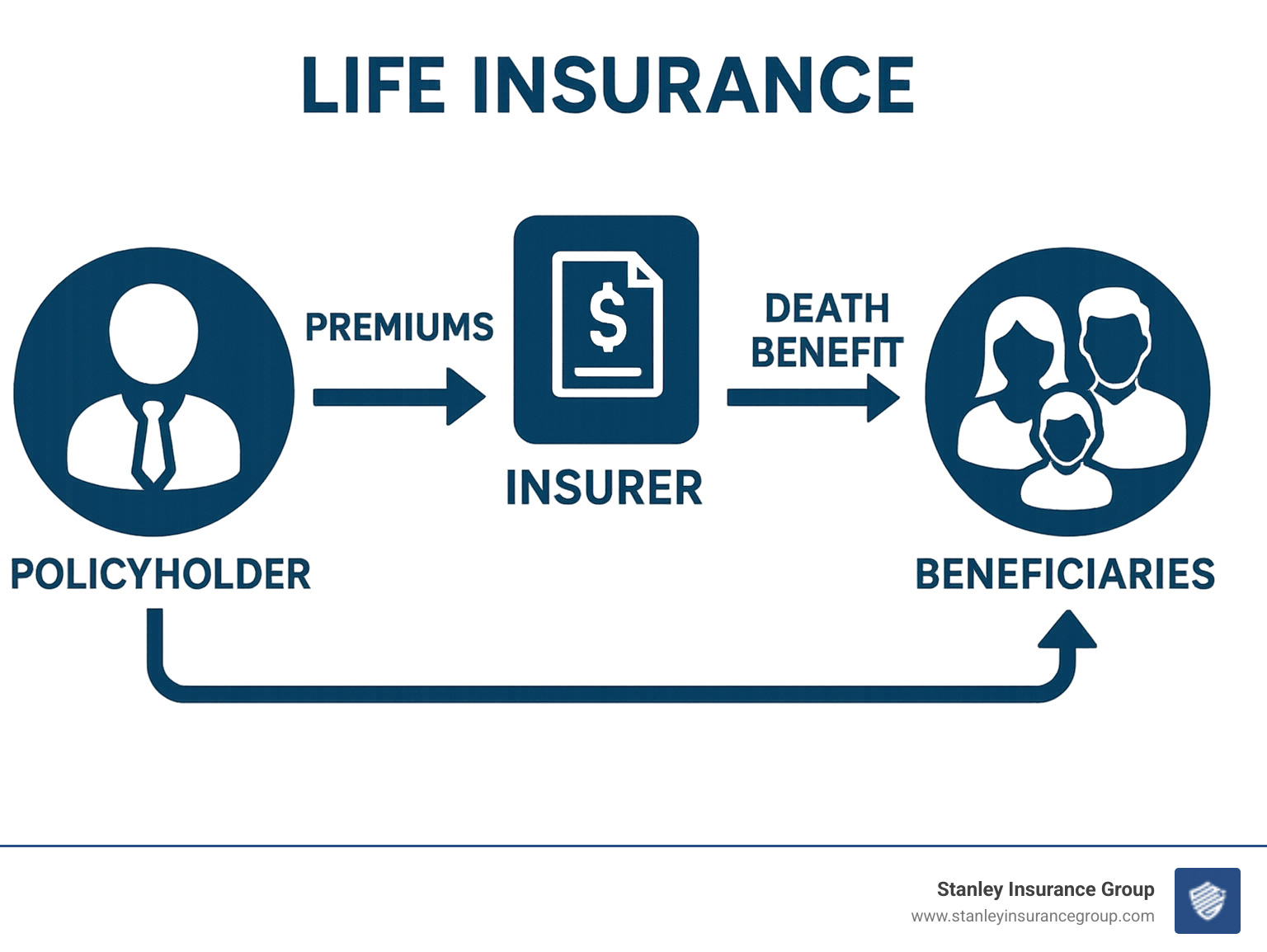
Simple life insurance word guide:
Understanding Life Insurance Basics
Life insurance is really just a promise – you pay a little now so your loved ones receive a lot later when they need it most. Think of it as transferring the financial risk of your passing to an insurance company. You make payments, and they promise to take care of your family financially when you're gone.
Every life insurance policy has a few key players:
- The policy owner (usually you) who controls the policy
- The insured person whose life is covered
- Your beneficiaries – the people who'll receive the money
- The premium payments that keep everything active
- The death benefit – the money paid to your loved ones
- Cash value – the savings component that builds up in permanent policies
Many people think life insurance is something to worry about later in life, but that's actually backwards! The younger and healthier you are when you buy coverage, the less you'll pay over time. Another common myth is that stay-at-home parents don't need coverage. But think about it – replacing childcare, household management, and everything else a stay-at-home parent does would be incredibly expensive.
How Does Life Insurance Work?
The beauty of life insurance lies in its simplicity. You make regular payments to keep your policy active, and if you pass away while covered, your insurance company pays your loved ones the death benefit you selected.
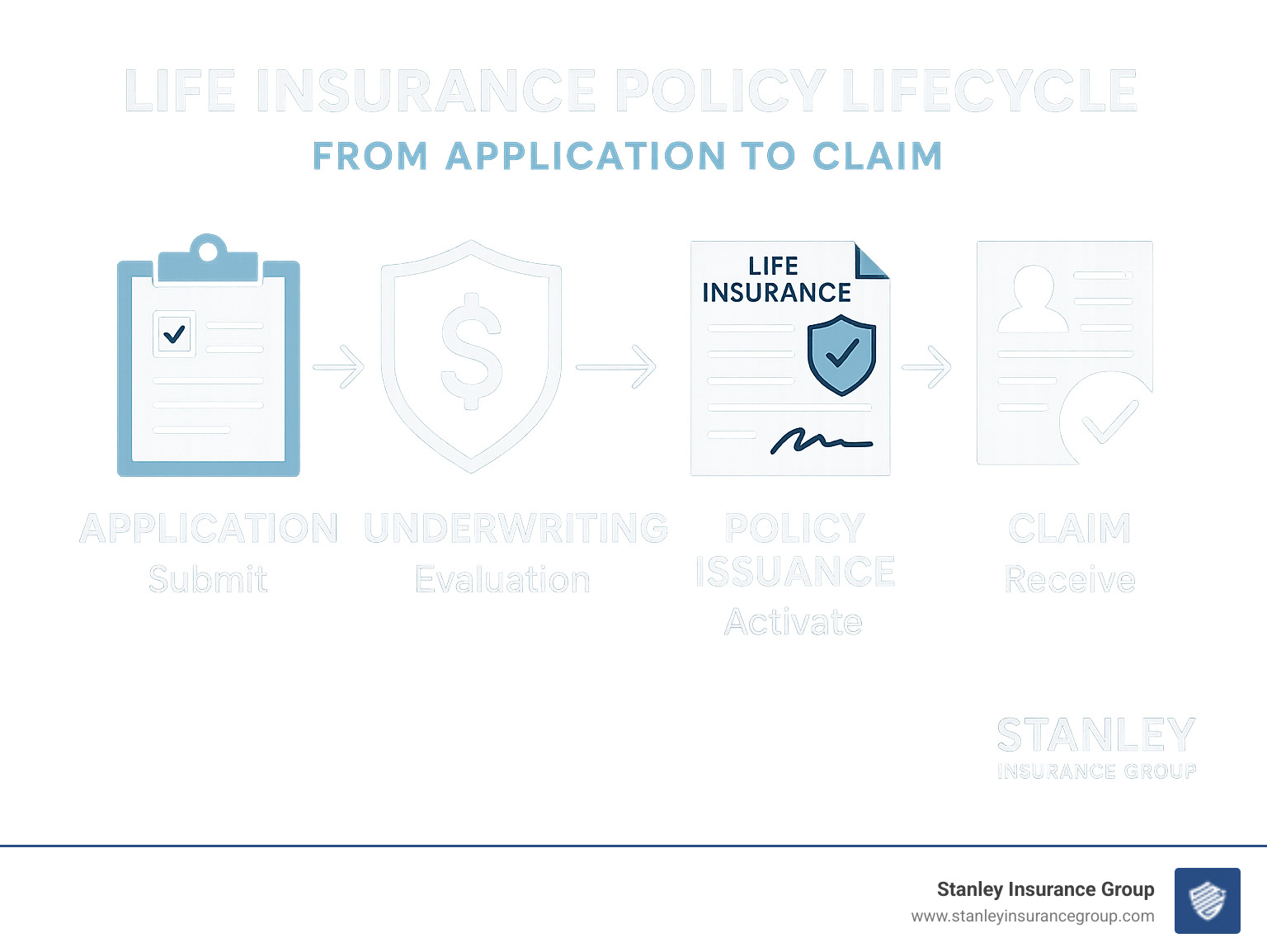
Here's what happens behind the scenes: First, you apply for coverage and the insurance company evaluates factors like your age, health, and lifestyle. Once approved, you'll receive your policy spelling out all the details. As long as you keep making your premium payments, your policy stays active.
When the time comes, your beneficiaries file a claim, and after verification, the insurance company distributes the death benefit. One of the most valuable aspects of life insurance is that these death benefits are generally income-tax-free for your beneficiaries – making it an incredibly efficient way to provide for your family's future.
Life Insurance Terminology You Should Know
Understanding a few key terms can make navigating life insurance much easier:
The face amount is simply the initial death benefit stated in your policy. Riders are optional add-ons that provide extra protection for specific situations. Underwriting is how insurers assess your risk factors to determine your eligibility and rates.
If you stop making payments, your policy could lapse, meaning your coverage ends. During the contestability period (usually the first two years), insurers can investigate and potentially deny claims if they find misrepresentation in your application.
For permanent policies, the cash surrender value is what you'd receive if you decided to cancel. An accelerated death benefit is a helpful feature that allows access to some of your death benefit if you're diagnosed with a terminal illness.
At Stanley Insurance Group, we've been helping families understand these concepts since '84. Our team, including Spanish-speaking agents Ana and Sandra, takes pride in explaining these terms in plain language to clients across Ohio, Pennsylvania, Tennessee, North and South Carolina, and Florida. We believe in building relationships, not just selling policies – it's what sets independent agencies like ours apart.
Types of Life Insurance Policies
Life insurance comes in several varieties, each designed to meet different needs and financial goals. The two main categories are term life and permanent life insurance, but there are several important variations within these categories that can make a big difference for your family's protection.
When I meet with clients at Stanley Insurance Group, I often compare life insurance to a toolbox – different policies are like different tools, each with a specific purpose. Let me walk you through the main types so you can understand which might be right for your situation.
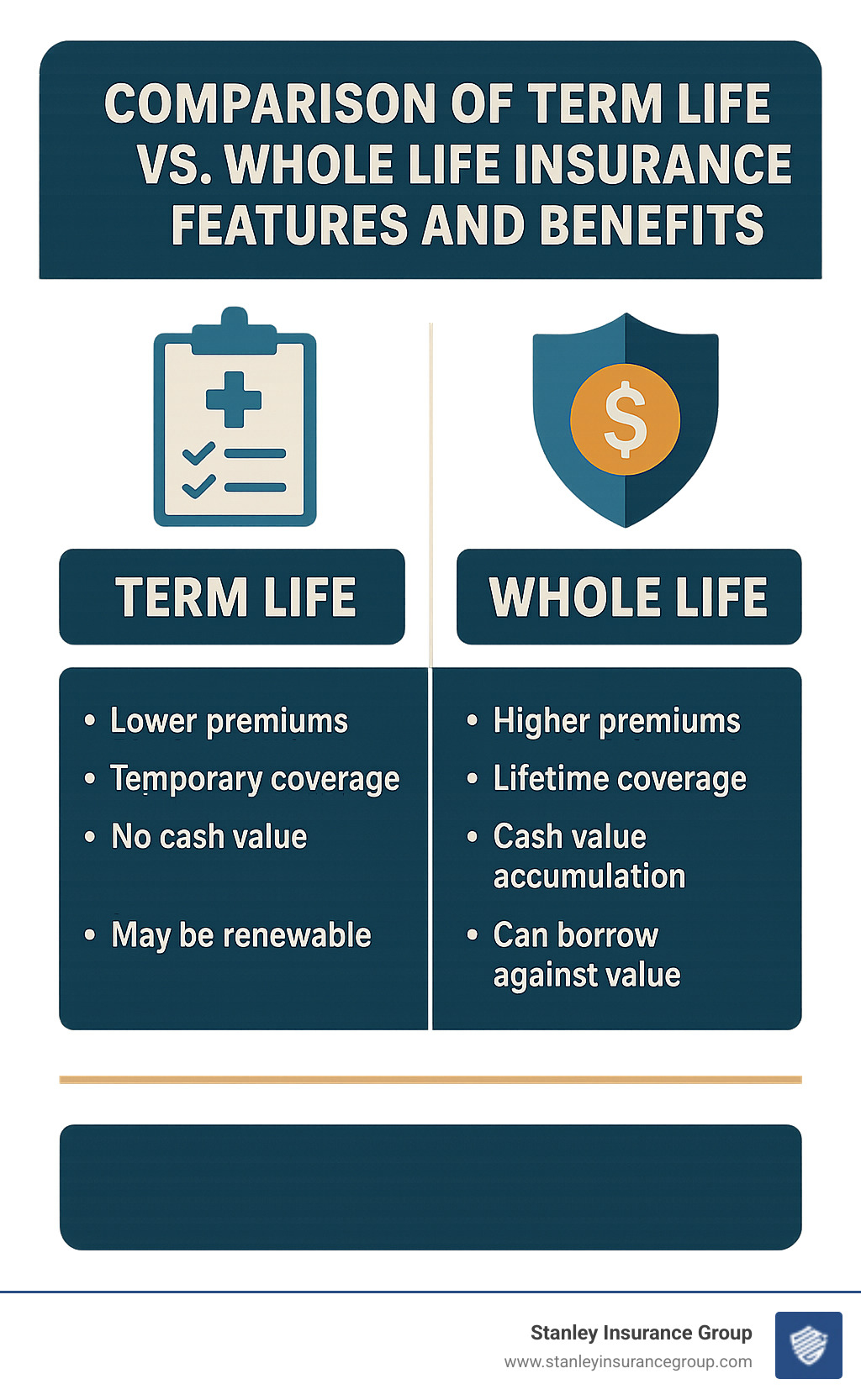
Term Life Insurance vs Whole Life Insurance
Term Life Insurance is like renting protection for a specific period. It provides coverage for a set timeframe (typically 10, 20, or 30 years) at an affordable rate. There's no cash value component, making it much more budget-friendly than permanent insurance. It's perfect for covering specific financial obligations that have end dates, like a mortgage or your children's college education. Many term policies also offer conversion options, allowing you to switch to permanent coverage later without a new medical exam.
Whole Life Insurance offers lifetime protection with predictable costs. Your premiums never increase, and the policy builds cash value at a guaranteed rate over time. Think of it as buying protection while simultaneously building a financial asset. This forced savings vehicle can be valuable for disciplined wealth building, and if purchased from a mutual insurance company, may even pay dividends. The trade-off? Whole life typically costs 5-15 times more than term insurance for the same death benefit.
Universal Life Insurance brings flexibility to permanent coverage. You can adjust both premiums and death benefits as your life circumstances change. The cash value grows based on current interest rates, making it somewhat of a hybrid between insurance and investment. This flexibility can be a blessing during tight financial times or when your protection needs evolve.
Guaranteed Acceptance Life Insurance opens doors for those with serious health conditions. With no medical exam or health questions required, these policies provide access to coverage for people who might otherwise be uninsurable. The coverage amounts are typically lower and premiums higher, with a waiting period (usually 2 years) before full benefits kick in.
Final Expense Insurance focuses specifically on covering funeral costs and settling final bills. With face amounts typically between $5,000 and $25,000, these policies ensure your loved ones won't face financial strain during an already difficult time. They're easier to qualify for than traditional policies and available to older individuals who might not need broader coverage.
Juvenile Life Insurance lets you purchase coverage for children, locking in their insurability for life regardless of health changes. These policies build cash value over decades and are generally quite affordable due to the young age of the insured.
When comparing group life insurance (offered through employers) with individual policies, group coverage often comes at lower rates but with limited protection and no portability if you change jobs. Individual policies, while sometimes more expensive, give you complete control and stay with you regardless of employment changes.
Since 1984, our team at Stanley Insurance Group has been helping families find the right life insurance solution for their unique needs. Being an independent agency means we can shop multiple carriers to find your perfect fit. Whether you need basic term coverage or a sophisticated permanent policy, our team – including our Spanish-speaking specialists Ana and Sandra – will guide you through the selection process with care and expertise.
Special Options for Veterans & Military Families
If you've served our country, you have access to unique life insurance programs that civilians don't. These specialized options often provide more favorable rates and terms:
Servicemembers' Group Life Insurance (SGLI) provides low-cost coverage for active-duty personnel, offering financial protection during your service years.
Veterans' Group Life Insurance (VGLI) allows you to convert your SGLI to lifetime renewable term coverage after separation from service, maintaining protection as you transition to civilian life.
VALife is a guaranteed-acceptance whole life program available to service-connected veterans aged 80 and under, ensuring coverage regardless of health conditions.
Veterans' Mortgage Life Insurance (VMLI) helps pay off home mortgages of disabled veterans who received specially adapted housing grants, protecting perhaps your family's most valuable asset.
While these military and veteran programs provide excellent foundational coverage, they may not meet all your family's needs. Many service members and veterans choose to supplement these policies with private insurance for comprehensive protection. At Stanley Insurance Group, we can help you understand how these special programs work alongside civilian options to create complete protection for your loved ones.
Learn more about Veterans' programs
Cost, Coverage & Buying Process
Figuring out life insurance can feel like a puzzle with three main pieces: how much coverage you need, what it will cost, and how to actually get it. Let's break this down together in a way that makes sense.
How Much Life Insurance Do I Need?
When I sit down with families to talk about life insurance, I often see the same worried look: "How do I know what's enough?" The truth is, the right amount depends on your unique situation.
The DIME Method is a helpful starting point that I've used with hundreds of clients since '84. It stands for:
- Debts and final expenses (including your mortgage, car loans, credit cards, and funeral costs)
- Income replacement (your annual salary multiplied by the years your family would need support)
- Mortgage (the remaining balance)
- Education (future college costs for your children)
Many financial advisors suggest having life insurance coverage equal to 10-15 times your annual income. This isn't just a random number—it's based on what your family would need to maintain their lifestyle if your income disappeared tomorrow.
Remember to factor in inflation too. What seems like plenty today might not stretch as far in 20 years when your kids are heading to college or your spouse is approaching retirement.
At Stanley Insurance Group, our team (including our associate agents Kaisen, Ethan, and Chase) can walk you through a personalized calculation that accounts for your family's specific needs and dreams. We've been helping Ohio families get this right since 1984.
What Affects Life Insurance Premiums?
Here's something that surprises many people: most Americans think life insurance costs about 2-3 times more than it actually does. This misunderstanding keeps too many families from getting protected.
Your premium is influenced by several factors:
Your age and health make the biggest difference. The younger and healthier you are when you buy, the less you'll pay. This is why I always tell new parents to lock in rates while they're young, even if their budget is tight.
Your lifestyle choices matter too. Tobacco use can double your premiums, while activities like scuba diving or piloting small aircraft might raise eyebrows in the underwriting department.
Policy details like term length and coverage amount obviously affect cost. A 30-year policy costs more than a 10-year policy, but might save you money in the long run.
Other factors include your family medical history, gender (women typically pay less due to longer life expectancy), driving record, and in some states, your credit history.

The buying process itself has gotten much simpler over the years. Here's what to expect:
- You'll explore options and get quotes (this is where an independent agent really helps)
- Complete an application with your personal and health information
- Possibly take a medical exam (though many "RAPIDecision" no-exam options exist today)
- The underwriting team reviews everything
- Once approved, you'll receive your policy to review
- Sign the paperwork and make your first payment to activate coverage
As an independent agency, Stanley Insurance Group can compare options from multiple carriers to find your best fit. Our Spanish-speaking specialists Ana and Sandra are also available to help families who prefer to discuss these important decisions in Spanish.
We believe in the concierge approach—we handle the complicated parts while you focus on what matters most: your family's security. That's the advantage of working with an agency that's been building relationships since '84.
Want to get a better sense of your coverage needs? Check out these helpful resources: How Much Life Insurance Do You Really Need? or our guide on How Much Life Insurance is Enough.
Managing Your Policy & Busting Misconceptions
Once you've secured your life insurance policy, keeping it up-to-date ensures it continues protecting your family as your life evolves. Think of your policy as a living document that should grow and change alongside you.
Regular Policy Reviews:Life moves quickly, and your insurance needs change just as fast. We recommend sitting down to review your life insurance coverage after significant life events like welcoming a new baby, getting married, buying a home, or receiving a substantial promotion. Even without major changes, it's wise to review your coverage every 3-5 years to make sure it still aligns with your family's needs.
Policy Updates You May Need:As your life changes, so should your policy. When a new child enters your family or you experience a divorce, updating your beneficiaries ensures your coverage protects the right people. As your income grows and your financial responsibilities expand, you might need to increase your coverage. You might also consider adding riders for specific concerns that develop over time, such as critical illness protection. And if you initially purchased term insurance, there may come a time when converting to permanent coverage makes sense for your long-term goals.
Brandon Stanley here – since founding Stanley Insurance Group in '84, I've helped hundreds of families keep their policies current through all of life's changes. Our team provides regular check-ins to ensure your coverage continues to meet your needs year after year.
Common Policy Management Questions:
When clients miss a payment, they often worry their coverage will immediately disappear. Thankfully, most policies include a 30-day grace period during which your coverage remains active. If you have a permanent policy with cash value, many insurers can even use that value to cover missed premiums temporarily. But don't wait too long – if the grace period expires, your policy could lapse.
Canceling a policy is straightforward but requires a bit more thought with permanent policies. For term coverage, you can simply stop paying premiums. With permanent policies that have accumulated cash value, you'll need to submit a written cancellation request to receive any surrender value (minus applicable fees).
Perhaps the most important aspect of policy management is making sure your beneficiaries know how to file claims when the time comes. They'll need to submit a claim form and a certified death certificate. At Stanley Insurance Group, we take pride in guiding beneficiaries through this process during what's often the most difficult time in their lives. Our team members Amy, Ana, Sandra, Kaisen, Ethan, and Chase are all trained to provide compassionate support when families need it most.
Common Misconceptions About Life Insurance:
"I'm single, so I don't need life insurance." I hear this one often, but even single individuals may have debts, funeral expenses, or loved ones who would be financially affected by their passing. Plus, locking in coverage when you're young and healthy secures lower rates for your future family.
"My employer-provided coverage is sufficient." While workplace coverage is a nice benefit, it's typically limited to just 1-2 times your annual salary. Plus, you'll likely lose this coverage if you change jobs. It's best to view employer coverage as a supplement to your personal policy.
"Life insurance is too expensive." This misconception keeps many families from getting the protection they need. In reality, most people overestimate the cost by more than 2.5 times the actual price. A healthy 30-year-old might pay less than the cost of a few coffee shop visits each month for substantial coverage.
"I can't get coverage because of my health condition." While health issues can affect rates, many options exist for people with various medical conditions. Our team at Stanley Insurance Group specializes in finding solutions for clients with health concerns, including guaranteed-issue policies that provide coverage regardless of health status.
"Only the breadwinner needs life insurance." This overlooks the valuable contributions of stay-at-home parents. Childcare, household management, and other services would be costly to replace. Additionally, the emotional impact of losing a spouse can affect the working partner's ability to maintain their employment, making coverage important for both partners.
Since '84, our independent agency has been helping Ohio families steer these misconceptions with personalized guidance. Our Spanish-speaking specialists Ana and Sandra ensure every family in our community can access clear information about life insurance, regardless of language barriers. Whether you're in Hilliard or throughout our service areas in Ohio, Pennsylvania, Tennessee, North and South Carolina, or Florida, we're here to build lasting relationships and provide the concierge-level service you deserve when protecting your family's future.
Want to learn more about the benefits of life insurance as you get older? We're just a phone call away.
Frequently Asked Questions about Life Insurance
Do I need life insurance if I have coverage through work?
That workplace life insurance policy is a nice perk, but it's a bit like bringing a rowboat to cross the ocean – it's just not quite enough for the journey.
Most employer-provided policies only cover 1-2 times your annual salary, falling significantly short of the recommended 10-15 times your income that most families need. Plus, there's the portability problem – change jobs or face a layoff, and that coverage disappears right when you might need it most.
Think of your workplace coverage as the appetizer, not the main course of your financial protection plan. It's a good starting point, but rarely provides the customization options you need for your unique situation. There can even be tax implications for employer-paid premiums exceeding $50,000.
At Stanley Insurance Group, we've been helping families since '84 find that perfect balance – using workplace coverage as a foundation while building a more robust personal policy that truly protects what matters most.
Are medical exams required for every life insurance policy?
Good news – you don't always need to roll up your sleeve for a blood draw to get life insurance! While traditional policies with medical exams typically offer the best rates for healthy people, there are several no-exam options available:
Traditional underwriting with an exam gives you the most comprehensive evaluation and usually the lowest premiums if you're in good health. The exam typically includes basic health measurements, blood and urine tests.
Simplified issue policies skip the exam in favor of detailed health questionnaires. You'll get faster approval (often within days instead of weeks) with slightly higher premiums. These policies generally offer coverage up to about $1 million.
For those with health challenges, guaranteed issue policies require no health questions or exams. While they're available to almost everyone, they come with higher premiums, lower coverage amounts (typically $25,000 or less), and usually include a 2-3 year waiting period for natural causes of death.
Our team at Stanley Insurance Group, including our associate agents Kaisen, Ethan, and Chase, can help you steer these options based on your health, budget, and how quickly you need coverage in place.
What can life insurance benefits be used for?
One of the most beautiful things about life insurance is its flexibility – the death benefit comes with no strings attached. Unlike other financial tools that restrict how money can be used, life insurance proceeds give your loved ones complete freedom during a difficult time.
Beneficiaries commonly use the money for immediate needs like funeral expenses, outstanding medical bills, and settling debts. For many families, the proceeds provide crucial ongoing financial support – covering mortgage payments, daily living expenses, and childcare costs that might otherwise be devastating after losing a breadwinner.
Beyond these immediate needs, life insurance benefits often fund longer-term goals like college education for children, retirement security for a surviving spouse, or even leaving a legacy through charitable donations.
For business owners, life insurance can be especially valuable, providing funds for business continuation, buy-sell agreements, or replacing key employees.
Since 1984, we've seen how life insurance benefits have provided not just financial support but also peace of mind during life's most challenging moments. Our Spanish-speaking specialists Ana and Sandra can help explain these benefits to all members of your family, ensuring everyone understands the protection you're putting in place.
Conclusion
Life insurance isn't just a financial product—it's a profound expression of love and responsibility. While thinking about mortality isn't anyone's favorite conversation, the comfort that comes from knowing you've protected your family's future is truly priceless.
Since 1984, we at Stanley Insurance Group have guided families through these important decisions with care and expertise. As an independent agency, we don't push one-size-fits-all solutions. Instead, we take the time to understand your unique situation and offer options from multiple carriers that truly fit your needs. Whether you're seeking term coverage for your growing family, permanent insurance for legacy planning, or specialized business continuation policies, our team brings decades of experience to your service.
We're proud to offer Spanish-speaking specialists on our team. Ana and Sandra ensure clear, comfortable communication for all our clients, reflecting our commitment to personalized service. In an age where insurance is increasingly becoming an impersonal online transaction, we believe in building genuine relationships that span generations—just like the protection your life insurance provides.
Our concierge-level service extends throughout Ohio—including Columbus, Hilliard, Dublin, and Arlington—as well as Pennsylvania, Tennessee, North Carolina, South Carolina, and Florida. As one of only 100 independent agencies nationwide with a Geico partnership, we offer the perfect balance of major carrier strength with the attentive care of a local, family-focused agency.
Life insurance isn't about planning for death—it's about living confidently today, knowing you've taken care of tomorrow. Whether you're welcoming a new baby, purchasing your first home, launching a business venture, or planning your retirement, the right life insurance strategy creates a foundation for lasting financial security.
We invite you to reach out for a personalized consultation with our team. Together with Amy from our Commercial Lines department or our associate agents Kaisen, Ethan, and Chase, we'll explore your options and craft protection that fits your life perfectly. At Stanley Insurance Group, we're not just selling policies—we're building relationships that protect what matters most to you.
Learn more about our Life Insurance options or get started with a trusted advisor today.
Similar posts


