Steering New Drivers to Cheaper Insurance Rates
Discover top tips for cheap car insurance for new drivers and learn how to save on premiums with expert advice and proven strategies.
The Sticker Shock: New Driver Insurance Realities
Tips for cheap car insurance for new drivers can save you hundreds or even thousands of dollars per year. If you're looking for immediate ways to reduce premiums, here are the most effective strategies:
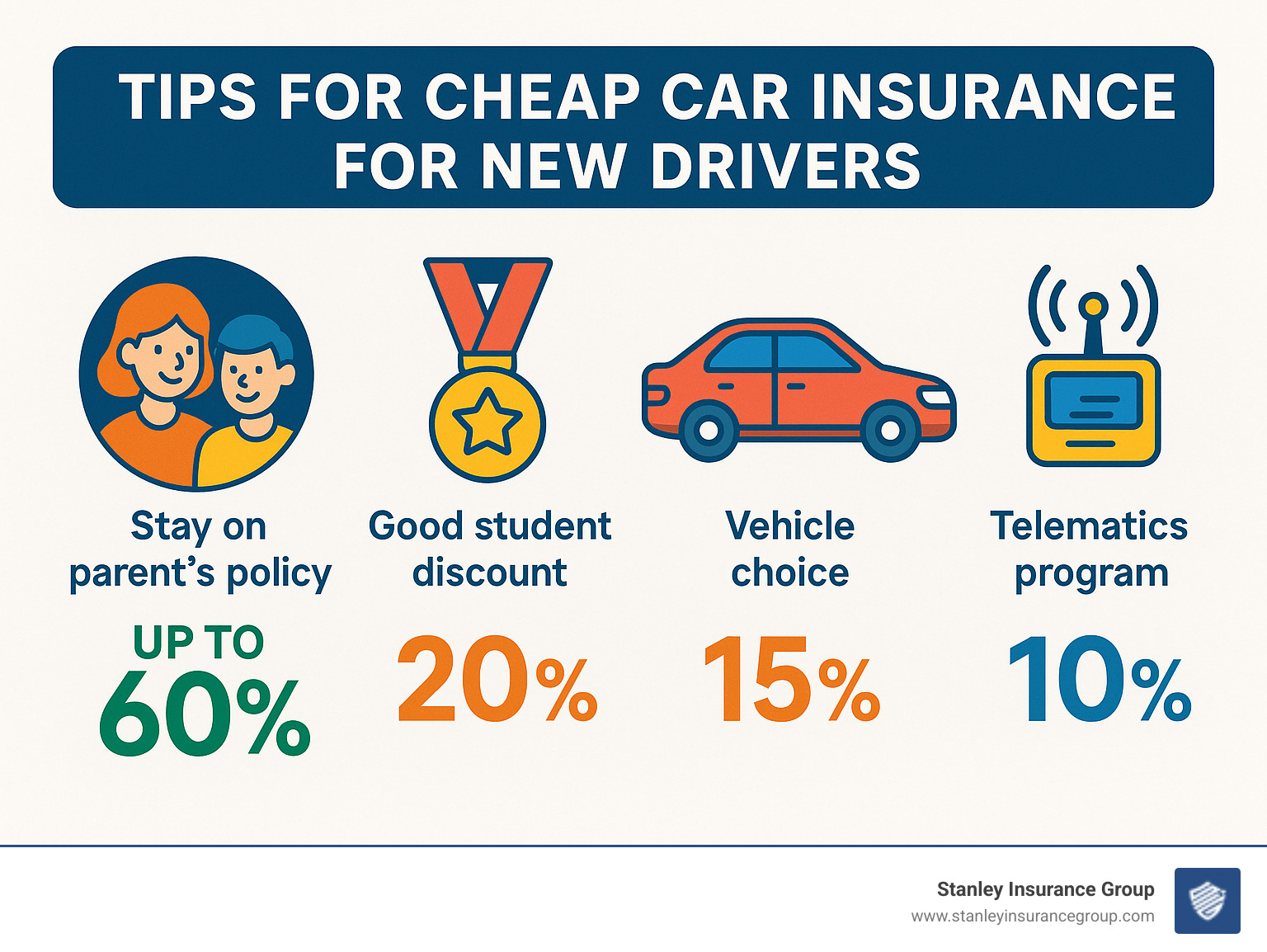
- Stay on a parent's policy (saves up to 60% compared to a standalone policy)
- Compare quotes from multiple insurers (can find savings of 30% or more)
- Choose a car in a lower insurance group (sedans vs. sports cars)
- Increase your deductible (raising from $500 to $1,000 saves ~9%)
- Apply for good student discounts (average savings of $283 per year)
- Install a telematics device (average 3% savings nationwide)
- Take a defensive driving course (10-15% discount in many states)
- Pay your premium annually (saves 4.9% over monthly payments)
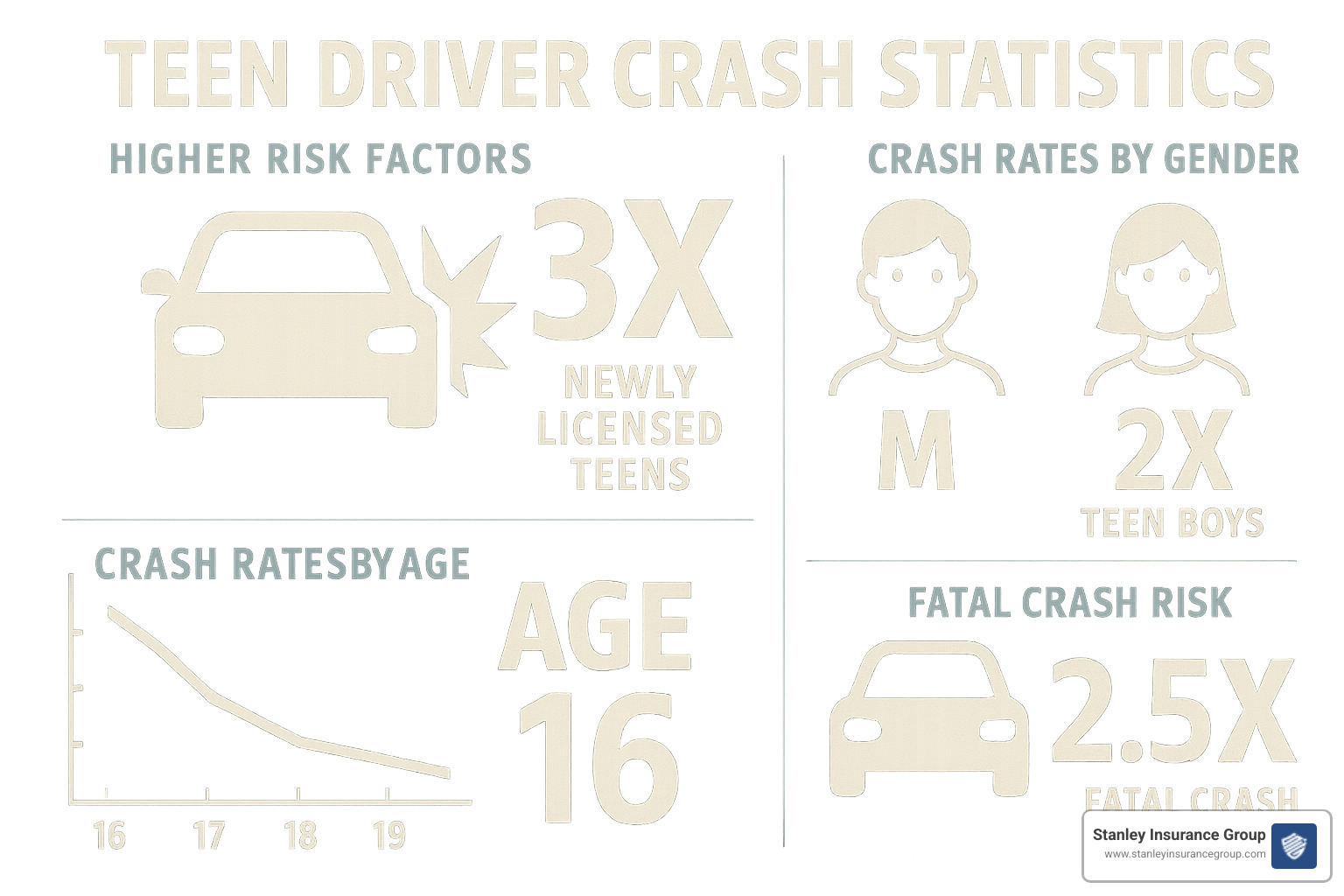
Getting that first car insurance policy as a new driver can feel like a financial gut punch. The national average premium for teen drivers ages 16-19 is a whopping $4,573 per year – more than double what experienced drivers pay. This steep cost exists because insurance companies view new drivers as high-risk customers, with statistics showing teen drivers are nearly three times more likely to be involved in fatal accidents.
I'm Brandon Stanley, President of Stanley Insurance Group, and I've been helping families find tips for cheap car insurance for new drivers since we opened our doors in 1984. Our independent agency in Hilliard has built lasting relationships with clients by providing personalized service while securing the most affordable protection for new drivers.
Basic tips for cheap car insurance for new drivers glossary:
Why New Drivers Face Higher Premiums
New drivers, particularly teenagers, face significantly higher insurance premiums for several compelling reasons. Understanding these factors is the first step in finding ways to reduce costs.
Inexperience Behind the Wheel
Statistics don't lie, and insurance companies know this well. According to the Insurance Institute for Highway Safety (IIHS), teen drivers have crash rates nearly four times higher than drivers aged 20 and older per mile driven. This inexperience translates directly to higher risk and, consequently, higher premiums.
"We've seen families shocked by their first quote," says Amy from our Commercial Lines department. "But once we explain the risk factors and show them our strategies for savings, that initial panic usually subsides."
No Driving History to Evaluate
Insurance companies rely heavily on driving records to assess risk. New drivers are essentially blank slates—there's no history of safe driving for insurers to evaluate. Without this data, companies default to statistical models that categorize new drivers as high-risk.
The Actuarial Reality
The cold, hard truth of insurance pricing is based on actuarial science—the statistical analysis of risk. Teen driver crash stats reveal that drivers aged 16-19 are almost three times more likely than drivers aged 20 and older to be in a fatal crash per mile driven. Male teen drivers are particularly concerning to insurers, accounting for 68% of teen driver fatalities despite making up only half of the teen driver population.
"When parents understand the statistical reality behind the pricing," explains Kaisen, one of our Associate Agents, "they often shift from asking 'Why so expensive?' to 'How can we make this more affordable?'"
The Age Surcharge Effect
While we don't like to call it a "surcharge," the reality is that age is a significant factor in insurance pricing until around age 25. After this milestone, rates typically begin to decrease substantially, assuming a clean driving record has been maintained.
Cost Snapshot: How Much Does Car Insurance for New Drivers Really Cost?
Let's talk real numbers. When parents see their first new driver insurance quote, many experience what I call the "premium panic moment." I've witnessed this reaction countless times since we opened our doors back in '84.
By the Numbers: Average Premiums
The reality of insuring a new driver hits the wallet hard:
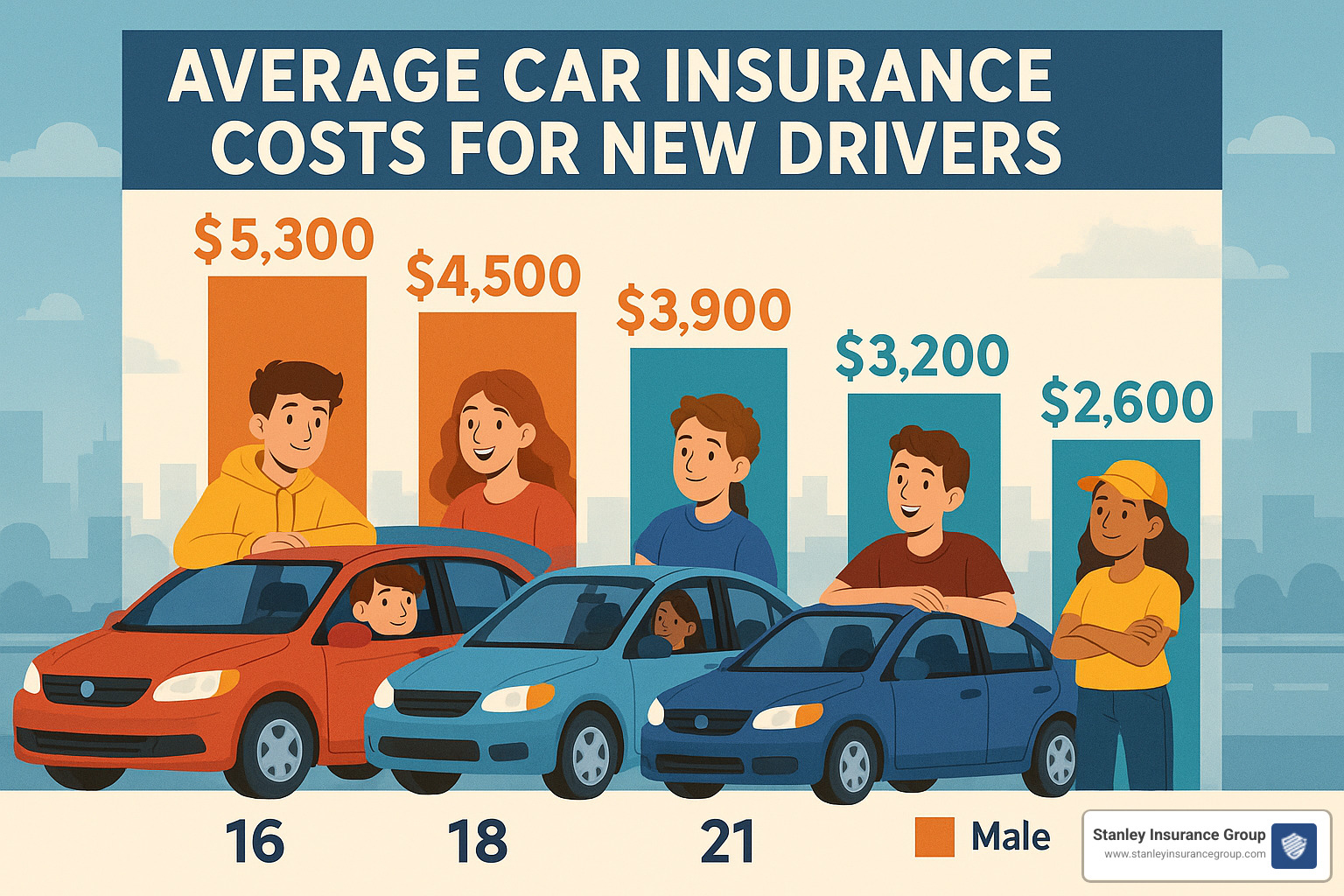
- 16-year-olds face an eye-watering average annual premium of $5,744
- 17-year-olds see a slight improvement at around $4,876 yearly
- 18-year-olds typically pay about $4,271 annually
- 19-year-olds begin to see real relief with averages of $3,082
This downward trend continues until about age 25, when rates finally level off to normal adult pricing—assuming your young driver keeps a clean record, of course!
Parent's Policy vs. Standalone Coverage
"Should we add them to our policy or get them their own?" This question comes up in nearly every conversation we have with parents at Stanley Insurance Group.
The numbers tell a clear story: adding an 18-year-old to a married couple's policy averages about $3,345 annually, while that same teen would pay around $6,110 for their own policy. That's a potential savings of nearly 60%!
"Most families are shocked by how much they can save with this one decision," says Ethan, one of our Associate Agents. "It's usually the first recommendation we make when helping families manage new driver costs."
The Deductible Decision
Choosing your deductible amount creates a direct tradeoff between monthly premiums and potential out-of-pocket costs. Bumping your deductible from $500 to $1,000 typically saves around 9% on premiums, while going up to a $2,000 deductible can save approximately 16%.
Ana, our Spanish-speaking Account Specialist, offers this practical advice: "Think about what you could comfortably pay if an accident happens tomorrow. That's your ideal deductible. No sense saving $20 a month if you can't afford the $2,000 out-of-pocket cost when you need to file a claim."
Annual vs. Monthly Payment Savings
Simply changing how you pay can put money back in your pocket. Paying your annual premium upfront instead of monthly installments saves an average of 4.9%. For an 18-year-old's typical $4,271 premium, that's about $210 staying in your bank account—enough for a few tanks of gas for your new driver!
Gender Differences in Pricing
Insurance statistics reveal a persistent gap in pricing based on gender:
Female drivers ages 16-19 pay an average of $3,307 yearly, while male drivers in the same age group pay about $3,717. This $410 difference reflects the unfortunate reality that young male drivers statistically have more accidents and fatalities than their female counterparts.
Full Coverage vs. Minimum Coverage
| Age | Full Coverage | Minimum Coverage | Potential Savings |
|---|---|---|---|
| 16 | $5,744 | $2,267 | $3,477 |
| 17 | $4,876 | $1,925 | $2,951 |
| 18 | $4,271 | $1,687 | $2,584 |
| 19 | $3,082 | $1,218 | $1,864 |
While the savings from minimum coverage look tempting, I've seen too many families regret this choice after an accident. Chase, another of our Associate Agents, puts it this way: "Minimum coverage is like wearing a life jacket in a hurricane—it's technically protection, but probably not enough when you really need it."
The potential savings of $2,584 for an 18-year-old might seem significant, but one moderate accident could easily exceed minimum coverage limits, leaving your family responsible for thousands more in damages or medical bills.
For more detailed information on finding affordable coverage without dangerous compromises, check out our comprehensive guide on Cheap Car Insurance.
Since '84, we've been helping Ohio families steer these complex decisions with our concierge approach to insurance. We don't just sell policies—we build relationships that help your family through every life stage, including that nerve-wracking moment when your teen first gets behind the wheel.
Core Coverage 101 for First-Time Drivers
Getting behind the wheel for the first time is exciting, but before you hit the road, let's make sure you understand what insurance protection you actually need. Since '84, we've been helping new drivers steer these choices.
State-Required Liability Coverage
Every state mandates minimum liability insurance - it's not optional. This basic protection includes:
Bodily Injury Liability covers medical costs for others if you cause an accident, while Property Damage Liability pays for repairs to their vehicles or property.
"The state minimums are just that—minimums," explains Ethan, one of our Associate Agents. "They're rarely enough to fully protect a driver in a serious accident. We recommend higher limits, especially for inexperienced drivers who are statistically more likely to be involved in accidents."
Collision Coverage
When your shiny new car meets an unfortunate telephone pole (or another vehicle), collision coverage comes to the rescue. This pays for repairs to your vehicle regardless of who caused the accident. For new drivers with newer vehicles, skipping this coverage could be a costly mistake.
Comprehensive Coverage
Think of comprehensive as protection against "everything else" - the unexpected dramas that have nothing to do with actual driving. This includes theft, vandalism, hail damage, floods, and even that deer that jumped out of nowhere. If Mother Nature or human mischief damages your car, comprehensive has your back.
Uninsured/Underinsured Motorist Protection
Imagine doing everything right, only to be hit by someone with no insurance or bare-minimum coverage. About 13% of drivers nationwide have no insurance at all. This coverage steps in when the at-fault driver can't pay for your injuries or damages.
Lender Requirements
If you're financing or leasing your vehicle, your lender isn't just suggesting coverage - they're requiring it. They'll typically demand full comprehensive coverage, full collision coverage, and often higher liability limits than state minimums. Until that loan is paid off, the vehicle isn't fully yours, and the lender wants to protect their investment.
Gap Coverage Consideration
Here's a scenario we see too often: A new driver totals their recently financed car. Insurance pays the actual cash value, but the driver still owes thousands more on the loan. That's the "gap" - and it can be financially devastating.
Chase, another of our Associate Agents, notes: "We've seen too many cases where a new driver totals a financed vehicle and ends up owing thousands on a car they no longer have. Gap coverage is relatively inexpensive protection against a potentially devastating financial hit."
At Stanley Insurance Group, we've been guiding drivers through these decisions since 1984. Our team, including Spanish-speaking specialists Ana and Sandra, can explain these coverages in plain language and help you find the right balance between protection and affordability.
For a deeper dive into coverage types, visit our comprehensive guide on Types of Auto Insurance Coverage.
Tips for Cheap Car Insurance for New Drivers
Now that we understand why insurance is expensive for new drivers and what coverage is needed, let's explore specific strategies to lower those premiums.
Stay on a Parent's Policy When Possible
For teen drivers and college students living at home, being added to a parent's policy is almost always the most cost-effective option. The savings can be dramatic—up to 60% compared to a standalone policy. For an 18-year-old, this could mean paying $3,345 instead of $6,110 annually.
Sandra, one of our Spanish-speaking Account Specialists, often tells families: "Even with the increase to the family policy, the combined cost is usually much lower than a separate policy for a young driver."
Shop Around for Multiple Quotes
At Stanley Insurance Group, our status as an independent agency since '84 gives us a unique advantage—we can shop multiple carriers to find the best rates. Different insurers weigh risk factors differently, and we've seen price differences of 30% or more between carriers for identical coverage. Some insurers even have special programs specifically designed for new drivers.
Choose Your Vehicle Wisely
The car you drive significantly impacts your insurance costs. Sedans and smaller SUVs typically cost less to insure than sports cars or luxury vehicles. Older vehicles with lower replacement costs can mean lower premiums, and vehicles with high safety ratings often qualify for discounts.
"We always recommend that families consult with us before purchasing a vehicle for a new driver," says Amy from our Commercial Lines department. "We can provide quotes for different models they're considering, which sometimes reveals surprising cost differences."
Raise Your Deductible Strategically
Increasing your deductible—the amount you pay out-of-pocket before insurance kicks in—directly lowers your premium. Raising from $500 to $1,000 typically saves about 9%, while going up to $2,000 can save around 16%. However, this strategy should be approached cautiously. Make sure you have sufficient savings to cover the deductible if needed.
Take Advantage of Good Student Discounts
Many insurers offer substantial discounts for students who maintain good grades—averaging $283 per year in savings. This typically requires maintaining at least a B average (3.0 GPA). Some carriers, like State Farm, offer up to 25% off for good students, acknowledging the correlation between academic responsibility and responsible driving behavior.
Accept Telematics and Usage-Based Insurance
Telematics programs use devices or smartphone apps to monitor driving habits. While the national average savings is about 3%, some states see much higher savings (over 8% in Connecticut). Safe drivers can earn increasing discounts over time.
"Telematics is a game-changer for new drivers," explains Kaisen, one of our Associate Agents. "It gives them a chance to prove they're safer than the statistics suggest, potentially earning significant discounts based on their actual driving behavior rather than just their age group."
Complete a Defensive Driving Course
Many insurers offer discounts of 10-15% for completing approved defensive driving courses. These courses are available online or in-person, and the knowledge gained may help prevent accidents, leading to long-term savings.
Bundle Policies for Additional Savings
If your household has multiple insurance needs, bundling can lead to significant savings of 8-10% when combining auto and home policies. For a teen driver with a $4,573 premium, this could mean savings of $366-$457 annually. At Stanley Insurance Group, our concierge approach means we look at your entire insurance picture to maximize savings across all policies.
Pay Your Premium Upfront
Simply changing how you pay can yield meaningful savings of about 4.9% by paying annually instead of monthly. For an 18-year-old's average premium of $4,271, this equals about $210 in savings.
Consider Mileage-Based Limitations
Some insurers offer discounts for drivers who drive less than average—typically under 7,500-10,000 miles per year. College students who leave their car at home can qualify for "student away" discounts, saving 15-30%.
Quick Tips for Cheap Car Insurance for New Drivers
For those seeking immediate savings, compare quotes regularly—when first getting insured, at each policy renewal, and after major life changes. "The insurance market is constantly changing," notes Chase, another of our Associate Agents. "What was the best deal last year might not be this year. That's why we proactively review our clients' policies at renewal time."
Pay annually whenever possible to save an average of 4.9% of your total premium, eliminate monthly billing fees, and reduce the risk of coverage lapses due to missed payments. And don't forget about multi-policy bundling, which offers some of the most significant discounts: 8-10% for auto + home, 5-7% for auto + renters, and an additional 10-25% for multiple vehicles.
For more strategies to reduce your insurance costs, check out our guide on Tips for Reducing Car Insurance.
Long-term Tips for Cheap Car Insurance for New Drivers
While immediate savings are important, building toward long-term affordability is equally valuable. Nothing impacts insurance rates more than your driving history—a first at-fault accident can increase rates by 30% or more, speeding tickets typically raise premiums by 20-25% per violation, and a DUI/DWI can double or triple your premiums.
"The best way to keep insurance affordable is to keep your record clean," advises Ethan, one of our Associate Agents. "No discount can offset the impact of accidents or violations."
Build toward claims-free discounts of 10-25% after 3-5 years without claims. Some carriers even offer accident forgiveness after a period of safe driving. Commit to usage-based programs, which offer an initial enrollment discount of 5-10% and can increase to 20-30% over time with safe driving.
For the latest research on these programs, check out the IIHS research on usage-based insurance.
In most states, credit history is a significant factor in insurance pricing. Improving from poor to excellent credit can reduce premiums by 40% or more, so regular credit monitoring and responsible financial habits pay insurance dividends.
At Stanley Insurance Group, we've been providing our concierge touch since '84, which includes proactive policy reviews with annual coverage evaluation, discount eligibility reassessment, and competitive market comparison.
"Insurance needs evolve as drivers gain experience," explains Sandra. "What made sense for a brand-new driver might not be the best approach after a few years of safe driving."
Car Choice & Tech That Slash New-Driver Premiums
Your vehicle choice has a massive impact on insurance costs, especially for new drivers. Vehicles are categorized into insurance groups—lower groups (1-20) are typically cheaper to insure, while higher groups (40-50) can double or triple premiums.
Popular low-insurance-group vehicles for new drivers include the Austin MINI (average annual premium of $372.18), Škoda Citigo (average annual premium of $648.51), and Suzuki Celerio (average annual premium of $673.17).
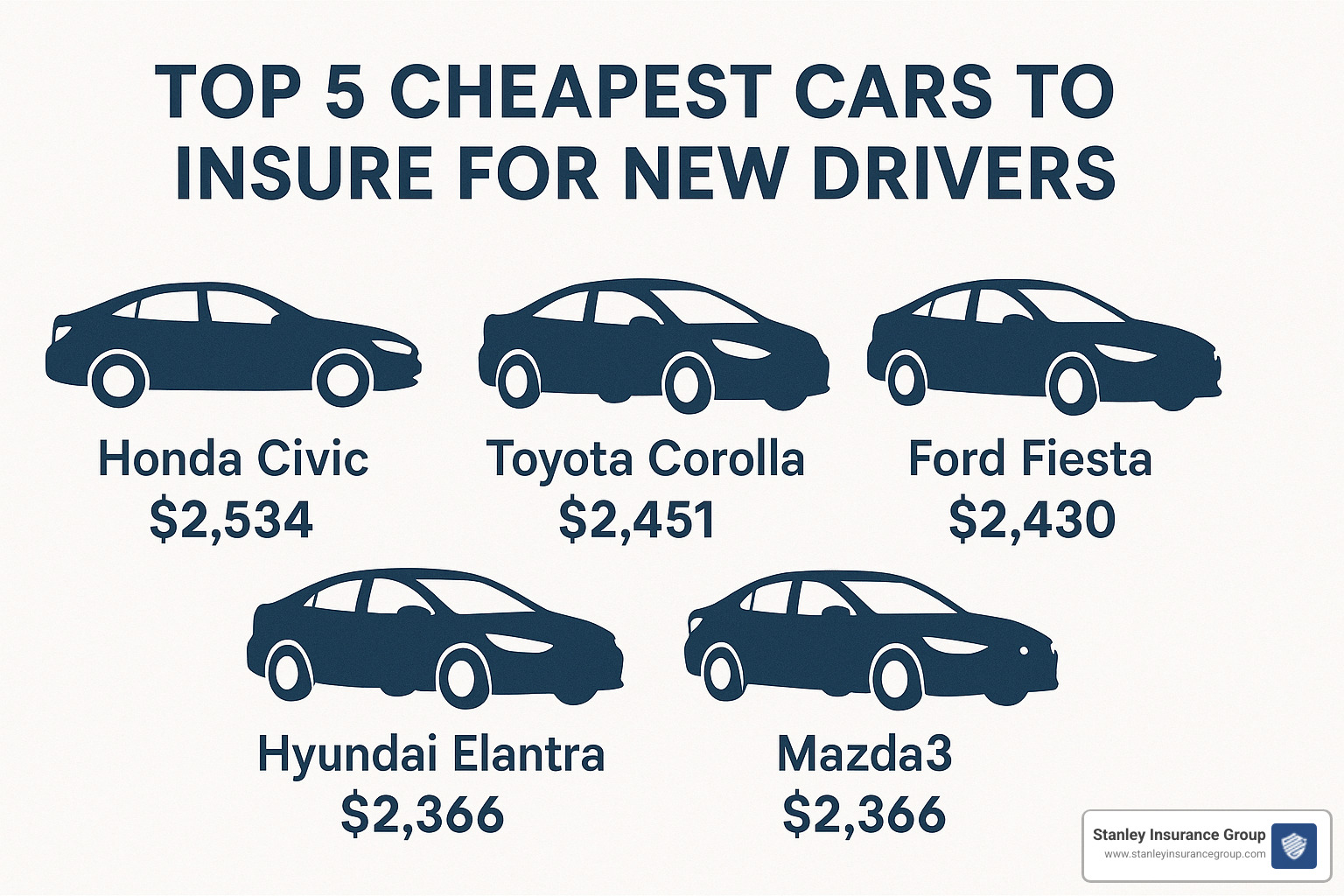
Vehicles with high safety ratings often qualify for insurance discounts. Look for vehicles with IIHS "Top Safety Pick" or "Top Safety Pick+" designations. Advanced safety features like automatic emergency braking can qualify for additional discounts.
Vehicles with advanced anti-theft features qualify for discounts with most insurers, including factory alarm systems, immobilizers, and GPS tracking systems. Engine size also directly impacts insurance costs—vehicles with engines under 2.0 liters typically cost less to insure, while high-performance engines can dramatically increase premiums for new drivers.
"When families consult with us before vehicle purchase," says Amy, "we often see them shift their thinking from 'What's the coolest car?' to 'What's the most insurance-efficient car?' The savings can be substantial enough to influence the buying decision."
Frequently Asked Questions about Cheap New-Driver Insurance
Who is considered a new driver and why are premiums higher?
The "new driver" category covers more people than you might think. It includes teenagers with fresh licenses, adults who've put off driving until later in life, newcomers to the country with foreign driving experience, and folks who've had a significant gap in their driving or insurance history.
"We see all kinds of new drivers coming through our doors," Ana explains, one of our Spanish-speaking Account Specialists. "The 35-year-old who just moved from Mexico with ten years of driving experience there has a completely different risk profile than the excited 16-year-old who just passed their test. We take time to understand each situation."
Insurance companies charge higher premiums for new drivers for some compelling reasons. The statistics tell a clear story – new drivers, especially teens, have significantly higher accident rates. Teen drivers are nearly three times more likely to be involved in fatal crashes per mile driven compared to experienced drivers. Without a driving history to evaluate, insurance companies have to rely heavily on these demographic statistics, which unfortunately point to higher risk.
Since '84, we've been helping new drivers steer this challenging insurance landscape with our concierge touch, finding the best possible rates despite these statistical realities.
Should I reduce coverage or raise deductibles to save money?
This question comes up in almost every conversation with new drivers and their families, and the answer isn't one-size-fits-all.
When it comes to reducing coverage, there's an immediate benefit of lower premiums, but it comes with increased financial exposure if an accident happens. At Stanley Insurance Group, we generally recommend keeping comprehensive coverage for new drivers, who statistically are more likely to need it. Consider reducing optional coverages only if you could realistically afford to repair or replace your vehicle without insurance help.
"This is where building a relationship with your agent really matters," says Chase, one of our Associate Agents. "We get to know your financial situation and risk tolerance before making recommendations about coverage levels."
For raising deductibles, the math is straightforward – increasing from $500 to $1,000 typically saves about 9% on premiums, while going up to $2,000 can save around 16%. However, that means you'll pay more out-of-pocket if you need to file a claim. Our advice? Only raise your deductible if you have that amount readily available in savings. The last thing you want is to have an accident and not be able to afford your deductible.
Ethan, another of our Associate Agents, often reminds clients: "Insurance is ultimately about sleeping well at night. The right balance of coverage and cost is the one that gives you peace of mind while still fitting your budget."
What documentation do new drivers need to get insured?
Getting your ducks in a row before applying for insurance can save you time and possibly even money. Here's what you'll need to have ready:
Your valid driver's license or permit is the most essential document. You'll also need complete vehicle information (including the VIN, make, model, and year), proof of your current address, and your Social Security number. Have your banking details handy for setting up payments, and if you have any previous driving history, that information will be helpful too.
For students, don't forget to bring proof of your good grades if you want to qualify for those valuable good student discounts. And for immigrants, if you have driving records from your home country, these can sometimes help establish your driving experience.
"Being prepared with all your documents makes everything so much smoother," Sandra notes, another of our Spanish-speaking Account Specialists. "We're happy to help families who need language support through this process – it's part of our commitment to serving our diverse community since '84."
Kaisen, one of our Associate Agents, adds: "We've built our reputation on making insurance accessible to everyone. Whether you're a teen getting your first policy or new to the country, our team takes the time to explain everything clearly and find you the best rates possible."
At Stanley Insurance Group, we understand that getting insurance as a new driver can feel overwhelming. That's why we've spent nearly four decades perfecting our concierge approach to guide you through every step of the process, answering all your questions with the patience and expertise you deserve.
Conclusion
Finding affordable car insurance as a new driver might feel like searching for a needle in a haystack, but it doesn't have to be that overwhelming. At Stanley Insurance Group, we've been guiding families through this journey since '84, offering that personal concierge touch that transforms a confusing process into a manageable one.
When you work with us to find tips for cheap car insurance for new drivers, you're not just getting a policy—you're building a relationship. Our team takes the time to understand your unique situation, whether you're a parent adding a teen to your policy or a new driver seeking coverage on your own. We believe in conversations, not transactions, which is why families throughout Ohio, Pennsylvania, Tennessee, North Carolina, South Carolina, and Florida have trusted us for nearly four decades.
"Insurance is ultimately about peace of mind," shares Amy from our Commercial Lines department. "Finding that sweet spot between affordability and proper protection is where we excel."
Our independent agency status gives us distinct advantages when helping you find affordable coverage:
- We work with multiple insurance carriers, including our exclusive partnership with Geico (we're one of only 100 independent agents nationwide with this special relationship)
- We provide personalized guidance through the maze of coverage options, rather than a one-size-fits-all approach
- We conduct regular policy reviews as your driving experience grows, ensuring you continue to receive optimal rates
- We maintain deep community roots in Hilliard, Columbus, Dublin, and surrounding areas
For our Spanish-speaking clients, team members like Ana and Sandra provide comprehensive assistance in your preferred language. This commitment to accessibility is just one more way we serve our diverse community with the attention everyone deserves.
Kaisen, one of our Associate Agents, often reminds clients: "The cheapest policy isn't always the best value if it leaves gaps in your protection. Our job is to find you affordable coverage that still provides real security."
While saving money matters, we focus on appropriate protection first. After all, the true cost of insurance isn't just measured in premiums—it's also measured in what happens after an accident occurs. Our team helps you strike that perfect balance between budget-friendly rates and comprehensive coverage.
We invite you to contact Stanley Insurance Group today to find how our personalized approach can help the new driver in your family find affordable, appropriate coverage. Your journey toward insurance confidence begins with a simple conversation.
For more insurance insights and expert advice, visit our blog where we regularly share guidance on navigating today's complex insurance landscape.
Similar posts