
A Comprehensive Guide to Auto Insurance Quotes for Young Drivers
Compare auto insurance quotes for young drivers and find affordable rates with tips from Stanley Insurance Group, including Spanish-speaking agents.
Compare Auto Insurance Quotes for Young Drivers With Confidence
Auto insurance quotes for young drivers are easiest to compare when each quote uses the same drivers, vehicle, coverage limits, and deductibles. Young drivers often face higher rates because they have less experience behind the wheel and teen drivers have a much higher crash rate per mile than drivers age 20 and older.
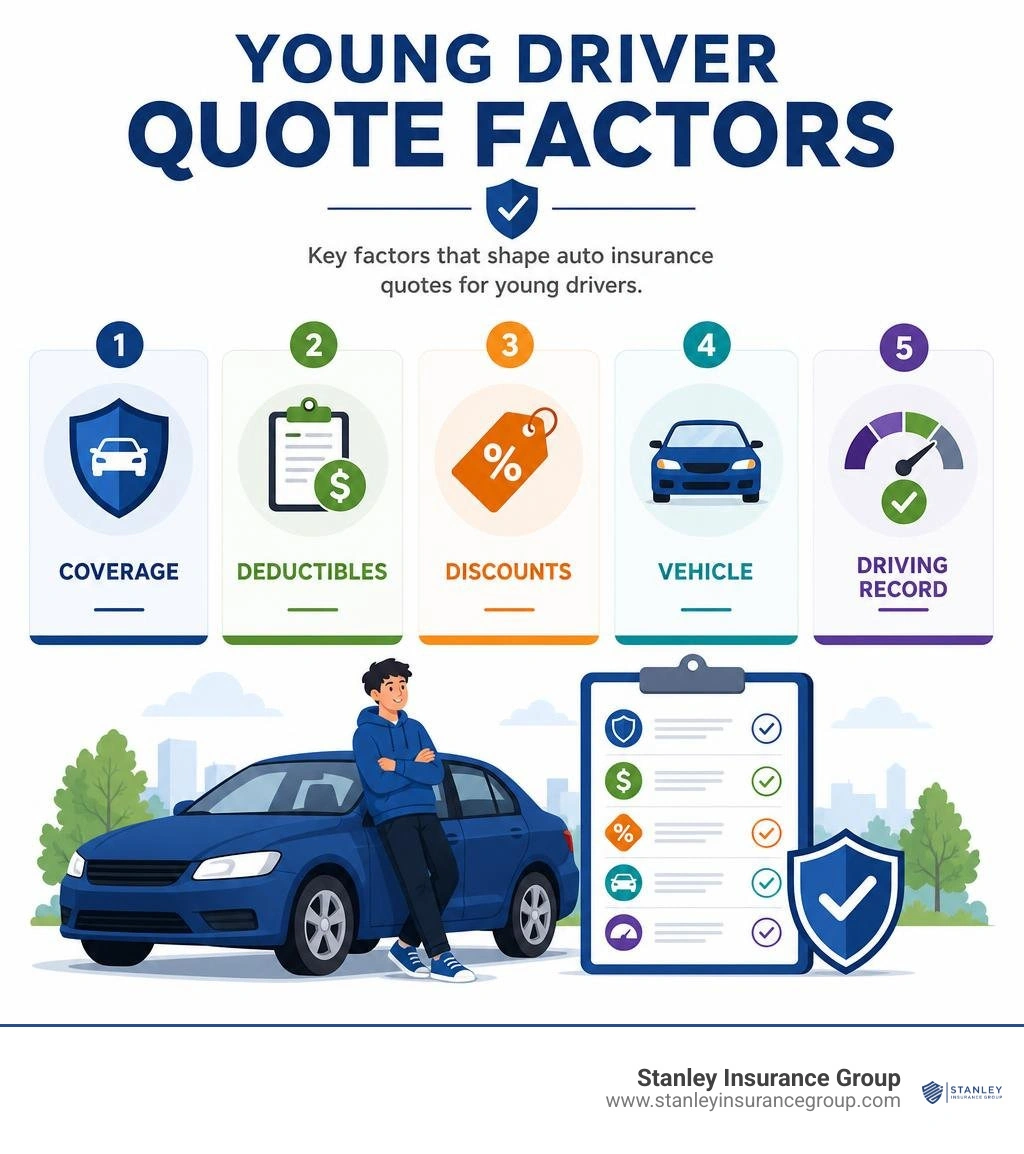
Key factors to compare on every quote:
- Liability limits: State minimums may not fully protect your family's assets after a serious crash.
- Collision and comprehensive: These cover damage to the young driver's vehicle from crashes, theft, weather, and more.
- Deductible amount: A higher deductible can lower the premium but increases what you pay after a covered claim.
- Discounts: Good student, driver training, telematics, and multi-policy discounts can make a meaningful difference.
- Family policy vs. separate policy: Adding an eligible young driver to a parent policy is often less costly than separate coverage.
At Stanley Insurance Group, we shop options with the concierge-style attention our clients have expected Since '84. Spanish-speaking help and agents are available through Ana and Sandra, our Spanish-speaking Account Specialists; Amy handles Commercial Lines, while Kaisen, Ethan, and Chase serve as Associate Agents. Stanley Insurance Group is also among the only 100 independent agents in the country with a partnership with GEICO.
I am Brandon Stanley, President of Stanley Insurance Group, a family-owned independent agency serving the Hilliard and Columbus area since 1984. My team helps families compare auto insurance quotes for young drivers while building coverage plans that support their home, vehicle, life, and business insurance needs.
Simple guide to auto insurance quotes for young drivers:
- Insurance for Teenage Drivers
- least expensive car insurance for young drivers
- most expensive car to insure for teenager
Understanding Auto Insurance Quotes for Young Drivers by Age
When families across Hilliard, Dublin, and Central Ohio begin looking into auto insurance quotes for young drivers, the initial premium numbers can come as a surprise. Statistically, drivers between the ages of 16 and 19 have crash rates nearly four times higher per mile driven than drivers aged 20 and older. Because insurance carriers calculate premiums based on risk probability, newly licensed teenagers sit in the highest risk category.
Rates drop noticeably as young motorists gain experience behind the wheel. Between ages 16 and 25, premiums drop by an average of 43 percent, assuming the driver maintains a clean record free of moving violations or at-fault accidents.
Key age milestones impact pricing throughout a young driver's early years:
- Age 16: Newly licensed teens face the highest baseline rates due to zero independent driving history and high statistical risk.
- Age 18: The first significant pricing adjustment typically occurs here as legal adulthood is reached and two full years of driving experience are accumulated.
- Age 21: Reaching 21 represents another key pricing threshold, where carriers recognize five years of continuous licensed driving.
- Age 25: This is widely recognized as the landmark transition point. At 25, drivers enter standard adult pricing tiers, provided they have built a positive driving history.
To explore how age brackets shift carrier risk metrics nationwide, review the latest market data in Car Insurance Rates by Age (Charts for 2026) and check out our detailed local insights in our teenage drivers insurance guide 2026.
Family Policy vs. Standalone Coverage Options
One of the most critical decisions parents in Central Ohio face is whether to add a young driver to an existing family policy or set them up with their own standalone coverage.
Adding a newly licensed teenager to a parent's existing auto policy is almost always the most cost-effective approach. On average, keeping a 16-year-old on a parent policy results in roughly a 68 percent savings compared to purchasing a separate, standalone policy for that same teenager.
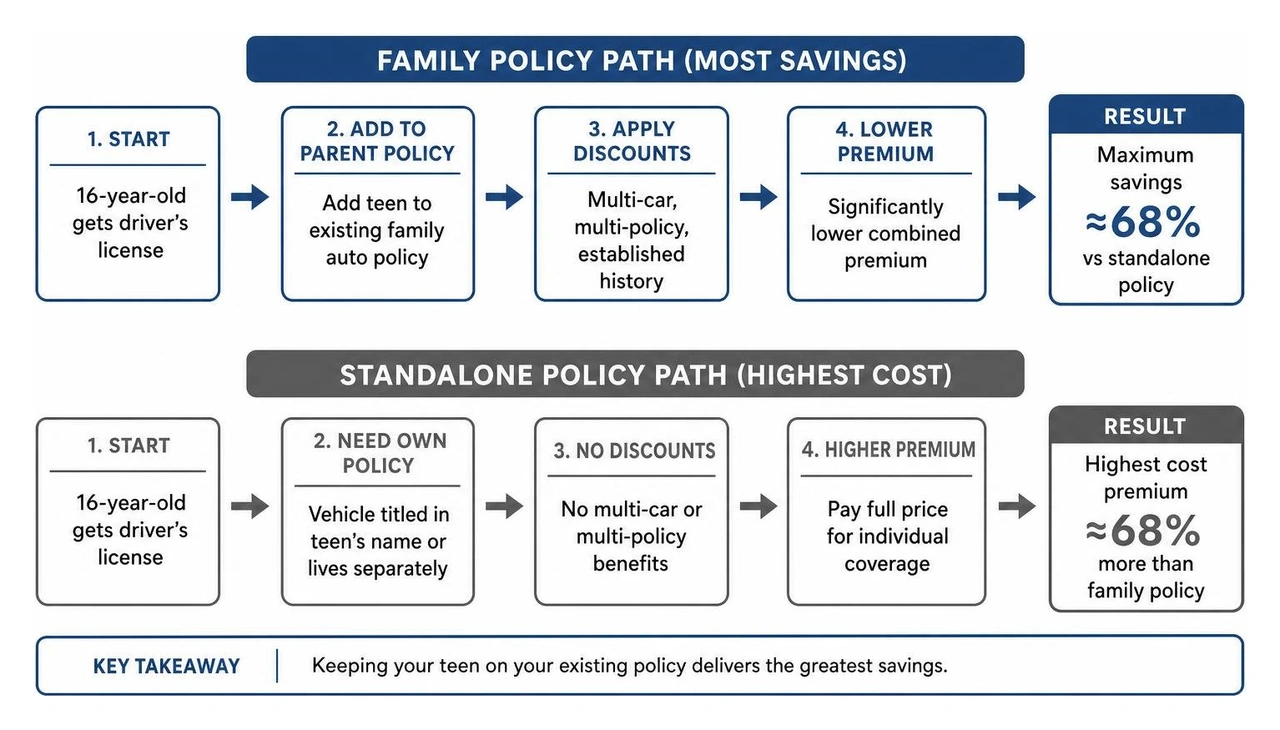
This massive difference comes down to multi-car discounts, multi-policy bundling, and the established credit and policy history of the parents. However, there are legal and structural rules to keep in mind:
- Residency Requirements: Insurance companies generally require all household members who hold a driver's license to be listed on the primary household policy unless they are explicitly excluded or live at a different permanent address.
- Vehicle Titling: In most cases, a vehicle must be titled in the parent's name (or co-titled with the young driver) to be insured on the parents' policy. If a young adult purchases a vehicle titled solely in their own name, carriers typically require a separate insurance policy.
- Standalone Costs: For young drivers who have moved out of the family home or purchased a vehicle in their own name, individual coverage is required. While more expensive, working with an independent agency allows young adults to shop multiple top carriers to secure competitive rates.
To dive deeper into structuring coverage efficiently, see Cheapest Car Insurance for New Drivers in 2026, review our guide on the least expensive car insurance for young drivers, and read our practical tips for cheap car insurance for new drivers.
Key Strategies to Lower Auto Insurance Quotes for Young Drivers
While base rates for young drivers are inherently higher, several actionable strategies can reduce monthly insurance costs:
- Good Student Discounts: High school and college students who maintain a "B" average (3.0 GPA) or higher can qualify for substantial discounts, often cutting premium costs by 10 to 25 percent. Homeschooled students can frequently qualify by scoring in the top 20 percent on standardized tests like the SAT or ACT.
- Defensive Driving & Driver Education Courses: Completing an approved driver safety or driver education course demonstrates extra training and can earn a driver education discount on comprehensive and liability coverages.
- Telematics and Usage-Based Apps: Many insurance partners offer mobile app programs that monitor driving behaviors such as smooth braking, gentle acceleration, daytime driving, and speed. Safe driving habits tracked via app can yield immediate enrollment discounts and ongoing renewal savings.
- Vehicle Selection: The type of car a teenager drives heavily dictates the premium. Standard sedans and compact SUVs equipped with modern crash-avoidance technology cost significantly less to insure than high-performance sports cars or high-end luxury vehicles.
- Deductible Adjustments: Raising comprehensive and collision deductibles (for example, moving from $500 to $1,000) lowers monthly premiums. Just ensure your family retains an emergency fund to cover the higher out-of-pocket deductible in the event of an at-fault claim.
For more hands-on strategies, explore our resources on ways to lower car insurance for young drivers and general car insurance saving tips.
Essential Coverages and Vehicle Choices for Young Drivers
When configuring auto insurance quotes for young drivers, selecting the right mix of coverage levels protects your family's broader financial health.

Here is a breakdown of essential policy components every parent and young motorist should evaluate:
- Bodily Injury and Property Damage Liability: State law mandates minimum liability limits, such as Ohio's baseline requirements ($25,000 bodily injury per person, $50,000 bodily injury per accident, and $25,000 property damage). However, state minimums rarely cover the total damage of a major multi-vehicle accident. Carrying higher liability limits protects your family from personal asset garnishment following a severe crash.
- Comprehensive and Collision Coverages: Collision pays for damage to your vehicle resulting from an accident, while comprehensive covers non-collision events like vehicle theft, vandalism, falling objects, or hitting an animal. On older vehicles where repair costs exceed the car's physical value, carrying full coverage may no longer be cost-effective.
- Uninsured and Underinsured Motorist Protection: Statistically, about one in eight drivers on the road carries no insurance at all. Uninsured motorist coverage ensures your medical costs and vehicle damages are covered if a hit-and-run or uninsured driver strikes your young driver.
- Accident Forgiveness: Because new drivers have a higher probability of an initial minor accident, adding accident forgiveness prevents a first at-fault claim from triggering steep policy surcharges at renewal.
Selecting the right vehicle is equally vital. High-performance, sports cars, and luxury models attract sky-high premiums due to increased crash risk, higher theft rates, and expensive replacement parts. Standard, modest mid-size sedans equipped with advanced driver-assist features provide optimum safety while keeping insurance manageable.
Learn more about vehicle selection and policy structure by checking out How to Get Car Insurance for New Drivers and Teens, reviewing the most expensive car to insure for teenager, and viewing our specialized page on teen driver coverage.
Where to Find High-Risk Coverage and Auto Insurance Quotes for Young Drivers
If a young driver accumulates moving violations, speeding tickets, or an at-fault accident within their first few years of driving, insurance costs will rise. In severe cases involving major infractions like DUIs or multiple tickets within three years, standard insurance companies may non-renew or cancel coverage altogether.
When a young driver becomes classified as high-risk:
- Violation Surcharges: Speeding tickets and traffic infractions can add significant surcharges to policy premiums for three to five years.
- Non-Standard Insurance Carriers: Independent agencies can place high-risk young drivers with specialized non-standard insurance carriers designed to handle higher-risk profiles while helping them rebuild a clean driving record over time.
- State Assigned Risk Plans: In situations where a young driver cannot find standard commercial coverage due to extreme risk history, state assigned risk programs serve as a safety net to ensure mandatory legal liability limits are maintained.
To understand your options if your young driver has a complex driving record, read about auto insurance for high-risk drivers or request a tailored auto insurance quote today.
Frequently Asked Questions about Young Driver Car Insurance
At what age does car insurance become significantly cheaper?
Car insurance rates for young drivers drop noticeably at three specific age milestones: 18, 21, and 25. The most significant decrease occurs at age 25, when insurers reclassify drivers into adult risk brackets. However, enjoying these rate drops requires maintaining a clean driving record free from speeding tickets, moving violations, or at-fault accidents throughout those early driving years.
Is standalone coverage better than joining a parent policy for a young driver?
In almost every situation, keeping a young driver on a parent policy is dramatically cheaper than getting standalone coverage. Parents benefit from multi-car discounts, home and auto bundling discounts, and longer policy histories. A standalone policy is generally necessary only if the young driver moves to a separate permanent address, purchases a vehicle titled strictly in their own name, or if the parents' insurance carrier requires separate coverage due to driver risk factors.
What happens if a young driver operates a vehicle without mandatory insurance?
Driving without valid auto insurance carries severe legal and financial consequences. In Ohio and surrounding areas, state law requires continuous proof of financial responsibility. Operating an uninsured vehicle can lead to heavy state fines, immediate suspension of the driver's license and vehicle license plates, reinstatement fees, mandatory high-risk SR-22 insurance filings, and catastrophic personal financial liability if an accident occurs.
Conclusion
Navigating auto insurance quotes for young drivers does not have to be overwhelming or excessively expensive. As an independent agency serving Hilliard, Columbus, Dublin, Arlington, and Central Ohio, Stanley Insurance Group works directly for you—not a single insurance provider.
Because we can shop across 20+ top insurance carriers, we compare options to find the ideal policy match for your family. We are also proud to be among the select group of only 100 independent agents in the country with a partnership with GEICO.
Our team takes a concierge, relationship-first approach to protecting what matters most—from Home & Property Insurance and Auto & Vehicle Insurance to Life Insurance and Business Insurance. Dedicated Spanish-speaking help and agents are available through Ana and Sandra, our Spanish-speaking Account Specialists. Amy handles Commercial Lines, while Kaisen, Ethan, and Chase serve as Associate Agents ready to assist your household.
Whether you need to add a newly licensed teenager to your family plan or compare standalone coverage for a young adult, we are here to help you navigate every milestone with confidence Since '84.
Explore comprehensive auto insurance options for young drivers
Similar posts