
Step-by-Step Guide to Level Term Policy Comparison
Compare level term life policy options to protect your family with the right coverage and affordable premiums.
What Is a Level Term Life Policy? (Quick Answer)
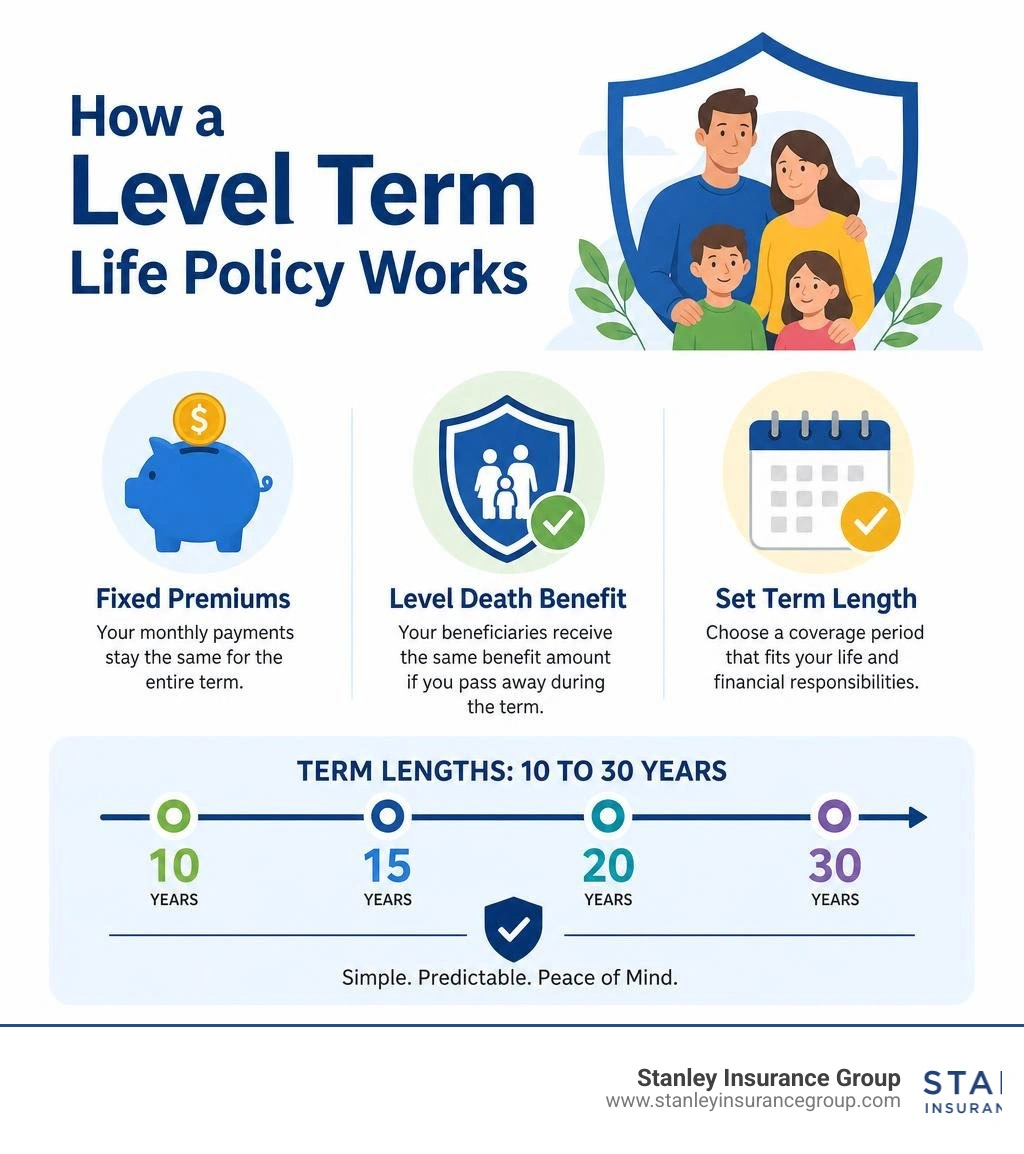
A level term life policy is a type of life insurance where both your monthly premium and your death benefit stay completely fixed for the entire length of the policy — whether that's 10, 20, or 30 years.
Here's what that means in plain terms:
- Death benefit: The payout your family receives never changes — if you buy $250,000 of coverage, that's exactly what they get, whether you pass away in year 1 or year 28.
- Premiums: Your monthly payment is locked in from day one and never increases during the term.
- Term length: Coverage typically runs between 10 and 30 years, chosen to match your biggest financial responsibilities.
- No cash value: Unlike whole life insurance, a level term policy is pure protection — you pay for coverage, not savings.
This makes it one of the most straightforward and affordable ways to protect the people who depend on your income.
Life doesn't come with warnings. Yet 1 in 4 U.S. households would feel the financial impact of losing their primary income earner almost immediately. That's not a small risk — that's a reality for millions of families right now.
The good news? Protection doesn't have to be complicated or expensive. A level term life policy is the most widely used form of life insurance in the country today, and for good reason. It offers clear, predictable coverage during the years when your family needs it most — while your mortgage is unpaid, your kids are still at home, or your business depends on you.
In 2024, 93.8% of term life insurance claims were paid out — a strong sign that when policies are in place, they work.
This guide walks you through everything you need to know to compare your options and find the right fit.
I'm Brandon Stanley, President of Stanley Insurance Group — a family-owned independent agency serving Central Ohio since 1984, where helping families find the right level term life policy is one of the most important conversations we have. With access to 20+ carriers, our team takes the time to match your coverage to your actual life — not just a quote on a screen.
What is a Level Term Life Policy and How Does It Work?
To truly appreciate the simplicity of a level term life policy, it helps to look at how it operates over time. When you purchase this type of coverage, you are essentially entering into a contract with an insurance company for a set number of years. In exchange for your regular premium payments, the insurer guarantees that they will pay a specific sum of money (the death benefit) to your designated beneficiaries if you pass away during that timeframe.
The word "level" is the most important part of this equation. It refers to two distinct features:
- The Death Benefit is Level: If you purchase a policy with a $500,000 face value, that amount remains exactly $500,000 from the first day the policy is active until the very last second of the term. It does not decrease as you get older or as your mortgage gets paid down.
- The Premium is Level: Your monthly or annual payments are locked in. Even if you develop a chronic health condition ten years into the policy, or if inflation skyrockets, the insurance company cannot raise your rates by a single penny.
When setting up your policy, you will select a term length that matches your financial timeline. The most common options are 10, 15, 20, 25, or 30 years. For example, if you have a newborn and a brand-new 30-year mortgage on your home in Dublin or Hilliard, a 30-year term ensures that your family is protected until the kids are financially independent and the house is fully paid off.
Unlike permanent policies (such as whole life or universal life), term insurance does not contain a cash value accumulation component. You are not treating this as an investment vehicle; instead, you are buying pure, unadulterated financial protection. This lack of complexity is precisely why term life is so much more budget-friendly than permanent alternatives. To learn more about how this fits into your broader financial plan, check out our Ultimate Life Insurance Buying Guide.
Level Term vs. Decreasing Term Life Insurance
When shopping for term insurance, you may run across another variation known as decreasing term life insurance. While level term keeps everything steady, decreasing term features a death benefit that shrinks over a pre-determined schedule, even though your premiums usually remain the same throughout the life of the policy.
Historically, decreasing term was heavily marketed as "mortgage protection insurance" because the payout was designed to mirror the declining balance of a traditional home loan. However, in June 2026, level term has overwhelmingly become the consumer choice.
To help you understand why, let's look at how they compare side-by-side:
| Feature | Level Term Life Policy | Decreasing Term Life Insurance |
|---|---|---|
| Death Benefit | Remains completely fixed (e.g., always $500,000) | Decreases over time (usually annually) |
| Premiums | Locked in and guaranteed never to change | Locked in (you pay the same rate for less coverage over time) |
| Flexibility | Highly flexible; beneficiaries can use the cash for any need | Often tied directly to a specific debt like a mortgage |
| Value Over Time | High; you get the same protection in year 19 as year 1 | Declining; your family receives less money if you die later in the term |
| Popularity | The industry standard for modern families | Increasingly rare and specialized |
With a level term policy, your family retains complete control over how the death benefit is spent. If you pass away, your spouse can use the money to pay off the mortgage, fund college tuition, cover daily living expenses, or invest for retirement. With a decreasing term policy, the shrinking payout might only cover the remaining mortgage balance, leaving nothing left over for other urgent financial needs.
If you are looking to protect your family's future, level term provides a much stronger safety net. For a deeper look at how these structures play out in real-world scenarios, you can read about Level Term Life Insurance Cover - Royal London .
Benefits, Drawbacks, and Customization of a Level Term Life Policy
Like any financial product, a level term life policy has its unique set of advantages and limitations. Understanding these pros and cons—and knowing how to customize your coverage—is essential to making an informed decision.

Before diving into the specifics, it is important to understand that the cost of your policy is heavily influenced by underwriting. When you apply, the insurance company evaluates several key factors to determine your risk level:
- Age: The younger you are when you lock in your term, the lower your rates will be.
- Health History: Your current physical health, prescription history, and family medical background play a massive role.
- Lifestyle & Habits: Smoking or using tobacco can more than double your premiums. Your driving record and any high-risk hobbies (like skydiving) are also taken into account.
To figure out how much coverage makes sense for your family's specific situation, take a look at our guide on How Much Life Insurance Is Enough.
Advantages of a Level Term Life Policy
The primary benefit of a level term policy is unmatched predictability. Because your premiums are guaranteed to stay the same, you can easily build this expense into your household budget for the next two or three decades without worrying about surprise rate hikes.
Other key advantages include:
- Simplicity: There are no confusing investment sub-accounts, interest rate calculations, or hidden management fees. You pay your premium, and you are covered. It is that simple.
- Affordability: Because you are only paying for pure insurance protection over a limited period, term life is incredibly cost-effective. It allows you to secure a substantial death benefit that would otherwise be cost-prohibitive under a permanent whole life structure.
- Peace of Mind: Knowing that your family is fully protected during your peak debt and child-rearing years allows you to sleep much better at night.
Many people delay buying life insurance because they believe common misconceptions about its complexity or cost. We debunk these hurdles in our article on Common Myths About Life Insurance.
Limitations of a Level Term Life Policy
While level term is an excellent fit for most people, it does have some drawbacks:
- No Cash Value Accumulation: Once the term ends, the policy expires, and there is no cash refund or savings account to show for it. It functions similarly to auto or home insurance—you pay for protection, and you hope you never actually have to use it.
- Coverage Expiration: If you outlive your term (which is the goal!), your coverage simply stops. If you still need insurance at that point, buying a new policy will be significantly more expensive because you will be older and potentially less healthy.
- Higher Renewal Costs: While some policies allow you to renew on an annual basis after your initial term expires, the rates will jump dramatically based on your attained age.
For a comprehensive comparison of how term life fits alongside permanent options, refer to our Life Insurance Complete Guide.
Customizing Your Coverage with Riders
To bridge the gap between simple term coverage and your family's changing needs, insurance companies offer optional add-ons known as "riders." Here are some of the most valuable riders you can add to a level term policy:
- Term Conversion Rider: This is a highly recommended feature. It allows you to convert your term policy into a permanent life insurance policy (like whole or universal life) before the conversion period ends, without having to undergo a new medical exam or prove insurability. This is incredibly valuable if your health declines during the term and you realize you need lifelong coverage.
- Waiver of Premium Rider: If you become totally disabled and are unable to work, this rider steps in and pays your premiums for you, ensuring your coverage does not lapse when you are at your most vulnerable.
- Accelerated Death Benefit Rider: Often included at no extra cost, this allows you to access a portion of your death benefit early if you are diagnosed with a terminal illness, helping to cover medical bills or hospice care.
- Child Term Rider: This provides a modest amount of life insurance coverage for your children, which can eventually be converted into permanent policies of their own when they reach adulthood.
Frequently Asked Questions About Level Term Insurance
What happens at the end of the level term period?
When your level term period ends, you generally have three main options:
- Let the Policy Expire: If your children are grown, your mortgage is paid off, and you have accumulated enough savings to self-insure, you can simply let the policy lapse. Your financial obligations have been met, and you no longer need the coverage.
- Convert to Permanent Coverage: If your policy includes a conversion rider, you can transition all or part of your term coverage into a permanent policy. To learn more about how your needs shift as the years go by, read about the Benefits of Life Insurance As You Get Older.
- Renew Annually: Most policies offer "guaranteed renewability" up to a certain age (often age 95). However, because your rate will be calculated based on your current age each year, the premiums will rise sharply and quickly become unaffordable for long-term use.
Who is a level term policy best suited for?
Level term insurance is highly recommended for:
- Young Families: Parents who want to ensure their children are cared for, college is funded, and daily living expenses are covered if a parent passes away.
- Homeowners: Anyone with a large, long-term debt like a 15- or 30-year home mortgage.
- Business Owners: Partners who need to fund buy-sell agreements or protect their business from the financial fallout of losing a key employee.
- Income Replacement: Anyone whose spouse or family relies heavily on their monthly paycheck to maintain their standard of living.
How do you apply and get approved for coverage?
Applying for a level term life policy is a straightforward, step-by-step process:
- Determine Your Coverage Needs: Calculate your outstanding debts, future education costs, and income replacement needs.
- Choose Your Term Length: Align the term with your longest-running financial obligations.
- Submit an Application: You will provide basic personal details, beneficiary designations, and answer a series of health and lifestyle questions.
- Undergo Medical Underwriting: Depending on the policy and coverage amount, you may need to complete a brief, free medical exam (where a nurse visits your home or office to check your blood pressure, height, weight, and take a blood sample). Some modern policies offer "simplified issue" underwriting, which skips the physical exam entirely for qualified applicants.
- Review and Activate: Once the underwriters review your file and approve your application, you sign the final documents, pay your first premium, and your coverage goes live.
For more details on navigating this process, you can explore the resources provided by Term Life Insurance Policies | New York Life .
Conclusion
Navigating life insurance can feel overwhelming, but finding the right level term life policy doesn't have to be a solo journey.
At Stanley Insurance Group, we have been serving Hilliard, Columbus, Dublin, Arlington, and the broader Central Ohio community since '84. As a family-owned independent agency, we do things differently. We aren't tied to a single insurance carrier's catalog. Instead, our team works directly for you, comparing options across 20+ top-rated national and regional insurance companies to find the absolute best fit for your family and your budget.
Whether you need Home & Property Insurance, Auto & Vehicle Insurance, Business Insurance, or Life Insurance, we bring a true concierge touch to the process. We believe in building genuine, long-term relationships with our clients—meaning you will always have a named local agent you can actually pick up the phone and reach. We are also incredibly proud to be one of only 100 independent agencies in the entire country to hold a direct partnership with Geico, giving our clients access to unique opportunities and competitive rates.
Have questions or need assistance in Spanish? Our dedicated account specialists, Ana and Sandra, are here to provide fluent, expert support. From our commercial lines specialist Amy to our associate agents Kaisen, Ethan, and Chase, the entire Stanley team is ready to help you protect what matters most.
Don't leave your family's financial security to chance. Let us do the heavy lifting and shop the market on your behalf.
Get a Quote today, or stop by our Hilliard office to speak with a local expert who will treat you like family.
Similar posts