
12 Ways to Lower Your Homeowners Insurance Costs
Discover proven ways to reduce home insurance premiums in 2026 with smart deductibles, bundling, upgrades and policy tips from Stanley Insurance Group.
Home Insurance Costs Are Rising — Here's How to Fight Back
If you're looking for ways to reduce home insurance costs without gutting your coverage, you're not alone. Average premiums rose 24% between 2021 and 2024, and rates continue climbing in 2026. For many Ohio families, that's a real budget problem.
Here are the most effective ways to lower your home insurance premium:
- Shop around and compare quotes — switching insurers can save $2,000 or more per year
- Bundle home and auto policies — multi-policy discounts can reach up to 30%
- Raise your deductible — going from $500 to $1,000 can cut premiums by up to 25%
- Install a monitored security system — earns 5% to 20% discounts with most carriers
- Upgrade your roof — a new roof can reduce premiums by 22% to 40% compared to a 20-year-old roof
- Improve your credit score — poor credit can double your premium in most states
- Maintain a claims-free record — staying claim-free for 5+ years earns loyalty discounts
- Review your policy annually — removing outdated coverage or adjusting limits prevents overpaying
- Ask about every available discount — many go unclaimed simply because homeowners never ask
These strategies work whether you own a starter home or a multi-property portfolio. The sections below break each one down with specific numbers and action steps.
I'm Brandon Stanley, President of Stanley Insurance Group — an independent agency serving Ohio homeowners since 1984 with a hands-on, relationship-first approach to finding the best ways to reduce home insurance costs across carriers. With decades of experience helping Hilliard families, retirees, and professionals navigate a shifting insurance market, I've seen which strategies actually move the needle on premiums.
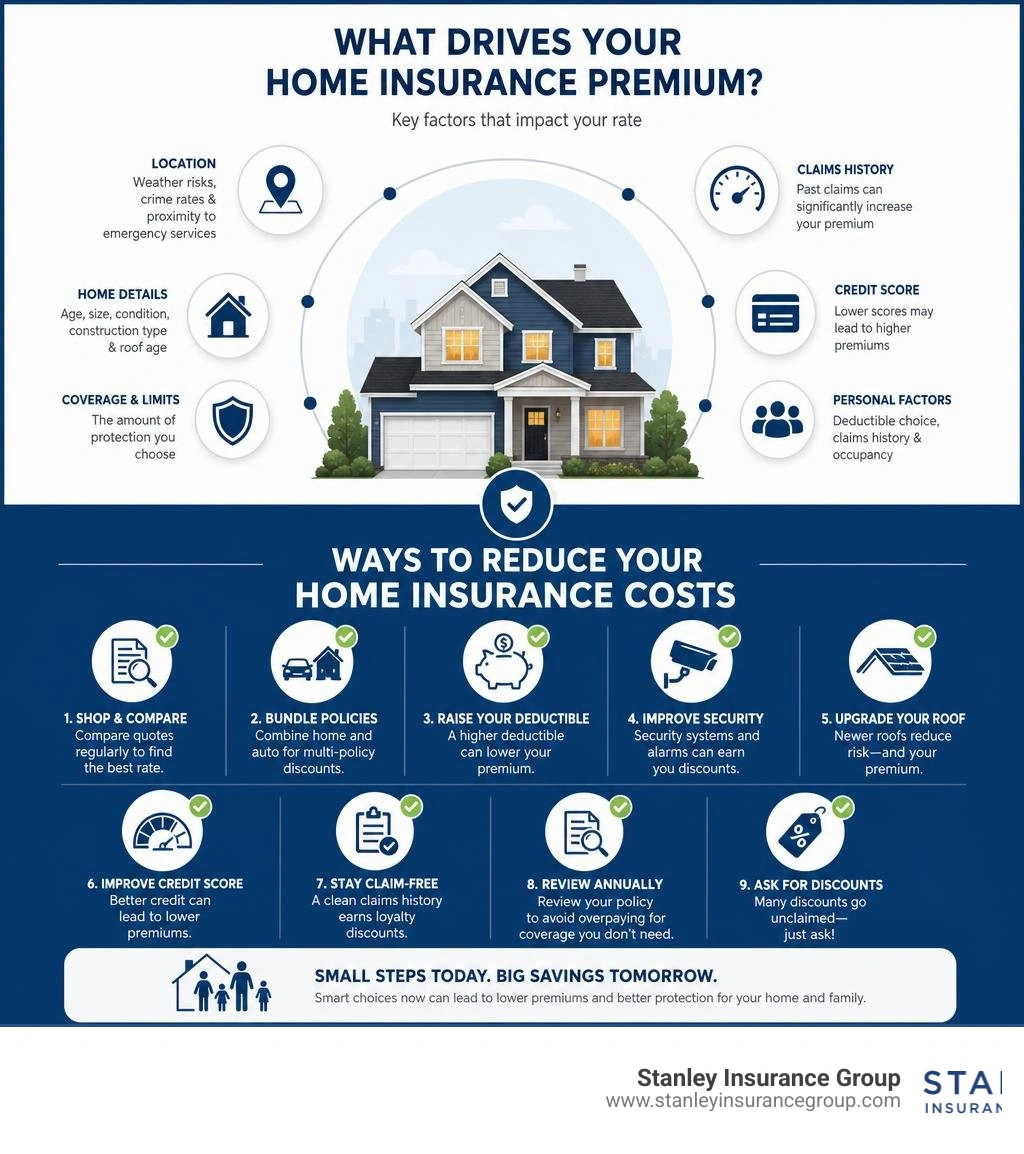
Ways to reduce home insurance terms to learn:
- Best home insurance discounts
- Bundle home and auto insurance
- how to lower homeowners insurance premiums
Why Home Insurance Premiums Are Skyrocketing in 2026
If you have opened your renewal bill recently and gasped, you are in good company. In the current 2026 market, homeowners across Central Ohio—from Hilliard to Dublin and Arlington—are experiencing unprecedented premium increases. This isn't just because of local claims; it is driven by a complex web of macroeconomic factors.
First, severe weather events have become more frequent and destructive nationwide. While we might not face coastal hurricanes in Columbus, global reinsurance costs—the insurance that insurance companies buy to protect themselves—have skyrocketed because of these massive catastrophes. When reinsurance rates rise globally, those costs are passed down directly to local policyholders.
Second, building inflation has hit the construction industry hard. The cost of labor and materials rose roughly 40% over the last few years. If your home is damaged, it costs significantly more to rebuild it today than it did in the early 2020s. Insurers have adjusted their replacement cost models to reflect these higher construction bills, which automatically pushes premiums up.
To navigate these changes, you need a proactive strategy. Understanding how underwriters evaluate your risk is the first step toward reclaiming control over your household budget. For a deeper dive into the market dynamics of 2026, check out How to Reduce Your Home Insurance Premiums in 2026 .
Understanding Actual Cash Value vs. Replacement Cost
When reviewing your policy, one of the most critical decisions you will make is choosing between Actual Cash Value (ACV) and Replacement Cost Value (RCV) for your dwelling and personal property coverage. This choice has a major impact on both your annual premium and your long-term financial security.
- Replacement Cost Value (RCV): This coverage pays to rebuild your home or replace your damaged belongings with brand-new items of similar quality, without any deduction for wear and tear (depreciation). While RCV carries a higher premium, it ensures you won't have to pay thousands of dollars out of pocket to rebuild after a disaster.
- Actual Cash Value (ACV): This option pays only what your property was worth at the time of the loss. It subtracts depreciation based on the age and condition of the item. For example, if a hail storm destroys a 15-year-old roof under an ACV policy, the insurer will only pay a fraction of the cost of a new roof, leaving you to pay the difference.
While choosing ACV can be one of the quickest ways to reduce home insurance premiums upfront, it exposes you to massive out-of-pocket expenses when a claim occurs. We almost always recommend maintaining RCV on your dwelling to protect your greatest financial asset. To learn more about how policy types differ, read our guide on What Are the Different Types of Home Insurance.
Strategic Ways to Reduce Home Insurance Costs Immediately
If you want to lower your home insurance bills today without sacrificing your core protections, you need to focus on structural adjustments to your policy. You do not have to reduce your liability limits or skimp on essential coverage to find relief. Instead, you can look at the structure of your policy deductibles and limits.
To give you a clearer picture of how immediately actionable these changes are, read our comprehensive resource on How to Lower Homeowners Insurance Premiums.
Here is a quick look at how adjusting your deductible can lower your premium:
- Raise your deductible from $500 to $1,000: You may save up to 25%. Keep at least $1,000 available for emergencies.
- Move from $1,000 to $2,500: You could see another 9% to 15% in savings. Aim for a $2,500 emergency fund.
- Increase from $1,000 to $5,000: Savings may reach up to 37% overall, but only if you can comfortably cover $5,000 out of pocket.
Adjusting Your Deductible Safely
Your deductible is the amount of money you agree to pay out of pocket before your insurance coverage kicks in. Raising your deductible is the single fastest way to lower your premium. Moving your deductible from $500 to $1,000 can save you up to 25% on your annual premium. If you are comfortable taking on more risk and have a healthy emergency fund, raising it to $2,500 or $5,000 can save you even more.
However, safety is key. Never raise your deductible to an amount you cannot comfortably afford to pay on short notice. If a major storm hits Hilliard and damages your home, you must have those funds readily available in a savings account to start repairs.
Additionally, keep in mind that many modern policies feature separate deductibles for specific perils, such as wind and hail. These are often structured as percentages (e.g., 1% or 2% of your home's total dwelling coverage) rather than a flat dollar amount. Make sure you understand how these percentage-based deductibles affect your potential out-of-pocket costs before making a change. For more tips on managing deductibles, consult How to reduce your homeowners insurance premiums .
Bundling Home and Auto Policies for Maximum Savings
If you are still buying your home insurance from one company and your auto insurance from another, you are likely leaving a significant amount of money on the table. Bundling your home and auto policies with the same carrier is one of the most reliable and painless ways to reduce home insurance costs.
Most major insurance carriers offer a multi-policy discount ranging from 10% to 30% off your combined premiums. Beyond the financial savings, bundling simplifies your life. You only have to deal with one insurance portal, one renewal cycle, and one team of agents.
At Stanley Insurance Group, we write Home & Property Insurance, Auto & Vehicle Insurance, Life Insurance, and Business insurance. This allows us to look at your entire risk profile and maximize your bundling discounts across all areas of your life. To see if bundling is the right financial move for your household, read Bundle Home and Auto Insurance and learn more about the mechanics of these savings at Does Bundling Insurance Save Money.
Home Upgrades and Security Enhancements That Lower Rates
Insurance companies love proactive homeowners. By upgrading your home's physical systems and adding modern security devices, you transform your property into a "preferred risk." This translates directly into lower premiums.
Smart Home Technology and Security Systems
In 2026, smart home technology is no longer just a luxury—it is a powerful tool for lowering your insurance bills. Water damage from internal plumbing failures is one of the most common non-weather-related home insurance claims. By installing a smart water shut-off valve, you can protect your home from catastrophic flooding and earn a substantial discount.
Carriers look highly upon the following devices:
- Monitored Security Alarms: Systems connected to a central monitoring station that alerts local authorities in the event of a break-in or fire can earn discounts of 5% to 20%.
- Smart Water Shut-Off Valves: These IoT-enabled devices detect unusual flow patterns and automatically shut off your main water line, earning discounts of 7% to 12% with top carriers.
- Smart Smoke and Carbon Monoxide Detectors: Connected alarms that notify your smartphone and monitoring services immediately during an emergency can qualify you for extra safety credits.
Investing in these systems often pays for itself within a few years of insurance savings. For a detailed list of qualifying upgrades, check out 11 Strategic Home Upgrades to Slash Your Insurance Premiums in 2026 | Surety Insights .
Structural Fortifications and Disaster Resistance
Making structural improvements to your home is another smart way to secure lower rates while building long-term equity. Your roof is your home's first line of defense, and its age and material play a massive role in underwriting.
A 20-year-old roof can cost 22% to 40% more to insure than a brand-new roof. If you are planning to replace your roof soon, consider upgrading to Class 4 impact-resistant shingles. These shingles are tested to withstand severe hail and high winds, often qualifying you for premium discounts of 20% to 35% in hail-prone states like Ohio.
Other high-impact upgrades include updating your home's electrical panel (such as upgrading an old 60-amp panel to a modern 200-amp service with Arc-Fault Circuit Interrupter breakers) and updating old galvanized plumbing to copper or PEX. These upgrades eliminate fire and water risks, which standard insurers view very favorably. To find out more about Ohio-specific home improvements and rates, read Ways to Help Reduce Homeowners Insurance Costs in Ohio .
Smart Policy Management and Behavioral Ways to Reduce Home Insurance
Some of the best ways to reduce home insurance don't require swinging a hammer or buying new smart gadgets. They simply require smart policy management and a strategic approach to how you interact with your insurance carrier.

What are the most reliable ways to reduce home insurance costs?
One of the most reliable ways to keep your insurance costs low is to protect your claims-free discount. Most carriers offer a discount of 5% to 20% if you have not filed a claim within the last three to five years.
Filing small claims—such as a $1,200 claim when you have a $1,000 deductible—is a costly mistake. You will only receive a tiny payout of $200, but you will lose your claims-free discount and your premium could jump by 20% to 40% for the next three to five years. As a rule of thumb, avoid filing claims for losses that are less than two to three times your deductible. Pay for minor repairs out of pocket to protect your long-term savings. For more guidance on claims, refer to our Home Insurance Claims Tips Guide.
Additionally, pay attention to your credit-based insurance score. In Ohio, insurers are permitted to use your credit history to help determine your premium. Maintaining a strong credit score by paying bills on time and keeping credit card balances low can keep your premium significantly lower than someone with poor credit.
Are there simple ways to reduce home insurance without losing coverage?
Yes! You can easily optimize your policy by reviewing your coverage limits annually. Over time, the value of your personal possessions can change. If you have sold expensive jewelry, downsized your belongings, or if certain high-value items have depreciated, you can remove special policy endorsements or riders that you no longer need.
Also, make sure you are not insuring the value of your land. Your home insurance policy should only cover the cost to rebuild the physical structure of your home (the dwelling), not the market value of the land it sits on. Land cannot burn down or be blown away by a windstorm, so excluding it from your coverage limits prevents you from overpaying on your premium.
To make sure your policy is right-sized for your current needs, check out our guides on the Home Insurance Policy and Ways to Save Money on Homeowners Insurance.
Frequently Asked Questions About Home Insurance Savings
How much can I save by raising my home insurance deductible?
Raising your deductible is one of the most effective ways to reduce home insurance costs quickly. Moving from a $500 deductible to a $1,000 deductible can save you up to 25% on your annual premium. If you are comfortable raising it to $2,500 or even $5,000, your savings could reach 35% to 45%, depending on your carrier and the age of your home. Always ensure you have this deductible amount saved in an accessible emergency fund. For more details on deductible savings, read about Ways to Reduce Insurance Costs.
Do smart home devices really lower homeowners insurance premiums?
Yes, they do. Many top-tier insurance carriers offer premium discounts ranging from 5% to 20% for smart home upgrades. Centrally monitored security systems, smart smoke alarms, and automatic water shut-off valves are highly valued by insurers because they actively prevent or mitigate major losses. Over time, the premium savings can easily pay for the cost of the devices. To explore which discounts you might qualify for, read our post on the Best Home Insurance Discounts.
How often should I shop around for a new home insurance policy?
We recommend reviewing your policy limits annually and comparing quotes from other carriers every 12 to 24 months, or whenever you experience a major life milestone (such as a home renovation, marriage, or bundling a new vehicle). Working with an independent agency makes this process effortless, as we can shop multiple carriers on your behalf to find the best rate without you having to fill out dozens of forms. If you need assistance with your annual review, visit our Insurance Help page.
Conclusion
At Stanley Insurance Group, we believe that navigating the changing home insurance landscape in 2026 shouldn't feel like a solo survival mission. As a family-owned independent agency based in Hilliard, Ohio, we have been serving Central Ohio families and businesses since '84.
Over the last 40+ years, we have built our reputation on a simple promise: providing a personalized, concierge touch that captive or chain agencies simply cannot match. We don't just sell policies; we build lifelong relationships.
Because we are independent, we don't work for a single insurance company—we work for you. We can shop your coverage across 20+ top-rated national and regional carriers to find the absolute best ways to reduce home insurance premiums for your specific situation.
Plus, we are proud to offer deep carrier relationships, including being one of only 100 independent agencies in the entire country with a direct partnership with Geico. Whether you are looking for home, auto, life, or business coverage, our dedicated team is here to guide you every step of the way.
Meet our team of licensed professionals:
- Amy — Commercial Lines Specialist
- Ana — Account Specialist (Spanish speaking available!)
- Sandra — Account Specialist (Spanish speaking available!)
- Kaisen — Associate Agent
- Ethan — Associate Agent
- Chase — Associate Agent
If you are ready to see how much you could save on your home insurance with an independent advocate in your corner, let us do the heavy lifting for you.
Get a customized quote today and experience the concierge difference that has kept Central Ohio families protected for more than four decades.
Similar posts