A Practical Guide to Affordable High-Risk Auto Insurance
A Practical Guide to Affordable High-Risk Auto Insurance - Learn about automobile insurance for high risk drivers
Understanding Automobile Insurance for High Risk Drivers
When insurance companies evaluate an application, they rely heavily on statistical risk assessment. Every insurance carrier uses complex algorithms to predict how likely you are to file an expensive claim or miss a premium payment. When those statistical odds cross a certain threshold, standard insurance carriers may decline to issue a policy or charge elevated rates. This is where non-standard insurance carriers step in to provide automobile insurance for high risk drivers.
The non-standard auto insurance market exists specifically to provide legal financial protection for drivers who do not meet typical underwriting criteria. Whether you need coverage to satisfy court-ordered license reinstatement requirements or simply want peace of mind while commuting, non-standard policies ensure you remain legally compliant. For a deep dive into modern coverage strategies, check out our Car Insurance Guide for High Risk Drivers 2026.
Who Qualifies as a High-Risk Driver?
A high-risk driver is anyone whose profile indicates an above-average statistical probability of traffic accidents, traffic violations, or claim payouts. Standard carriers often flag applicants based on specific items in their driving records.
Drivers who typically qualify as high-risk include:
- Individuals with major moving violations like DUIs, DWIs, or reckless driving.
- Drivers involved in multiple at-fault accidents over a short timeframe.
- Inexperienced drivers, such as teens under 21 or adults who recently obtained their driver's license.
- Seniors over age 70, whom insurers statistically associate with higher accident vulnerability.
- People with significant gaps or lapses in past car insurance history.
Non-Standard vs. Standard Policies
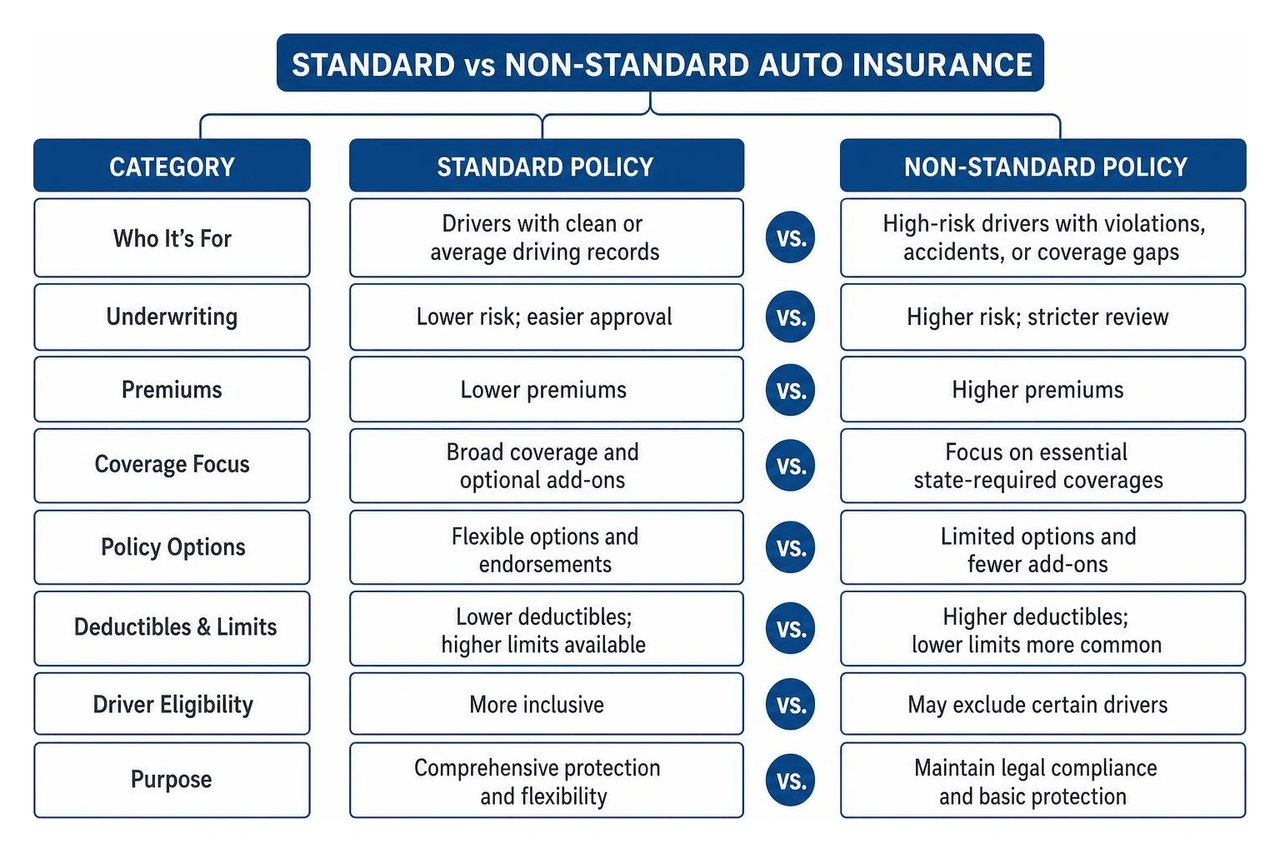
Insurers generally segment drivers into three primary risk tiers: Preferred, Standard, and Non-Standard. Preferred drivers enjoy clean records and the lowest premiums, while Standard drivers represent average consumer risk. The Non-Standard tier includes high-risk individuals who require specialized policy structures.
While standard policies offer broad endorsements and low deductibles, non-standard auto policies focus heavily on essential state-mandated protections. Non-standard policies may come with tighter coverage limits, higher deductibles, or strict driver exclusion lists. However, working with an independent agency allows you to secure robust protection—including collision and comprehensive limits—even within the non-standard market. To learn more about customized policy limits, review our breakdown of Auto Insurance Coverage.
Key Factors That Lead to High-Risk Classification

Underwriting criteria vary between carriers, but certain red flags consistently trigger high-risk placement during risk evaluations. Understanding these triggers helps you anticipate rate adjustments and plan your record's recovery path.
Traffic Violations, DUIs, and At-Fault Accidents
Your recent driving history carries the heaviest weight during insurance rating checks. Major offenses and repeated moving violations drastically increase your risk profile.
- DUI and DWI Convictions: A single conviction for driving under the influence can double your auto insurance premiums instantly. Industry statistics show that having a DUI could nearly double your car insurance rates, requiring specialized coverage and formal state filings.
- At-Fault Accidents: On average, auto insurance rates go up about 50% after an at-fault accident. Insurers view past accidents as key indicators of future claim likelihood.
- Multiple Moving Violations: Accumulating several speeding tickets or reckless driving citations within three years marks you as an aggressive driver, moving you quickly out of standard insurance pools.
For additional insight into finding competitive rates following serious citations, you can consult Bankrate's High-Risk Driver Resource.
Coverage Lapses, Age Demographics, and Poor Credit
High-risk labels aren't strictly reserved for dangerous driving habits. Non-driving factors and administrative gaps play a massive role in setting your premiums.
- Lapses in Insurance Coverage: Allowing your auto policy to lapse for even 30 days puts you in a high-risk bracket. Insurers view gaps in coverage as a warning sign of poor payment reliability or unlicensed driving.
- Age Demographics: Young drivers under 21 lack driving experience, while drivers over 70 experience age-related risk spikes. Both age demographics face automatic rate surcharges from standard carriers.
- Credit-Based Insurance Scores: In Ohio, insurers legally evaluate credit history to calculate pricing. The average annual car insurance rate for a 25-year-old driver with poor credit is $3,373 for full coverage and $1,164 for minimum coverage.
If you have experienced license suspensions or coverage gaps, explore our dedicated resource on Auto Insurance for High Risk Drivers to map out your next steps.
Coverage Options, SR-22 Filings, and Expected Costs

Securing automobile insurance for high risk drivers means understanding mandatory state filings alongside your standard policy coverage options.
Essential Coverage Types and SR-22 Requirements
High-risk drivers can buy more than just legal minimum liability. Depending on whether your vehicle is financed, non-standard policies can include:
- Property Damage and Bodily Injury Liability: Covers damages and medical bills for other parties when you are at fault.
- Collision Coverage: Pays to repair your vehicle following a collision with another car or object.
- Comprehensive Coverage: Protects against non-collision events like theft, vandalism, animal strikes, or storm damage.
If your license was suspended due to a DUI or severe traffic conviction, the state motor vehicle department will require an SR-22 certificate. An SR-22 is not an insurance policy itself; it is an official certificate of financial responsibility that your insurance company files directly with the state to prove you carry active minimum liability coverage. Specialty carriers can issue electronic SR-22 filings quickly to restore your legal driving status.
Automobile Insurance for High Risk Drivers: Cost Breakdown and Duration
How much does non-standard auto coverage cost, and how long does the high-risk classification stick around?
Non-standard minimum coverage car insurance typically ranges from $900 to $2,000 per year, while non-standard full coverage car insurance ranges between $1,800 and $3,500 annually. For context, high-risk drivers pay significantly more than the $565 national average annual cost for minimum coverage.
In most states, minor traffic tickets and convictions stay on your driving record for roughly three to five years, affecting your rates throughout that window. At-fault accidents also influence your premiums for up to five years. For a comprehensive cost overview, see our breakdown on the Average Cost for High Risk Car Insurance or read The Zebra's High-Risk Driver Analysis.
Practical Strategies to Lower Premiums and Rebuild Your Record
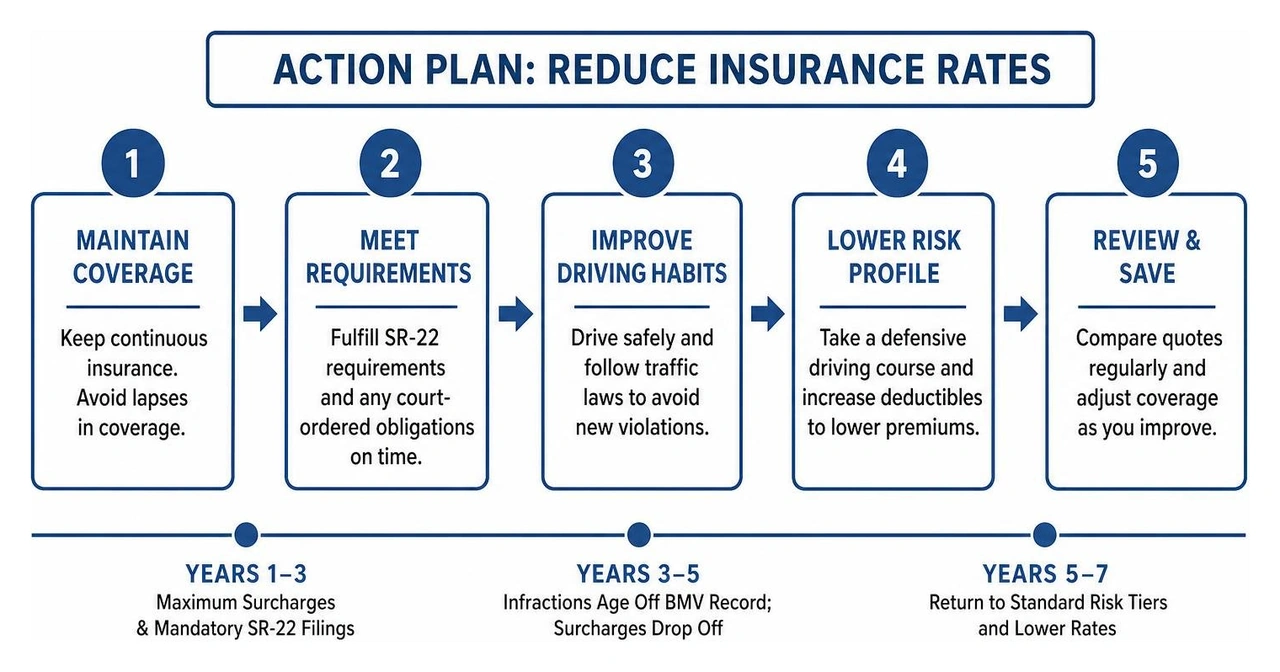
Being classified as a high-risk driver is a temporary state, not a permanent life sentence. You can take immediate, proactive steps to lower your premiums right now while steadily improving your insurance standing.
Proven Ways to Rebuild Driving Status
- Maintain Continuous Coverage: Never allow your policy to lapse. If you sell your car but want to prevent coverage gaps, purchase a non-owner auto insurance policy to keep your insurance record intact.
- Take a Defensive Driving Course: Completing a state-approved driver improvement program demonstrates commitment to safety and often earns you an immediate policy discount.
- Adjust Your Deductibles: Raising your collision and comprehensive deductibles (for example, from $500 to $1,000) reduces your ongoing monthly payments. Just ensure you keep that deductible amount saved in an emergency fund.
- Improve Credit-Based Scores: Pay bills on time and review credit reports for errors. Raising your credit score directly reduces auto insurance costs over time.
- Bundle Insurance Policies: Combine your auto coverage with home, renters, or business insurance to unlock valuable multi-policy discounts.
Discover additional cost-cutting techniques by reviewing our guide on the Cheapest Insurance for Bad Driving Record.
What to Do If You Are Denied Automobile Insurance for High Risk Drivers
If standard and specialty direct carriers decline your application, don't worry—you won't be left stranded. Every state provides access to an assigned risk plan through the Automobile Insurance Plan Service Office (AIPSO). These state pools assign high-risk applicants to licensed insurance companies, guaranteeing that every driver can obtain legal coverage.
Before resorting to state pools—which can be expensive—partner with an independent agency. Independent brokers can shop across dozens of specialized non-standard carriers that don't market directly to the public. To explore your options further, check our comprehensive guide on High Risk Car Insurance.
Frequently Asked Questions
How long will I remain in the high-risk driver category?
In most cases, you will remain classified as high-risk for 3 to 5 years. Minor moving violations and at-fault accidents usually affect rates for 3 to 5 years before falling off your state record. Major offenses like DUIs can impact rates slightly longer, but keeping a clean driving history during those initial years will trigger substantial rate decreases as surcharges expire.
What is the difference between an SR-22 and an FR-44 filing?
Both are official certificates of financial responsibility filed by insurance carriers on your behalf. An SR-22 verifies that you meet state minimum liability limits. An FR-44 (required primarily in states like Florida and Virginia for serious offenses like DUIs) requires significantly higher liability limits—often double or triple standard state minimums.
Can I get full coverage auto insurance with a DUI on my record?
Yes! A DUI conviction does not restrict you to basic liability insurance. Specialty non-standard insurance carriers offer full coverage options—including collision and comprehensive coverage—to drivers with DUIs on their records.
Finding Affordable High-Risk Auto Coverage

Navigating automobile insurance for high risk drivers shouldn't feel like a lecture or an uphill battle. At Stanley Insurance Group, we believe every driver deserves access to reliable, affordable protection and a second chance on the road.
As a family-owned, independent insurance agency serving Hilliard, Columbus, Dublin, Arlington, and the broader Central Ohio community Since '84, we bring over 40 years of local experience to your side. Captive or chain agencies can only offer policy quotes from a single brand—if their company says no, you're out of luck.
We do things differently. Our team works for you, leveraging deep carrier relationships to shop over 20 top national and regional carriers on your behalf. In fact, we are proud to be among only 100 independent agencies nationwide with a direct partnership with GEICO.
When you work with us, you experience true concierge service. You'll build genuine relationships with named account specialists like Ana and Sandra—who offer full Spanish-speaking support for our clients—commercial specialist Amy, or associate agents Kaisen, Ethan, and Chase. Whether you need a same-day electronic SR-22 filing, guidance on non-owner coverage, or support bundling your auto insurance with home, life, or business insurance, we are here to simplify the process.
Don't let a blemished driving history keep you off the road or drain your bank account. Contact our team today or visit our website to Get a Quote and see how much you can save with a trusted local partner on your side.
Similar posts


