Navigating the Road: What High-Risk Auto Insurance Really Means
Understand high risk car insurance. Learn what makes you high-risk, reduce costs, and find your path back to standard coverage.
Understanding High-Risk Car Insurance: The Basics
High risk car insurance isn't a separate policy type; it's standard auto insurance priced higher for drivers seen as more likely to file claims. This classification directly affects your premiums and coverage options.
Key factors that make you a high-risk driver:
- Multiple at-fault accidents or speeding tickets
- DUI/DWI convictions or reckless driving charges
- Lapses in insurance coverage or cancelled policies
- Poor credit score (in most states)
- Being a new or inexperienced driver
- Driving certain high-performance vehicles
What this means for your insurance:
- Premiums can be 30-80% higher than standard rates
- Some insurers may require upfront payment of your full policy
- You might need an SR-22 filing to prove financial responsibility
- Limited coverage options from some insurance companies
The good news? High-risk status isn't permanent. Most violations affect your rates for 3-5 years, and there are proven strategies to lower your premiums.
I'm Brandon Stanley. Since founding Stanley Insurance Group in 1984, I've helped countless Ohio drivers steer high risk car insurance challenges. My team specializes in working with independent carriers to secure competitive rates for drivers in these situations.
What Makes a Driver "High-Risk"?
Insurance companies use data to identify drivers more likely to file claims, labeling them as high-risk. This statistical analysis determines who pays more for high risk car insurance.
Key red flags on your driving record include at-fault accidents. Even one can place you in high-risk territory, while multiple accidents almost guarantee it. Speeding tickets also add up, signaling risky behavior to insurers. The most serious offenses are DUI or DWI convictions and reckless driving charges, which show a history of dangerous choices behind the wheel.
It's not just about violations. Young drivers and inexperienced drivers of any age face higher rates until they build a solid, safe driving history. We offer helpful resources on Ways to Lower Car Insurance for Young Drivers.
Even non-driving factors can hurt you. A history of lapsed coverage or policies cancelled for non-payment suggests financial instability, which insurers link to higher claim rates. In most states, your credit score is also a major factor. Insurers have found a strong link between credit management and claim frequency, so poor credit can significantly increase your rates. You can learn more about this through Credit-Based Insurance Scores.
How Violations Impact Your Premiums
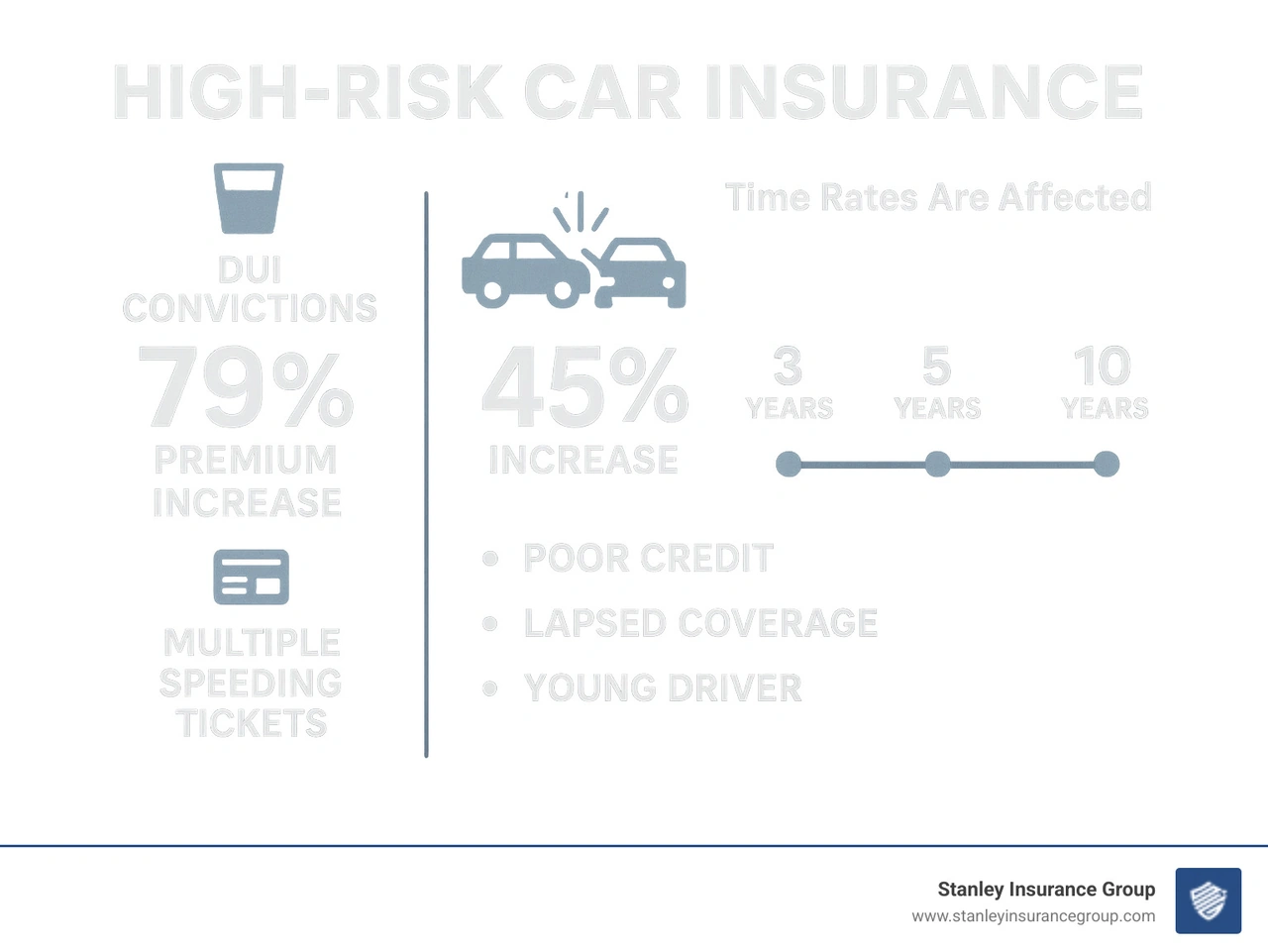
Violations hit your wallet hard. A DUI conviction is the most severe, with an average premium spike of 79% and some drivers facing increases of over 500%. One poor decision can cost thousands annually.
A single at-fault accident typically increases premiums by 45% to 53% (about $920 annually), as insurers see you as more likely to have another.
Multiple speeding tickets also have a significant impact. Two tickets can raise your rates by 43%, while three or more could double your premium.
Criminal code offenses like careless driving can be devastating, sometimes leading to increases of over 500%. A policy cancelled for non-payment can also force you into the high-risk market for at least three years.
Non-Driving Factors That Increase Risk
Your driving record isn't the only factor. Several non-driving elements can place you in the high risk car insurance category.
Age and experience are critical. Teen drivers face higher rates due to inexperience, while very elderly drivers might see increases due to age-related risks. We have specialized guidance for Auto Insurance for Elderly Drivers.
Your credit score is a major factor in states like Ohio. Poor credit can nearly triple your insurance costs compared to excellent credit. Stanley Insurance Group has helped Ohio drivers steer this since '84.
The vehicle you choose also plays a role. Sports cars and luxury vehicles cost more to insure due to higher repair costs, theft rates, and performance capabilities.
Even your zip code affects your rates. Living in areas with high rates of accidents, theft, or vandalism automatically increases your premiums, regardless of your personal driving safety.
The Impact of a High-Risk Classification
Being labeled a high-risk driver shifts you from the standard insurance market to the "non-standard" or "specialty" market. The experience and the bill will be quite different.

The most immediate impact is higher premiums. High risk car insurance typically costs two to three times more than a standard policy, as insurers adjust rates to match the increased financial risk.
You'll shop for non-standard policies designed for drivers who don't qualify for traditional coverage. While this might sound limiting, these policies can be comprehensive when you work with the right agent.
Coverage limitations can be another reality. While you can still get liability, collision, and comprehensive coverage (learn more about Types of Auto Insurance Coverage), some non-standard policies may have higher deductibles or lower limits.
For serious violations, SR-22 requirements are common. This is a certificate your insurer files with the state to prove you carry minimum coverage, acting as a monitor for your insurance.
Understanding the Cost of High Risk Car Insurance
Understanding the financial impact is key. High risk car insurance is a significant budget adjustment, with non-standard policies typically costing 30% to 80% more than standard rates.
The severity of your violation dictates the cost. A DUI conviction can multiply your premiums, while an at-fault accident might spike them by around 45% (an average of $920 annually). While factors like the Car Insurance Inflation Rate affect everyone, high-risk drivers feel these impacts more acutely.
Standard and non-standard policies differ in several practical ways:
- Eligibility: Standard auto insurance is usually for drivers with clean or minor driving records, while non-standard high-risk auto insurance is for drivers with problematic records or other risk factors.
- Premiums: Standard policies generally cost less because the driver is viewed as lower risk. Non-standard policies cost more because the insurer is taking on elevated risk.
- Coverage: Standard policies often offer a broad range of options, including full coverage. Non-standard policies may still provide liability, collision, and comprehensive coverage, but they can come with fewer options, lower limits, or higher deductibles.
- Payment terms: Standard insurers often offer flexible monthly or annual payment plans. High-risk policies may require more money upfront, and some may require the full premium to be paid in advance.
- Insurers: Most major insurance companies write standard auto policies. High-risk drivers may need specialized insurers or, in limited cases, an assigned risk pool.
- Duration: Standard coverage can continue as long as the driver remains an acceptable risk. High-risk coverage is often temporary, and many drivers can move back toward standard rates after 2-3 years of clean driving.
- Underwriting: Standard underwriting is usually broader and less restrictive. Non-standard underwriting is more stringent and customized around the driver's specific risk factors.
SR-22 Filings and State Requirements
An SR-22, or Certificate of Financial Responsibility, isn't insurance. It's a document your insurer files with the state DMV to prove you have the minimum required liability coverage.
You'll typically need an SR-22 after serious offenses like a DUI conviction, driving without insurance, reckless driving, or having your license suspended. The state wants proof that you are properly insured.
Most states require an SR-22 for two to five years. During this period, your insurer must notify the state if your policy lapses, making on-time payments critical.
Here in Ohio, we understand these requirements inside and out. At Stanley Insurance Group, serving Columbus, Hilliard, Dublin, and Arlington since '84, we've helped countless drivers steer the SR-22 process. For more details on Ohio's requirements, see our guide to Ohio Auto Insurance: What You Need to Know About Auto Insurance.
An SR-22 requirement isn't permanent—it's part of your journey back to standard insurance rates.
Navigating the World of High Risk Car Insurance
When you're looking for high risk car insurance, you have more options than you might think.
Specialized insurance companies exist to help high-risk drivers get coverage. When traditional insurers say no, independent insurance brokers like our team at Stanley Insurance Group step in. Since '84, we've helped Ohio drivers by working with dozens of carriers, including those specializing in high risk car insurance, to shop around on your behalf.
If private insurers can't help, every state has an assigned risk pool as a safety net. This ensures every licensed driver can get basic liability coverage, though it's not the cheapest option.
Driving uninsured is never the answer. The consequences are severe, especially for high-risk drivers: hefty fines, license suspension, vehicle impoundment, and potential jail time. It also makes future insurance more expensive and often requires an SR-22. For guidance, check our resource on Auto Insurance for High-Risk Drivers.
The Role of an Independent Insurance Broker
For high risk car insurance, an independent broker is your best ally. At Stanley Insurance Group, we provide the concierge touch only independent agents can, building genuine relationships to understand your unique situation.
Our market access is our strength. We partner with numerous carriers, including specialists in high-risk coverage. As one of only 100 independent agencies in the country with a Geico partnership, we have exceptionally broad access to find the best match for your needs and budget.
Personalized advice sets us apart. We review your risk factors, explain non-standard policies in plain English, and outline steps to improve your standing over time.
Policy comparison goes beyond price. We examine coverage limits, deductibles, and terms to find comprehensive protection and available discounts.
Advocacy during claims means you're never alone. We work with the insurer for a fair and timely resolution, an approach that has served our clients well since 1984.
Our team brings diverse expertise. Amy handles commercial lines, while Ana and Sandra are Spanish-speaking account specialists. Associate agents Kaisen, Ethan, and Chase are ready to guide you through the process.
Finding the Best High Risk Car Insurance Policy
Finding the right high risk car insurance policy means balancing coverage and affordability for your situation.
Comparing quotes is the golden rule. Different insurers view risk differently. Our independent agents streamline this process, saving you time and finding better rates.
Understanding your coverage options is crucial. Liability coverage, the legal minimum, covers damages you cause to others. Collision and comprehensive protect your own vehicle from accidents, theft, and other damage. While costlier for high-risk drivers, they provide essential financial protection.
Before choosing a policy, ensure it meets your state's minimum liability requirements. Driving without it leads to severe penalties.
If you need coverage quickly, our Same Day Auto Insurance options can help you secure protection when time is critical.
Your Roadmap Back to Standard Insurance
Being classified as a high-risk driver isn't a permanent label. With time, patience, and safe driving, you can work your way back to standard insurance rates. Every violation-free year moves you further from the high risk car insurance classification.
The key ingredients for your comeback story include:
Maintaining a spotless driving record is critical. This means no tickets, accidents, or lapses in coverage. Proactive steps like completing defensive driving courses can also help, often qualifying you for immediate discounts.
Improving your credit score can significantly impact your premiums in states like Ohio. Paying bills on time and keeping credit card balances low can make a real difference.
Adjusting your policy by choosing higher deductibles or bundling auto with homeowners insurance can also lead to savings. At Stanley Insurance Group, we've helped drivers find these opportunities since '84.
Even high-risk drivers can qualify for discounts like multi-car, good student, or low-mileage reductions. Our team—including Amy, Ana, Sandra, Kaisen, Ethan, and Chase—knows which discounts to look for. For more strategies, see our guide on Tips for Reducing Car Insurance.
How Long Will I Be Considered High-Risk?
The timeline for leaving high-risk status depends on your violation. Understanding these timeframes helps you plan and stay motivated.
Minor violations like speeding tickets typically affect rates for 3-5 years, with their impact diminishing over time until they fall off your record.
At-fault accidents influence rates for about 6 years, but their impact lessens with a subsequent clean record.
Policy cancellations for non-payment or driving without insurance can keep you in the high-risk market for 3-6 years.
Major convictions like a DUI present the biggest challenge, remaining on your record for many years and potentially requiring high risk car insurance for a decade or more.
The good news is most drivers can transition back to standard policies after 2-3 years of clean driving. Once you qualify, your previous high-risk status won't impact new premiums.
Every insurer evaluates risk differently. Our independent agency's relationship with multiple carriers—including being one of only 100 agencies nationwide partnered with Geico—is a major advantage for our clients.
Frequently Asked Questions about High-Risk Auto Insurance
After nearly four decades in the business (since '84!), our team at Stanley Insurance Group has heard just about every concern. Here are the most common questions we encounter about high risk car insurance.
How much more does high-risk insurance typically cost?
High risk car insurance costs significantly more, often 30% to 100%+ higher than standard rates. After a major violation like a DUI, premiums can be two to three times higher. The exact increase depends on the violation, your profile, and the insurer. An independent agent can shop multiple carriers to find the best available rate in the high-risk market.
Can I get the same level of coverage as a standard driver?
Yes, you can get the same coverage types (liability, collision, comprehensive) as a standard driver. The main difference is the higher cost. Some non-standard policies may have stricter terms, like higher deductibles or upfront payment requirements. Our agents help you find the right policy to ensure you're properly protected.
What are the consequences of driving uninsured if I'm high-risk?
Driving uninsured while high-risk has severe consequences: hefty fines, license suspension, vehicle impoundment, and potential jail time. You will likely need an SR-22 to restore your license, making future insurance even more expensive. If you cause an accident, you are personally liable for all damages, which can be financially devastating. The cost of high risk car insurance is always less than the cost of being uninsured. Our team, including our Spanish-speaking specialists Ana and Sandra, can help find affordable options to keep you legal and protected on Ohio's roads.
Conclusion
The truth about high risk car insurance is that it's not a life sentence. This status is temporary. With consistent safe driving, proactive steps, and the right guidance, you can work your way back to standard insurance rates.
The key is taking action. Whether it's a defensive driving course, improving your credit, or maintaining a clean record, every positive step counts toward lower premiums.
Expert guidance makes all the difference. Since '84, Stanley Insurance Group has helped drivers steer these exact challenges. As an independent agency, we offer a concierge touch, building real relationships with our clients instead of just processing policies.
Our team understands every situation is unique. Amy handles commercial lines, while our Spanish-speaking specialists, Ana and Sandra, ensure language is no barrier. Associate agents Kaisen, Ethan, and Chase serve clients across Ohio, Pennsylvania, Tennessee, North Carolina, South Carolina, and Florida.
Our access to multiple insurance markets sets us apart. As one of only 100 independent agencies nationwide with a Geico partnership, we can shop your coverage with numerous carriers to find the best fit.
Don't let a high-risk classification keep you off the road or overpaying. Our experienced team knows how to work with high-risk insurers and present your case in the best light.
Ready to take control of your insurance costs? Get a personalized auto insurance quote today and let us help you chart your course back to better rates.
Similar posts


