How Inflation Affects Insurance Rates: Beginner's Guide
Learn how inflation affects insurance rates and discover practical ways to lower your premiums today.
Why Inflation Hits Your Insurance Bill Harder Than You Think
How inflation affects insurance rates is one of the most common questions homeowners, drivers, and business owners are asking right now — and for good reason. Here is the short answer:
How Inflation Raises Insurance Premiums: Quick Summary
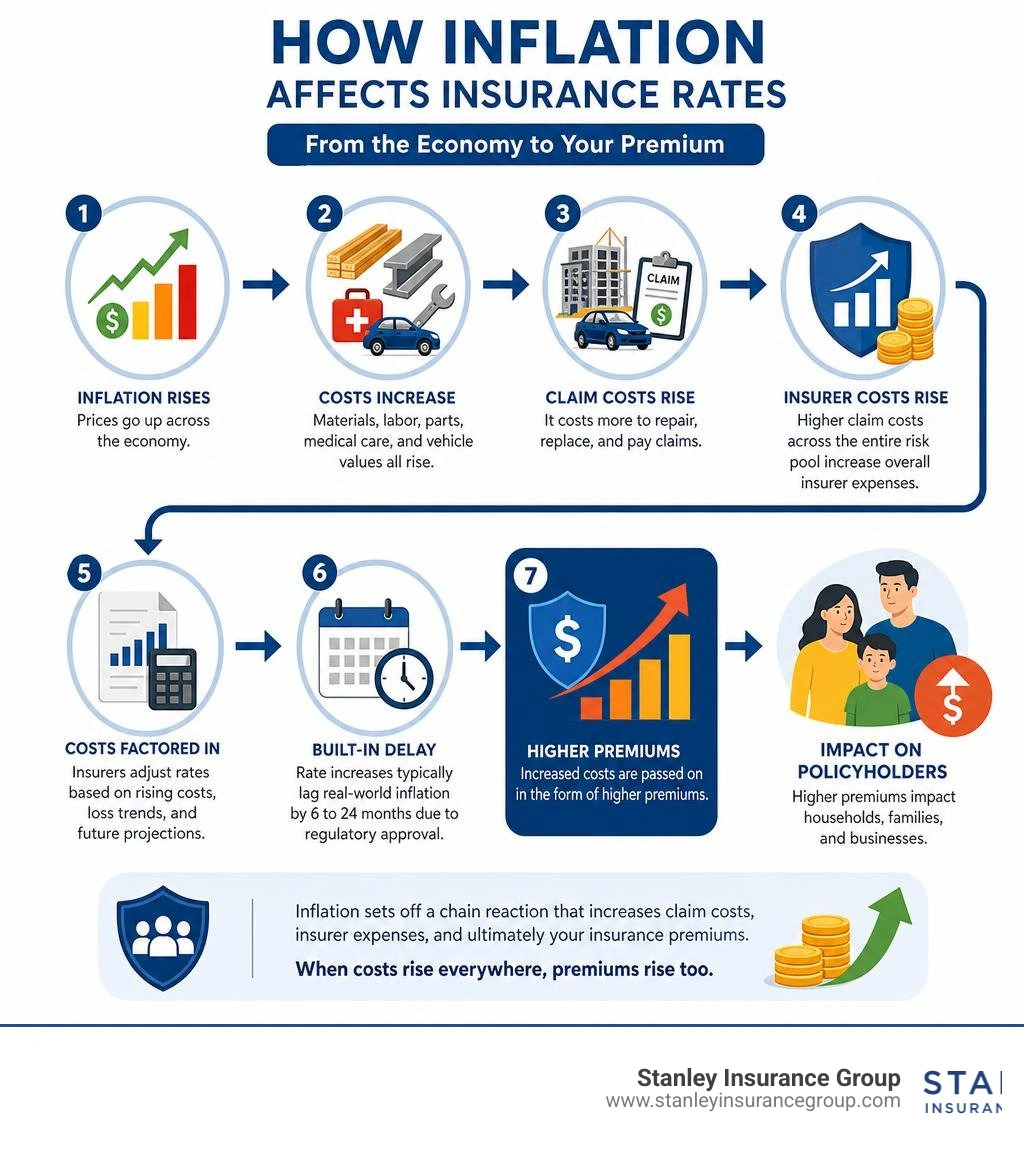
- Repair and rebuild costs go up. When lumber, steel, and auto parts cost more, every claim costs the insurer more to settle.
- Medical expenses rise. Injury claims tied to auto or liability policies become more expensive to pay out.
- Vehicle values increase. Higher used car prices mean larger total-loss payouts from insurers.
- Labor gets more expensive. Skilled tradespeople and auto technicians charge more, pushing claim costs higher.
- Insurers pass those costs on. Higher claim costs across the entire risk pool eventually flow into your premium — even if you never filed a claim.
- There is a built-in delay. Premium increases typically lag real-world inflation by 6 to 24 months due to state regulatory approval requirements.
The result? You open a renewal letter and the number is higher — sometimes much higher — even though nothing changed on your end.
This is not a temporary blip. Motor vehicle insurance inflation exceeded 20% in a single 12-month period at its recent peak, according to the U.S. Bureau of Labor Statistics. Construction material costs have risen 20–30% in some regions since 2020. And across personal auto, commercial auto, and general liability combined, increasing inflation added an estimated $231.6 billion to $281.2 billion in insurance losses from 2015 to 2024.
For families in Hilliard and across Ohio, that translates directly into tighter household budgets and harder coverage decisions.
I'm Brandon Stanley, President of Stanley Insurance Group — a family-owned independent agency serving central Ohio since 1984 — and helping clients navigate exactly these kinds of market shifts is at the core of what we do. Understanding how inflation affects insurance rates across your home, auto, life, and business policies is the first step toward making smart coverage decisions that protect your family without breaking the budget.
Key terms for how inflation affects insurance rates:
How Inflation Affects Insurance Rates: The Core Mechanics
To understand why your bills are climbing, it helps to understand how insurance companies actually calculate your premiums. Insurance is, at its heart, a shared risk pool. When you buy a policy, your premium joins a collective fund used to pay for the losses of the few who file claims.
When general economic inflation rises, the cost of everything the insurance company has to buy or repair on your behalf also goes up. Actuaries call this claim severity—the average cost of a settled claim. Even if the total number of accidents or house fires (claim frequency) remains flat or decreases, the skyrocketing cost of repairing each individual car or home means insurers must bring in more premium dollars to maintain financial stability and keep reserves adequate.
In addition to standard economic inflation (the rising cost of physical goods and labor), the insurance industry is heavily impacted by social inflation. This refers to rising litigation costs, broader definitions of liability, and a dramatic increase in "nuclear verdicts"—jury awards that far exceed historical norms. Between 2013 and 2025, American juries awarded tens of billions in nuclear verdicts, driving up liability claims.
When economic and social inflation compound, insurance companies are legally required by state regulators to prove they hold enough cash reserves to pay future claims. If their projected payout costs exceed their current premium structure, they must file for rate increases. This is how broader macroeconomic shifts directly dictate the price of your individual policy. For a deeper dive into this process, check out this guide on How Inflation Affects Insurance Rates | MoneyGeek .
The Impact of Inflation Across Different Insurance Lines
Inflation does not impact all insurance policies in the exact same way. Property and casualty (P&C) lines—such as homeowners, auto, and commercial liability—feel the pressure immediately because they deal with physical assets and active litigation.
One of the most dangerous side effects of inflation for policyholders is underinsurance. If your policy limits were set three or four years ago, they may no longer reflect today’s real-world replacement costs.

When you set up a policy, you typically choose between two types of valuation methods:
- Replacement Cost Value (RCV): Pays to repair or replace your property with materials of like kind and quality at current market prices, without deducting for depreciation.
- Actual Cash Value (ACV): Pays to replace your property minus depreciation. Under inflation, an ACV policy will leave you with a massive out-of-pocket gap because the depreciated payout won't come close to covering today's inflated retail prices.
How Inflation Affects Insurance Rates for Homeowners
Homeowners insurance is experiencing a massive pricing reset due to compounding construction costs. Since 2020, construction materials in many Midwest regions have surged by 20% to 30%. Key materials like steel, aluminum, copper, and lumber have seen dramatic, sudden spikes.
Compounding the material price crisis is a severe skilled labor shortage. The construction industry needs hundreds of thousands of net new workers to keep pace with demand. When labor is scarce, wages rise, and project timelines drag out. For a homeowner rebuilding after a storm, a longer construction timeline also means the insurance company must pay more for "Additional Living Expenses" (ALE) to house the family in a rental home, further inflating the total claim cost.
Because of these factors, a home that cost $300,000 to build a few years ago might cost significantly more to construct today. If your policy limit hasn't kept pace with these rising costs, you run the risk of being underinsured. To protect your home without overpaying, explore our guide on Ways to Save Money on Homeowners Insurance and learn more about How to Lower Homeowners Insurance Premiums. For additional context, read about How is inflation affecting insurance? .
How Inflation Affects Insurance Rates for Auto Policies
If you think your car insurance premium has climbed, you are not alone. Auto-specific inflation has dramatically outpaced general consumer price indexes.
Several unique factors explain why auto premiums are rising so sharply:
- Advanced Driver Assistance Systems (ADAS): Modern vehicles are packed with complex technology, including cameras, radar modules, and parking sensors embedded in windshields and bumpers. A minor bumper replacement that used to cost $1,000 now requires specialized calibration, pushing the repair bill over $3,000. Actuarial data shows that while ADAS reduces accident frequency, it massively inflates claim severity.
- Used Car Valuations: When supply chain disruptions drove used vehicle prices up, insurers had to pay significantly more for total-loss payouts, which are based on actual cash value at the time of the accident.
- Tariffs on Imported Parts: With a high percentage of collision repair parts imported, tariffs on steel, aluminum, and auto components add hundreds of dollars to average repair estimates.
These forces have caused auto insurance rates to climb significantly. To understand these trends and protect your budget, read our analysis on the Car Insurance Inflation Rate and review the insights in Car Insurance & Inflation: How Rising Costs Affect Your Coverage in 2026 | Penny Pincher .
Business and Commercial Insurance Pressures
Business owners are facing similar inflationary headwinds. Commercial auto liability and general liability lines have seen massive loss increases. According to actuarial studies, increasing inflation added tens of billions of dollars to commercial auto liability losses and direct containment costs between 2015 and 2024.
Supply chain disruptions also mean that commercial property claims take longer to resolve. If a restaurant or manufacturing facility suffers a fire, delays in acquiring specialized machinery or building materials extend the "Business Interruption" period. The insurer must pay out more for lost revenue while the business remains closed, driving up the total claim severity. To understand how these compounding factors impact commercial risk management, read P&C Claims Severity Faces a Four-Factor Compounding Problem in 2026 | actuary.info .
Life Insurance and Savings-Based Policies
While property and casualty lines feel the immediate shock of inflation, life insurance and savings-based policies are affected differently.
For traditional term life insurance, inflation does not change your premium or your death benefit because both are fixed at the time of purchase. However, inflation erodes the purchasing power of that future payout. A $500,000 policy bought today will buy significantly less in twenty years if inflation continues to climb.
For permanent life insurance policies with cash value components, inflation can impact investment yields. While rising interest rates can eventually improve the returns on the bonds that back these policies, high inflation in the short term may reduce your real, inflation-adjusted returns. To learn more about managing these long-term financial products, read How Inflation Is Affecting Insurance Coverage .
Practical Ways to Lower Your Insurance Costs
While you cannot control macroeconomic inflation, you do have control over how you structure your insurance portfolio. Here are the most effective strategies to manage and lower your premiums:
- Bundle Your Policies: Placing your home and auto policies with the same carrier is almost always the most effective way to secure a discount.
- Adjust Your Deductibles: Raising your deductible from $500 to $1,000 or $2,500 can significantly reduce your monthly or annual premium. Just ensure you keep enough cash in an emergency fund to cover that out-of-pocket amount if you need to file a claim.
- Review Your Coverage Limits: Work with an independent agent to ensure you aren't paying for coverage you don't need, while verifying that your dwelling limits actually match current local rebuilding costs.
Actual Cash Value (ACV) vs. Replacement Cost Value (RCV)
Actual Cash Value (ACV) pays based on today’s replacement cost minus depreciation. Premiums are usually lower, but inflation risk is high because rising repair, material, and labor costs can leave you with a bigger out-of-pocket gap. ACV may make sense for older, lower-value belongings or older vehicles.
Replacement Cost Value (RCV) pays based on the current cost to repair or replace damaged property with new materials. Premiums are usually higher, but inflation risk is lower because coverage is better aligned with today’s rebuilding and replacement costs. RCV is often better for primary homes, roofs, and newer vehicles.
To explore more ways to optimize your insurance budget, read our guides on Ways to Save on Insurance, Ways to Reduce Insurance Costs, and see if Does Bundling Insurance Save Money.
Frequently Asked Questions About Inflation and Insurance
Why is there a lag between inflation news and premium increases?
It can be incredibly frustrating to read that inflation is cooling off, only to receive a renewal notice with a double-digit rate hike. This disconnect happens because of regulatory lag.
Insurance is a highly regulated industry. In states like Ohio, insurers cannot simply raise rates overnight. They must compile historical claims data, project future losses, and submit formal rate filings to the state department of insurance. This review and approval process can take anywhere from 6 to 18 months.
Additionally, because most policies are written on 6-month or 12-month terms, you won't feel a rate change until your policy comes up for renewal. This means that the rate hikes you are seeing today often reflect the inflation and underwriting losses that insurers absorbed a year or more ago. For a detailed breakdown of this timing delay, see Insurance Premiums Are Exploding — Here’s Why - Smart Insurance 101 Smart Insurance 101 .
How do rising interest rates affect insurance companies?
To combat inflation, central banks raise interest rates. This has a dual effect on insurance companies:
- The Bond Portfolio Benefit: Insurers invest the premiums they collect in highly secure, conservative assets—primarily bonds. When interest rates rise, insurers can reinvest their cash into higher-yielding bonds, which eventually improves their investment income and financial strength.
- The Present Value Effect: For long-tail liabilities (claims that take years to settle, like major commercial lawsuits or workers' compensation), higher interest rates increase the discount rate used to calculate the net present value of future payouts. This can technically reduce the amount of reserves they must hold today for those future claims.
However, in the short term, the rapid rise in claims costs (severity) usually outpaces the slow increase in bond yields, which is why rate hikes remain necessary. For more information on how these broader financial trends impact your coverage, read our Help with Insurance Premiums Guide.
Will insurance rates go down if inflation decreases?
Historically, insurance rates rarely drop significantly when general inflation slows. Instead, a decrease in inflation leads to rate stabilization—meaning your premiums will stop climbing at such a rapid pace and return to normal, predictable adjustments.
This is because insurance rates are sticky; they reflect the permanent structural reset of material and labor costs. A bumper that has risen in price from $1,000 to $2,500 is unlikely to drop back down to $1,000, even if inflation falls to 2%. Additionally, rates are heavily influenced by local risk factors, such as regional weather patterns, local litigation trends, and accident frequencies in your specific ZIP code. To learn more about how these localized factors influence your premium, explore How Does Inflation Affect Insurance Rates? .
Navigate the Changing Market with Stanley Insurance Group
Navigating a high-inflation insurance market on your own can feel overwhelming. When you work with a captive or direct online writer, you are limited to a single company's pricing structure. If their rates go up, your only option is to pay more or drop essential coverage.
That is where we do things differently. At Stanley Insurance Group, we are independent insurance agents. Since '84, we have served families and businesses across Hilliard, Columbus, Dublin, Arlington, and the broader Central Ohio region.

Because we are independent, we don't work for a single insurance company—we work for you. We build long-term relationships through a personalized, concierge-style approach. Our team has the unique ability to shop your coverage across 20+ top national carriers—including Nationwide, Progressive, Travelers, Liberty Mutual, Grange, Safeco, and more—to find the best fit and the most competitive pricing available. Plus, we are proud to be one of only 100 independent agencies in the entire country with a direct partnership with Geico, giving our clients access to exclusive coverage options.
Whether you are looking to optimize your Home & Property Insurance, find the best value for your Auto & Vehicle Insurance, secure your family's future with Life Insurance, or protect your business with tailored Business Insurance, our experienced team is here to help:
- Amy is our Commercial Lines specialist, helping local business owners navigate complex liability and property risks.
- Ana and Sandra are our dedicated Account Specialists who provide expert assistance, with bilingual Spanish-speaking help available for our Spanish-speaking community members.
- Kaisen, Ethan, and Chase are our Associate Agents, ready to review your current policies and find hidden discounts.
Don't let inflation dictate your financial security. Let us do the shopping, compare the rates, and build a policy that fits your budget and protects what matters most.
Ready to see how much you could save? Get a Quote today or stop by our office to speak with a local agent who cares.
Similar posts