
Strategies to Reduce Your Insurance Costs
Discover proven strategies and expert tips for help with insurance premiums to lower your costs and maximize your coverage today.
The Rising Cost of Insurance: Finding Relief
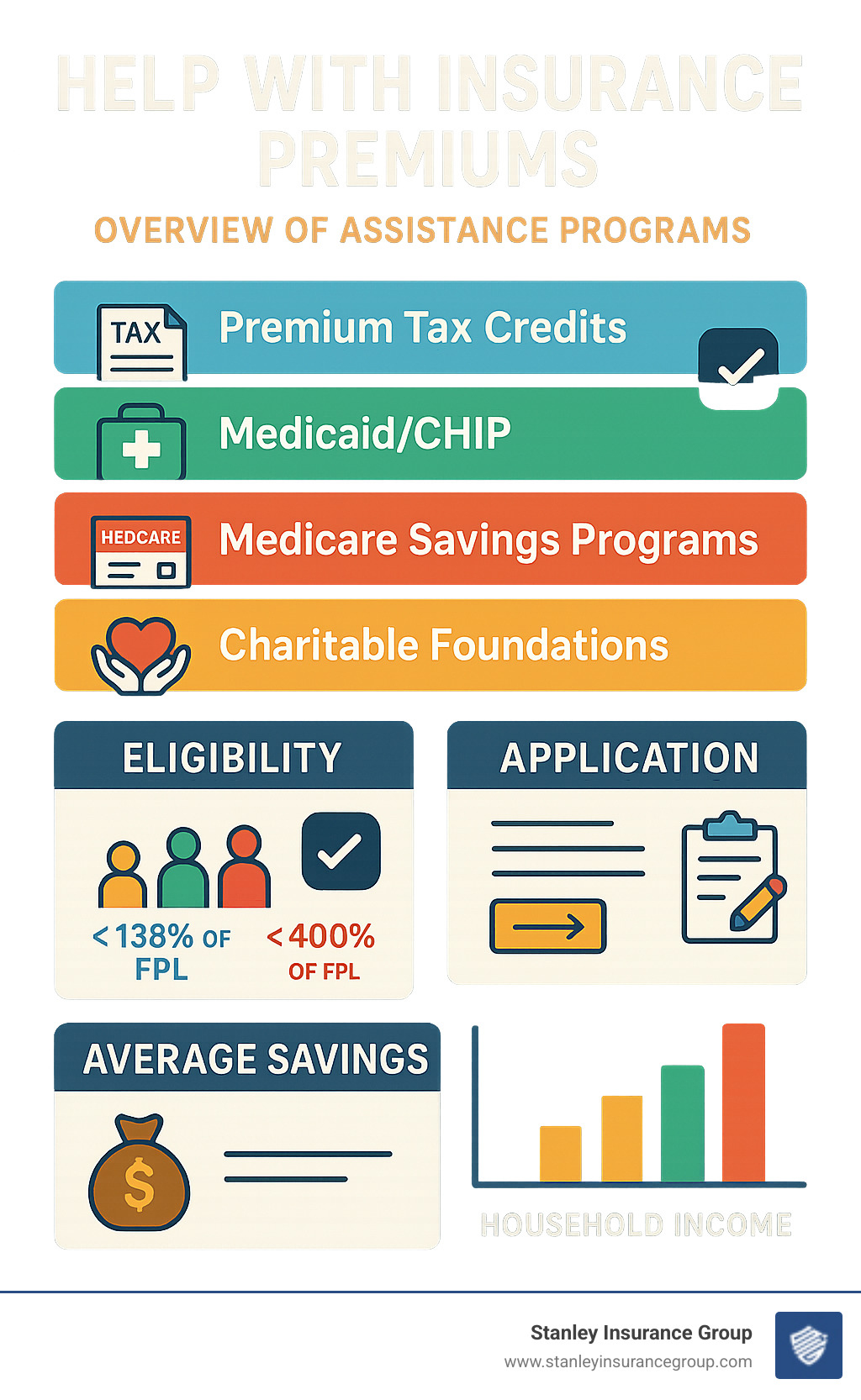
If you're looking for help with insurance premiums, here are the most effective options:
- Premium Tax Credits - Can cap health insurance at 8.5% of income
- Medicaid/CHIP - Free or low-cost coverage for eligible families
- Medicare Savings Programs - Help with Part A/B premiums
- Charitable Foundations - Disease-specific premium grants
- Bundling Policies - Save 10-25% by combining home and auto
- Higher Deductibles - Lower monthly costs with emergency fund backup
Help with insurance premiums is more important than ever as rates continue to climb across all insurance types. Just like groceries and gas, insurance costs are affected by inflation, extreme weather events, and supply chain disruptions. The good news is that there are multiple strategies to reduce what you pay—whether through government assistance programs, charitable foundations, or smart policy management.
For many families, insurance premiums have become a significant monthly expense that requires careful budgeting. Homeowners in particular face increasing rates due to rising replacement costs for building materials and labor. Vehicle owners aren't faring better, with advanced technology making repairs more expensive. Life and business insurance premiums are similarly trending upward.
I'm Brandon Stanley, President of Stanley Insurance Group, and I've been helping families find help with insurance premiums through our independent agency since 1984, providing personalized guidance to steer complex coverage options while maintaining affordable protection.
Similar topics to help with insurance premiums:
Why Your Premiums Cost What They Do
When you open that insurance bill and notice your premium has increased, it's natural to wonder why. Since 2021, we've seen several forces driving up insurance costs across all types of coverage.
"Much like the price of groceries and gasoline, insurance premiums are increasing," explains Amy, our Commercial Lines specialist at Stanley Insurance Group. "This isn't arbitrary—insurers are responding to real economic pressures."
The truth is, your premiums reflect the actual risks and costs in today's world. Understanding these factors can help you make better decisions about your coverage:
Inflation has driven up the costs of everything from building materials to medical care, directly impacting what insurers pay out in claims. When it costs more to repair your home or car, or to provide medical treatment, premiums must increase to cover these expenses.
Supply chain disruptions continue to create headaches for everyone. When parts for your vehicle take months to arrive, rental costs and labor expenses climb, making even simple repairs more expensive for insurance companies.
Extreme weather events have become more frequent and severe. Here in Ohio, we've seen how destructive storms can damage dozens of homes in a single neighborhood, resulting in millions of dollars in claims.

"In Ohio specifically, we've seen homeowners facing premium increases after the series of severe storms that hit Columbus and surrounding areas in recent years," notes Chase, one of our Associate Agents. "When insurers pay out more in claims across a region, rates tend to rise for everyone in that area."
Your claims history plays a significant role in what you pay. If you've filed multiple claims in recent years, insurers view you as higher risk. Similarly, your credit score often influences your rates (in states where this practice is permitted).
Modern vehicles with advanced technology features like backup cameras and lane-departure warnings are safer, but they're also much more expensive to repair. A simple fender bender that once cost $800 might now run $3,000 if sensors need replacement.
For homeowners, the age and condition of your home matters greatly. Older electrical systems, plumbing, and roofs present higher risks and therefore command higher premiums.
Your deductible choices directly impact your premium costs. Opting for a higher deductible means you'll pay more out-of-pocket when a claim occurs, but your monthly premiums will be lower.
The Math Behind Premiums
Insurance pricing isn't guesswork—it's based on careful calculations and probability. Behind your premium is a complex world of risk assessment:
Actuarial tables analyze decades of historical data to predict future claims with remarkable accuracy. These statistical models help insurers understand how likely you are to experience different types of losses.
Loss ratios measure claims paid out versus premiums collected. Insurers typically aim for 60-70% loss ratios, meaning if they collect $100 in premiums, they expect to pay $60-$70 in claims. The remaining 30-40% covers operating expenses, employee salaries, and a modest profit margin.
Underwriting rules evaluate your specific risk factors based on dozens of variables, from your home's proximity to a fire hydrant to your driving history and even your occupation.
Hidden Factors That Raise Rates
Beyond the obvious elements, several less apparent factors can significantly impact what you pay for coverage:
Your annual mileage matters more than you might think. The more time you spend on the road, the greater your chances of being involved in an accident.
Neighborhood risk factors like local crime rates, distance to the nearest fire station, and flood zone designations all influence your home insurance premiums. Even living on a busy street can increase your auto insurance costs.
Those recent traffic violations might seem minor, but even a simple speeding ticket can raise your rates for three years or more as it indicates higher risk behavior.
"Many clients are surprised to learn that their credit history can affect their insurance premiums," says Kaisen, one of our Associate Agents. "While this practice is restricted in some states, it remains a significant factor in many areas where we operate, including Ohio."
Is your home frequently unoccupied? Home occupancy patterns matter because vacant or rarely occupied homes face higher risks of undetected damage from water leaks, fire, or break-ins.
At Stanley Insurance Group, we've been helping Ohio families understand and manage their insurance costs since '84. Our independent agents take a concierge approach to reviewing your coverage and finding opportunities to save without sacrificing protection. We're proud to offer services in Spanish through our bilingual team members Ana and Sandra, ensuring everyone in our community has access to the insurance guidance they need.
Help with Insurance Premiums: Tax Credits, Subsidies & Grants
When it comes to health insurance costs, you're not alone in the struggle. Thankfully, there are substantial resources available to provide help with insurance premiums through government programs and charitable foundations that have expanded significantly in recent years.
Premium Tax Credits
The Premium Tax Credit (PTC) offers real relief for families purchasing health insurance through the Health Insurance Marketplace. This refundable credit can dramatically reduce your monthly premium burden.
"The game has completely changed for many of our clients," explains Sandra, one of our Spanish-speaking Account Specialists at Stanley Insurance Group. "Thanks to the American Rescue Plan and Inflation Reduction Act, health insurance premiums are now capped at 8.5% of household income through 2025, regardless of how much you earn."
This expansion is truly significant. Previously, only households earning up to 400% of the Federal Poverty Level could qualify, but now families at all income levels may receive help with insurance premiums.
The Premium Tax Credit offers flexibility in how you receive it. You can take it in advance (with monthly payments going directly to your insurer) or claim it when filing your taxes. Eligibility depends on your household income, family size, and enrollment in a Marketplace plan. The improved subsidies through 2025 have made coverage substantially more affordable – in fact, many of our clients now pay less than $10 per month for comprehensive health insurance.
Cost-Sharing Reductions
Beyond premium assistance, Cost-Sharing Reductions (CSRs) provide additional financial relief by lowering your out-of-pocket costs like deductibles, copayments, and coinsurance. These valuable benefits are only available if you choose a Silver plan through the Marketplace. Typically, families earning between 100% and 250% of the Federal Poverty Level qualify, and the best part is they're applied automatically – no separate application needed.
Medicaid & CHIP
For families with more modest incomes, Medicaid and the Children's Health Insurance Program (CHIP) can be lifesavers, providing free or very low-cost coverage.
Eligibility varies by state, with significant differences between states that expanded Medicaid under the ACA and those that didn't. CHIP specifically covers children in families that earn too much to qualify for Medicaid but still need assistance. It's worth noting that last year, 9 out of 10 people who enrolled through state marketplaces qualified for some form of financial help with insurance premiums.
Medicare Savings Programs
Our senior clients often benefit from Medicare Savings Programs that help with Part A and Part B premiums. These include the Qualified Medicare Beneficiary (QMB) Program, Specified Low-Income Medicare Beneficiary (SLMB) Program, Qualifying Individual (QI) Program, and Qualified Disabled and Working Individuals (QDWI) Program.
"Many of our older clients don't realize these programs exist," notes Ethan, Associate Agent at Stanley Insurance Group since '84. "We make it a point to inform eligible clients about these options during our annual reviews – it's part of the concierge-level service we provide as independent agents."
Charitable Foundations
For those facing specific medical conditions, several foundations offer grants specifically for insurance premiums:
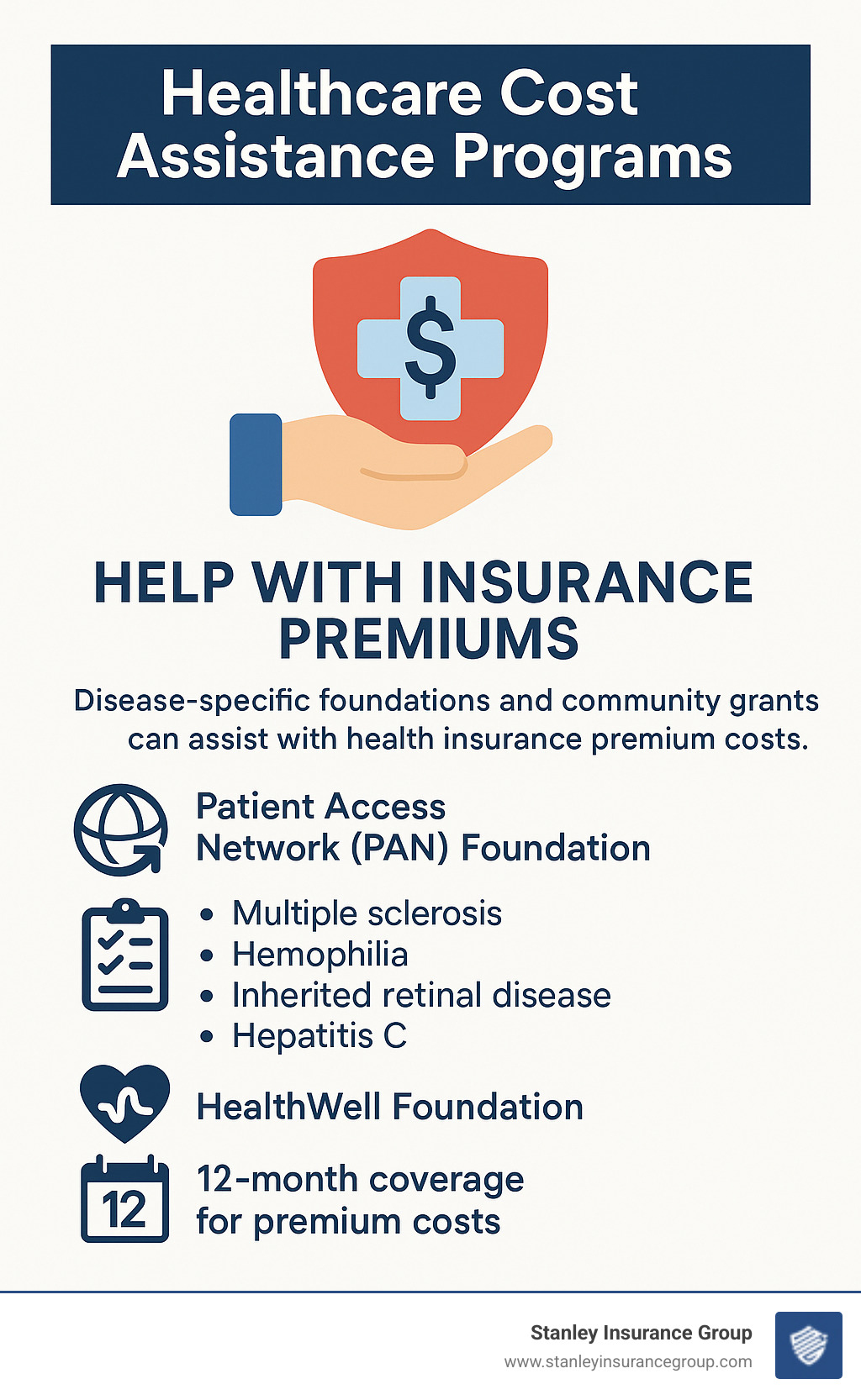
The Patient Access Network (PAN) Foundation offers health insurance premium grants for patients being treated for specific diseases. The HealthWell Foundation has served over 930,000 patients with various assistance programs, while the Patient Advocate Foundation provides both financial assistance and valuable case management services.
These foundations typically cover the portion of your premium associated with your individual coverage, provide assistance for a 12-month period, and require diagnosis verification and income qualification.
"For clients facing serious medical conditions, these foundations can be lifesavers," says Ana, our Spanish-speaking Account Specialist. "We've helped connect several families with these resources when they were struggling with both health challenges and financial pressures."
Comparing Advance Credits vs. Claiming at Tax Time
| Approach | Advantages | Considerations |
|---|---|---|
| Advance Premium Tax Credit | - Lower monthly payments - Immediate financial relief - Paid directly to insurer | - Must reconcile on tax return - May owe money if income increases - Must report life changes promptly |
| Tax-Time Credit | - No reconciliation surprises - Larger tax refund - No reporting requirements during year | - Full premium due monthly - No immediate financial relief - Requires sufficient tax liability |
| Partial Advance | - Some immediate relief - Reduced reconciliation risk - Flexibility in budgeting | - Still requires tax filing - Partial monthly payment still required - More complex to manage |
For more in-depth information about premium tax credits, you can review scientific research on the premium tax credit published by the IRS. If you're concerned about rising insurance rates in general, check out our article on Insurance Rate Inflation.
Who Qualifies for Help with Insurance Premiums
Finding out if you qualify for help with insurance premiums doesn't have to be complicated. While eligibility rules vary by program, I've helped hundreds of families steer these waters, and I'm happy to break it down in simple terms.
Federal Poverty Level (FPL) Thresholds
Your household income compared to the Federal Poverty Level is the main factor in determining your eligibility for most assistance programs:
"One of the biggest changes in recent years is how many more people now qualify for premium help," explains Ana from our team at Stanley Insurance Group. "The income caps have been temporarily removed, which means many more families can get meaningful assistance."
For 2023, here's what the numbers look like for a family of four:
- Federal Poverty Level: $30,000
- 138% FPL (Medicaid expansion threshold): $41,400
- 250% FPL (Cost-Sharing Reductions threshold): $75,000
- 400% FPL (former Premium Tax Credit cap): $120,000
The great news is that Premium Tax Credits are now available at all income levels through 2025, with benefits that gradually phase out as income increases. Cost-Sharing Reductions remain available for those between 100-250% FPL, while Medicaid is generally available up to 138% FPL in states that expanded coverage.
Household Size Considerations
Your "household" for premium assistance isn't always who you think it might be. This trips up many of our clients initially.
"This is an area where we see a lot of confusion," explains Chase, one of our Associate Agents at Stanley Insurance Group. "For example, unmarried partners living together are typically separate households for subsidy purposes, even if they purchase a family plan together."
For premium assistance, your household generally includes:
- You and your spouse (if filing taxes jointly)
- Anyone you claim as a tax dependent
- Children who live with you (with some exceptions)
Understanding this definition can make a significant difference in the amount of help with insurance premiums you receive.
Immigration Status Requirements
You don't need to be a U.S. citizen to qualify for most federal premium assistance programs. Generally speaking:
- U.S. citizenship is not required
- Lawful presence in the U.S. or territories is typically sufficient
- Some programs have specific documentation requirements
Our Spanish-speaking specialists, Sandra and Ana, have helped many families steer these requirements successfully. "Muchas familias no saben que pueden calificar para asistencia," notes Sandra, which means "Many families don't know they can qualify for assistance."
Special Rule for Unemployment Recipients
If you received unemployment compensation in 2021, you got a special boost. Under the American Rescue Plan, unemployment recipients were treated as if their income was at 133% of the federal poverty line for premium tax credit purposes. This provided maximum subsidies regardless of actual income.
While this specific provision has expired, it demonstrates how these programs can evolve to provide targeted relief during challenging times.
Income Caps Removed (Temporarily)
Perhaps the most significant recent change is the removal of the 400% FPL income cap for premium tax credits through 2025. This means:
- No more "subsidy cliff" where assistance suddenly disappears
- Premiums capped at 8.5% of household income for everyone
- Particularly beneficial for older adults not yet eligible for Medicare
"This change has been life-changing for many of our clients who previously made just a little too much to qualify," says Ethan, Associate Agent at Stanley Insurance Group. "Since '84, we've been helping families steer insurance challenges, but this is one of the most impactful policy changes we've seen for making coverage more affordable across the board."

If you're unsure about your eligibility for help with insurance premiums, we're here to guide you through the process. Our team at Stanley Insurance Group provides that concierge-level service that only independent agents can offer, taking the time to understand your unique situation and identify all possible avenues for assistance.
How to Apply and Keep Your Help with Insurance Premiums
Navigating the application process for premium assistance doesn't have to be overwhelming. With the right approach, you can secure and maintain the financial help you deserve. Here's how to handle this important process with confidence:
Application Process
Getting started with help with insurance premiums through the health insurance marketplace is straightforward:
Create your account at HealthCare.gov or your state's exchange website, then complete the application with your household and income information. The system will calculate your eligibility for premium tax credits and other assistance automatically.
"Many folks are surprised by how simple the process can be," says Ana, one of our Spanish-speaking Account Specialists at Stanley Insurance Group. "We often sit with clients at our office and walk through the entire application in under an hour. The relief on their faces when they see the reduced premium amounts is truly rewarding."
When you reach the end of the application, you'll need to decide how to receive your assistance. You can have it paid directly to your insurance company each month (reducing your monthly bill), wait to claim it all when filing taxes, or choose a combination of both approaches.
Reporting Income Changes
This might be the most crucial part of maintaining your help with insurance premiums. Your initial subsidy amount is based on your estimated annual income, but if your actual income differs significantly, it can affect your final subsidy amount.
If you get a raise, lose hours, change jobs, or experience any substantial income change, report it to the Marketplace as soon as possible. The same goes for household changes like marriage, divorce, or having a child. These life events allow you to adjust your coverage and subsidy amount mid-year.
"I always tell clients to think of their Marketplace application as a living document," explains Sandra from our team. "When your life changes, your application should too. This simple habit can prevent stressful tax surprises later."
Appeal Rights
The system isn't perfect, and sometimes determinations about your help with insurance premiums may seem incorrect. If you're denied assistance or believe the amount is wrong, you have the right to appeal.
Appeals must typically be filed within 90 days of receiving the decision notice. During the appeal process, you can maintain your current coverage, which provides peace of mind while the issue is resolved.
"We've helped several clients successfully steer the appeals process," shares Chase, one of our Associate Agents. "Sometimes it's just a matter of providing additional documentation or clarifying information that was misunderstood in the original application."
Year-End Reconciliation
If you receive advance premium tax credits throughout the year, you'll need to reconcile them when filing your taxes. This process ensures you received the correct amount of help with insurance premiums based on your actual annual income.
The Marketplace will send you Form 1095-A in January, which contains the information you need to complete Form 8962 with your tax return. If you received more assistance than you qualified for, you may need to repay some of it—though there are repayment caps based on income level. Conversely, if you received less than you qualified for, you'll get the difference back as a tax refund.
"We've built relationships with several local tax professionals who understand these forms well," notes Ethan, Associate Agent at Stanley Insurance Group. "Since '84, we've been connecting our clients with the resources they need, whether that's premium assistance or tax help at year-end."
At Stanley Insurance Group, we believe everyone deserves personalized guidance through these processes. That's why we offer concierge-level service, including Spanish-speaking support through Ana and Sandra, to help our Columbus community steer the complexities of insurance premium assistance.
For more detailed information about insurance rate trends affecting your premiums, check out our article on Insurance Rate Inflation.
8 Proven Strategies to Lower Costs on Home, Auto, Life & Business
Beyond government and charitable assistance, there are numerous practical strategies to reduce your insurance premiums across all policy types.

1. Bundle Policies for Multi-Line Savings
If you're looking for a straightforward way to reduce your insurance costs, bundling multiple policies with the same company is one of the most effective strategies available.
"Since '84, we've been helping families save through multi-policy discounts," says Amy, our Commercial Lines specialist at Stanley Insurance Group. "It's not uncommon to see 10-15% savings on both home and auto when bundled together. For some of our clients, this can mean hundreds of dollars back in their pocket every year."
The concept is simple but powerful. When you bring more of your insurance business to one carrier, they reward your loyalty with meaningful discounts. Your insurance company saves on administrative costs and knows that clients with multiple policies tend to be more stable, long-term customers who file fewer claims.
The most common bundling combination is home and auto insurance, but the savings opportunities extend much further. You might consider combining your auto policies for multiple vehicles, pairing your home insurance with an umbrella liability policy for extra protection, or packaging various business coverages together. Even adding life insurance to your home and auto bundle can trigger additional discounts with many carriers.
For business owners, the savings can be particularly significant. Commercial package policies that combine property, liability, and specialized coverages often come with substantial multi-line discounts that can help manage your operational expenses.
What makes bundling especially attractive is that you're not sacrificing coverage quality for the discount. You're simply being rewarded for consolidating your policies, while also enjoying the convenience of managing your insurance through a single point of contact.
Want to learn more about how bundling can help with your insurance premiums? Check out our detailed guide on Bundle Home and Auto Insurance for a deeper look at potential savings and strategies.
2. Raise Your Deductible—But Build an Emergency Fund
One of the simplest ways to lower your monthly insurance costs is adjusting that magic number—your deductible. It's the financial threshold where your responsibility ends and your insurer's begins.
"I always have an honest conversation with clients about deductibles," shares Ethan, one of our Associate Agents. "Yes, raising your deductible from $500 to $1,000 might save you 15-20% on premiums, but that strategy only makes sense if you've got that extra $500 tucked away somewhere safe."
That's why we recommend creating a dedicated emergency fund alongside a higher deductible. Think of it as your personal insurance for your insurance! This approach works particularly well for clients with good driving records or homes in low-risk areas who rarely file claims.
For homeowners, deductibles typically range from $500 up to $2,500, with each step up providing noticeable premium relief. Auto deductibles generally fall between $250 and $1,000, though we're seeing more clients opt for higher thresholds to manage monthly costs.
But here's something important to remember: The savings curve flattens out. The jump from a $250 to $500 deductible might save you significantly, but moving from $1,000 to $2,500 often yields diminishing returns. Since '84, we've helped clients find that sweet spot where the math actually works in their favor.
Some of our carrier partners have introduced creative options like disappearing deductibles that gradually reduce for each claim-free year. It's a nice reward for careful drivers and responsible homeowners that can eventually bring your out-of-pocket costs down to zero after several years without a claim.
At Stanley Insurance Group, we don't just throw out a number and walk away. We'll analyze your specific situation—claim history, financial cushion, risk tolerance—to find the deductible level that makes the most sense for your household budget while still providing meaningful help with insurance premiums.
3. Install Protective Tech & Telematics
Today's smart technology doesn't just make our lives more convenient—it can significantly lower your insurance costs while keeping you safer.
"When clients ask me about immediate ways to reduce premiums, I often point to technology solutions first," says Chase from our office. "These investments typically pay for themselves within a year through premium savings alone."
For homeowners, several tech upgrades can lead to substantial discounts:
Smart water leak detectors have become one of our most recommended devices. These small sensors can detect even minor leaks before they become catastrophic water damage claims—the most common and costly type of homeowners insurance claim. Some insurers offer discounts up to 15% for homes with these systems.
Security systems with professional monitoring provide both peace of mind and premium savings. Many of our clients are surprised to learn that a $30/month monitoring service can reduce their homeowners premium by more than that amount, essentially paying for itself while providing added protection.
Smoke and CO detectors connected to monitoring services ensure emergency response even when you're away from home. "These systems have literally saved lives among our client families," notes Amy, our Commercial Lines specialist.

For auto insurance, telematics programs have revolutionized how premiums are calculated. Rather than relying solely on demographic information, these usage-based insurance programs track your actual driving habits through a smartphone app or device plugged into your vehicle.
"Since '84, we've seen many innovations in insurance, but telematics might be the most significant for safe drivers," explains Kaisen. "Instead of paying for others' risky behavior, you can pay based on how you actually drive."
The savings can be substantial—many of our clients see reductions of 15-30% for demonstrating safe driving habits like gentle braking, moderate speeds, and avoiding late-night driving. It's important to note, however, that risky driving patterns could potentially lead to higher rates with these programs.
Other auto technology discounts include:
Dash cameras provide evidence in accident situations and can lead to discounts with certain insurers. They're particularly valuable for parents of teen drivers or business fleets.
Anti-theft devices remain relevant for premium discounts, with GPS tracking systems offering the most significant savings potential.
Advanced driver assistance systems (ADAS) like automatic emergency braking and lane departure warnings are increasingly recognized by insurers for their safety benefits. Some carriers now offer specific discounts for vehicles equipped with these features.
At Stanley Insurance Group, we help clients identify which technology investments will provide the best return through premium savings, improved safety, and peace of mind. As Ana, one of our Spanish-speaking Account Specialists often tells clients, "The right technology not only saves you money but could prevent a life-changing loss."
4. Maintain a Claim-Free Record
Your claims history speaks volumes to insurance companies, and it's one of the most influential factors in determining your premiums.
"Insurance is designed for significant losses, not minor inconveniences," explains Chase, one of our Associate Agents at Stanley Insurance Group. "When clients call about small damages that barely exceed their deductible, I often recommend they think twice before filing. Those multiple small claims can lead to surcharges or even non-renewal that far outweigh the immediate benefit."
Defensive driving courses offer dual benefits—they refresh your safety knowledge while often qualifying you for an immediate premium discount. Many insurers recognize these courses as evidence of your commitment to safety, rewarding you with lower rates that can last for years.
For homeowners, regular maintenance prevents the kind of damage that leads to claims. A well-maintained roof, regularly inspected plumbing, and updated electrical systems dramatically reduce your risk profile. Similarly, keeping your vehicle in top condition through regular brake checks, tire rotations, and lighting inspections helps prevent accidents before they happen.
"We've seen clients save thousands over time by being strategic about claims," notes Kaisen from our office. "For example, one family had a $750 windshield crack but a $500 deductible. They were about to file a claim for the $250 difference when we explained how that single claim might affect their premium for the next three years—potentially costing them much more than $250 in the long run."
Most insurers examine 3-5 years of claims history when calculating your premiums. This means that maintaining a claim-free record doesn't just save you money today—it builds a foundation for lower premiums well into the future. Since '84, we've helped our clients understand this long-term perspective, which is part of the concierge-level service that sets independent agents apart.
The strategic approach to claims doesn't mean never filing—that would defeat the purpose of having insurance. Rather, it means being thoughtful about when to use your coverage, saving it for truly significant losses where the financial protection outweighs the potential premium impact.
5. Leverage Wellness & Lifestyle Discounts
Your everyday choices and habits can translate into significant savings on your insurance premiums—something many of our clients are pleasantly surprised to find.
"When I sit down with clients to review their life insurance options, they're often unaware how much their health affects what they pay," Ana explains with a smile. "I've seen people save 15-20% simply because they don't smoke, which adds up to thousands over the life of a policy."
For life insurance, the discounts tied to your wellness can be substantial. Non-smoker rates are the most common, but maintaining healthy weight, blood pressure, and cholesterol levels can also lead to preferred rating classifications. Some insurers have even introduced interactive programs where you can earn additional discounts by tracking your fitness activities or completing preventive health screenings.
"Just last month, a client mentioned how her fitness tracker helped reduce her premiums," Sandra shares. "Her insurer offers a wellness program that rewards consistent physical activity with premium reductions of up to 10%."
Auto insurance offers its own set of lifestyle-based savings opportunities. Good student discounts reward young drivers maintaining a B average or better, often saving families 10-15% on their premiums. Many insurers also offer discounts based on your profession or organizational memberships—teachers, military personnel, and members of certain alumni associations frequently qualify for special rates.
"Since '84, we've helped clients identify every possible discount they qualify for," Chase notes. "Even something as simple as having low annual mileage can reduce your auto premium by 5-10% with many carriers."
The key to maximizing these discounts is being proactive about them. During our annual reviews at Stanley Insurance Group, we specifically look for lifestyle changes that might qualify you for new discounts. Just got a new job? Joined a professional organization? Started a fitness program? These could all translate into premium savings.
"As independent agents, we have the advantage of knowing which carriers offer the best wellness and lifestyle programs for different situations," Ethan points out. "For instance, some companies offer better rates for vegetarians or people with active lifestyles, while others might give better discounts for professional credentials."
The best time to leverage these discounts is before you apply for new coverage, especially for help with insurance premiums on life policies where health classifications are set at the beginning of your policy.
6. Review Coverage Annually & Shop Smart
When was the last time you really looked at your insurance policies? Life changes, and your coverage should too. Taking time each year to review your protection isn't just smart—it could save you hundreds.
"The beauty of working with an independent agency since '84 is our ability to shop multiple carriers for the best fit," explains Brandon Stanley. "Unlike captive agents who can only offer one company's products, we compare options from numerous insurers to find the perfect balance of coverage and value."
Annual insurance reviews should be as routine as your yearly physical. During these check-ups, we help you:
- Reassess your coverage limits based on current replacement costs (especially important with today's inflation)
- Update your inventory of valuable items you've acquired or sold
- Review life insurance needs as your family circumstances evolve
- Consider dropping comprehensive/collision on older vehicles where the premium might exceed the car's value
- Identify new discounts you might qualify for based on life changes
The best time to review your coverage is typically 60-90 days before renewal. This gives you plenty of time to make changes and shop alternatives if necessary. Many clients are surprised to learn they qualify for new discounts or that their coverage needs have shifted significantly.
"We take pride in our concierge touch," adds Amy from our Commercial Lines department. "Our annual reviews aren't just about renewing policies—they're about strengthening relationships and ensuring our clients have optimal coverage at the best possible rates."

During open enrollment periods for health insurance (typically November to January), we make a special effort to help clients steer the marketplace options. For business clients, we time reviews around their fiscal year to align insurance planning with broader financial decisions.
The shopping process itself has evolved dramatically since we opened our doors in 1984. Today, we leverage technology to compare dozens of carriers instantly, while still providing the personal guidance that algorithms simply can't match. As one of only 100 independent agencies in the country with a partnership with Geico, we offer unique options many other agencies can't.
Loyalty doesn't always pay in insurance. While some companies offer longevity discounts, others rely on what the industry calls "price optimization"—gradually increasing rates for customers they believe won't shop around. Having an independent advocate in your corner ensures you're never paying more than you should for the protection you need.
7. Optimize Business Risk Controls
Business owners face unique insurance challenges, but with smart risk management, you can significantly lower your premiums while creating a safer workplace.
"I've seen how our commercial clients who invest in risk management end up with much healthier bottom lines," says Amy, our Commercial Lines specialist at Stanley Insurance Group. "It's really one of those rare win-wins in business—fewer workplace incidents naturally lead to lower insurance costs over time."
Since '84, we've helped Ohio businesses implement effective risk control measures that insurance companies truly value. The most impactful approaches include:
Developing a comprehensive written safety program that goes beyond basic compliance. The best programs clearly outline procedures, responsibilities, and accountability measures custom to your specific industry risks.
Regular employee safety training isn't just about checking a box—it creates a culture where safety becomes second nature. "When we visit client workplaces where safety training is taken seriously, you can feel the difference the moment you walk in," Amy notes.
Fire protection and security systems often qualify for immediate premium discounts, sometimes as high as 10-15% depending on the carrier. Modern systems that connect to monitoring services provide the greatest savings potential.
Fleet safety programs are particularly valuable for businesses with company vehicles. Telematics, driver screening protocols, and preventive maintenance schedules all contribute to lower commercial auto premiums.
Accepting insurance carrier loss control recommendations signals to insurers that you're serious about risk management. When loss control specialists visit your business, they're not just looking for problems—they're offering expertise that can translate to premium savings.
Many business owners don't realize that insurers often provide substantial premium credits specifically for implementing recommended safety measures. These aren't just minor discounts—we've seen businesses reduce their premiums by 15-25% through consistent risk management.
"What makes our approach different at Stanley Insurance Group is our concierge touch," Amy explains. "We don't just sell you a policy and disappear. We build relationships with our commercial clients, walking through their facilities, understanding their operations, and proactively suggesting risk improvements that can lower costs."
For Spanish-speaking business owners in our community, Ana and Sandra provide comprehensive support to ensure language is never a barrier to implementing effective risk management strategies.
8. Tap Disease-Specific Foundations & Community Grants
When serious health challenges strike, the financial burden of insurance premiums can feel overwhelming. Fortunately, several compassionate organizations offer specialized help with insurance premiums for those facing specific medical conditions.
"I've seen how these foundations become lifelines for families already dealing with difficult diagnoses," shares Sandra, our bilingual Account Specialist. "What makes these programs special is they focus specifically on keeping your insurance active when you need it most."
The Patient Access Network (PAN) Foundation stands out as a remarkable resource, providing health insurance premium grants for patients receiving treatment for numerous conditions including multiple sclerosis, hemophilia, inherited retinal disease, and hepatitis C. Their assistance typically covers premium costs for up to a full year, giving families breathing room to focus on health rather than finances.
Similarly, the HealthWell Foundation has built an impressive track record of compassion, having assisted more than 930,000 patients through various programs. What's particularly noteworthy about HealthWell is their efficiency—99 cents of every donated dollar goes directly to patient assistance rather than administrative costs.
"The application process for these foundations is refreshingly straightforward," explains Ana from our team. "Most require documentation of your diagnosis, proof of insurance coverage, and financial information showing need. Our team at Stanley Insurance Group can help guide you through gathering the necessary paperwork."
These organizations understand that maintaining continuous health coverage is critical during treatment. Rather than forcing patients to choose between medication and insurance premiums, they bridge the gap with targeted financial support.
For our clients facing serious diagnoses, we take pride in connecting them with these resources as part of our concierge-level service. Help with insurance premiums doesn't always have to come from government programs—sometimes the most meaningful assistance comes from foundations created specifically to support patients with your exact condition.
Frequently Asked Questions about Help with Insurance Premiums
What happens if I receive too much premium assistance?
Life happens—your income might increase, or your family situation could change during the year. If you end up receiving more advance premium tax credit than you're actually eligible for, you'll need to reconcile this when filing your taxes.
"I always explain to clients that there's a safety net built into this system," says Ethan, one of our Associate Agents. "The government understands that predicting your exact annual income isn't always possible."
The good news is that repayment amounts are capped based on your income level:
- Incomes below 200% FPL: You'll never pay back more than $650 (individual) or $1,300 (family)
- Incomes between 200-300% FPL: Repayment is capped at $1,600 (individual) or $3,200 (family)
- Incomes between 300-400% FPL: Repayment maxes out at $2,700 (individual) or $5,400 (family)
- Incomes above 400% FPL: Unfortunately, you'll need to repay the full amount
This is precisely why we emphasize reporting income changes promptly to the Marketplace. A quick adjustment during the year is much less painful than a surprising tax bill in April.
Can I appeal if I'm denied help with insurance premiums?
Absolutely! The system isn't perfect, and sometimes legitimate claims for help with insurance premiums get denied. You have every right to appeal any Marketplace decision about your eligibility.
"Last year, I helped a family successfully appeal their subsidy denial," Ana shares. "It turned out to be a simple documentation issue that, once fixed, saved them over $700 monthly on their premiums."
Here's what the appeal process typically looks like:
- File an appeal form or write a letter explaining why you believe the decision is incorrect
- Submit everything within 90 days of receiving your eligibility determination
- Include any supporting documentation that strengthens your case
- Expect a decision usually within 90 days of submitting your appeal
At Stanley Insurance Group, we've guided many clients through successful appeals since '84. Sometimes it's as simple as correcting information or providing additional documentation that was missing from the original application.
How long will the improved subsidies last?
The improved premium subsidies we're currently enjoying have been a game-changer for many families. These improvements—first established by the American Rescue Plan and later extended by the Inflation Reduction Act—are currently set to expire after 2025.
"The difference these expanded subsidies have made is remarkable," Sandra, our Spanish-speaking Account Specialist, points out. "I've seen families who previously couldn't afford coverage now protected with quality insurance."
Without further action from Congress, here's what would happen after 2025:
- The 400% Federal Poverty Level income cap would return, creating a subsidy cliff
- Premium contributions would increase across all income levels
- Many middle-income families could face premium increases of hundreds of dollars monthly
There's significant advocacy underway to make these improvements permanent, and with good reason. The expanded subsidies have helped drive marketplace enrollment to record levels—more than 16 million Americans signed up for coverage in 2023.
"We're keeping a close eye on this legislation," says Brandon Stanley. "Whatever happens, our team will be ready to help clients steer changes and find the most affordable options available."
If you're concerned about future changes to premium assistance, schedule a consultation with one of our independent agents. We can help you develop a long-term strategy for maintaining affordable coverage regardless of legislative changes.
Conclusion
Finding help with insurance premiums doesn't have to be a solo journey through a maze of options. Whether you're looking at government assistance programs, charitable foundation grants, or simply smarter ways to manage your policies, there are real solutions available for every situation.
At Stanley Insurance Group, we've been guiding families through these choices since '84, providing the personalized attention that only comes from working with independent agents who truly care about your financial well-being. We don't just sell policies—we build relationships that stand the test of time.
"Insurance shouldn't be a one-size-fits-all product," says Brandon Stanley. "What works for your neighbor might leave your family vulnerable in ways you haven't considered. That's why we take the time to understand your specific needs before recommending solutions."
Our team brings diverse expertise to serve our equally diverse community. Ana and Sandra, our Spanish-speaking Account Specialists, ensure that language is never a barrier to securing affordable protection. Amy, our Commercial Lines expert, helps business owners steer the complex world of commercial coverage. Meanwhile, Kaisen, Ethan, and Chase, our Associate Agents, are always ready to explore creative ways to maximize your protection while minimizing costs.
The concierge-level service we provide means you're never just a policy number. When rates increase or your circumstances change, we're proactive about finding new ways to help you maintain quality coverage at an affordable price. This personalized approach has earned us the trust of communities across Ohio, Pennsylvania, Tennessee, the Carolinas, and Florida.
The true value of insurance isn't found in the lowest possible premium—it's in having the right protection in place when life takes an unexpected turn. Our balanced approach ensures you're never sacrificing essential coverage just to save a few dollars.
Whether you're in Columbus, Hilliard, Dublin, or beyond, we invite you to experience the difference that working with an independent agency can make in your search for help with insurance premiums. Since '84, we've been proving that insurance doesn't have to be impersonal or overwhelming—it can be a conversation between neighbors who genuinely care about your well-being.
Similar posts