
All About Umbrella Insurance for Real Estate Investors
Protect your assets with umbrella insurance for real estate investors—discover coverage essentials and liability protection strategies.
Why Real Estate Investors Can't Afford to Skip Umbrella Coverage
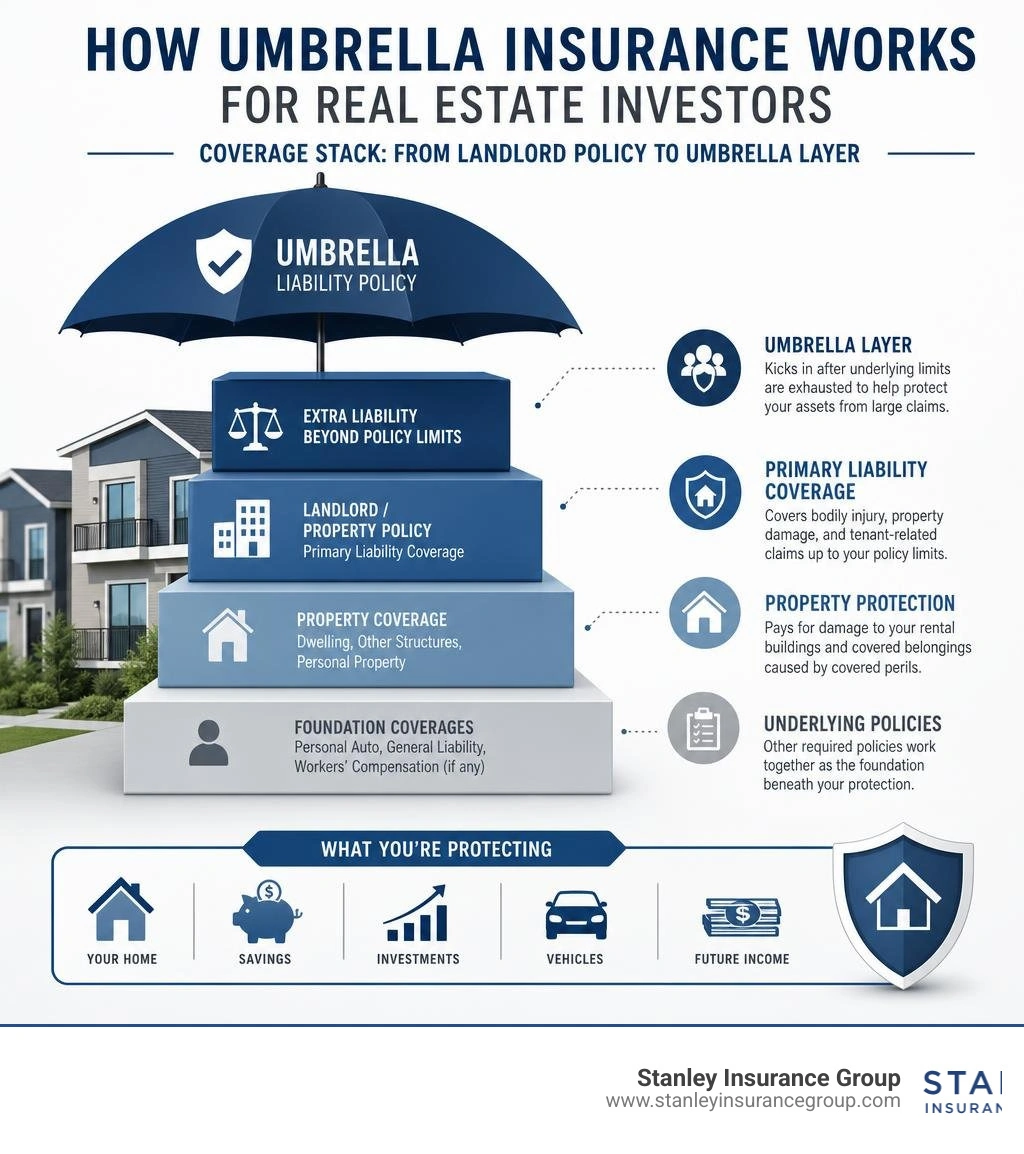
Umbrella insurance for real estate investors is a layer of extra liability protection that kicks in after your standard landlord or property policy reaches its limit — shielding your rental income, savings, and personal assets from catastrophic lawsuits.
Quick answer: What does umbrella insurance do for real estate investors?
- Covers liability claims that exceed your landlord policy's limits (typically $300k–$1M)
- Protects multiple rental properties under a single policy
- Pays legal defense costs even when a lawsuit is frivolous
- Guards personal assets like your home, savings, and vehicles from judgments
- Can extend across commercial auto, general liability, and rental property policies at once
Here's a scenario that happens more often than most investors expect: a tenant's guest slips on an icy walkway, suffers a serious injury, and sues you for $3 million. Your landlord policy covers $500,000. The other $2.5 million? That's your problem — unless you have an umbrella policy.
Landlords face roughly a 1-in-20 chance of being sued by a tenant over the course of owning a rental property. As your portfolio grows, so does your exposure. A single serious claim can exceed standard policy limits faster than you'd think, and without a backup layer of coverage, your personal assets are on the line.
I'm Brandon Stanley, President of Stanley Insurance Group, and since 1984 our team has helped Ohio property owners — from first-time landlords to multi-property investors — build smart, layered protection strategies, including umbrella insurance for real estate investors who need more than a basic landlord policy. If you're growing a rental portfolio and wondering whether your current coverage is really enough, keep reading — we'll walk you through everything you need to know.
Understanding Umbrella Insurance for Real Estate Investors
As a real estate investor in Central Ohio, you aren't just managing physical buildings; you are managing a business that comes with inherent risks. Every time a tenant signs a lease, a contractor steps onto your property, or a delivery driver walks up your steps, your liability exposure increases.
Standard landlord insurance is excellent for covering physical damage to your structure and providing basic liability protection. However, when a catastrophic event occurs, those primary liability limits can be exhausted in the blink of an eye. That is where an umbrella policy steps in.
An umbrella policy is designed to sit on top of your existing primary policies. Once the liability limit on your underlying landlord or commercial general liability policy is completely used up, the umbrella policy opens up to cover the remaining balance of the claim. To understand how this fits into your overall risk management plan, it helps to look at the 3 Situations Where Umbrella Insurance is Necessary.
How Umbrella Insurance for Real Estate Investors Differs from Excess Liability
It is common for property owners to hear the terms "umbrella insurance" and "excess liability" used interchangeably, but they are actually quite different. Understanding the distinction is crucial when structuring your portfolio's defense.
An excess liability policy is highly restrictive. It provides additional coverage limits over one specific underlying policy (such as a single landlord policy for a specific property). It mirrors the exact terms, conditions, and exclusions of that primary policy. If your underlying policy doesn't cover a specific type of claim, your excess liability policy won't either.
An umbrella insurance policy, on the other hand, is much broader. It can sit on top of multiple underlying policies simultaneously—such as your landlord policies, commercial auto insurance, and general business liability. Furthermore, an umbrella policy can sometimes "drop down" to cover certain claims that are completely excluded by your primary policies, acting as primary coverage for those specific gaps (subject to a self-insured retention, which functions like a deductible).
For a deeper dive into these structural differences, you can review the details in Umbrella & Excess Liability Policies: What Investors Need to Know.
Scope of coverage: Umbrella insurance can sit over several underlying policies, such as auto, general liability, and landlord insurance. Excess liability usually extends just one specific policy.
Exclusion alignment: Umbrella policies may offer broader protection and can sometimes fill certain coverage gaps. Excess liability typically follows the same exclusions as the primary policy.
Portfolio utility: Umbrella insurance often makes more sense for investors with multiple properties or varied business risks. Excess liability may be enough for a single property with a simpler risk profile.
Determining the Right Limit of Umbrella Insurance for Real Estate Investors
There is no "one-size-fits-all" answer when deciding how much umbrella coverage to carry. In June 2026, the cost of litigation, medical care, and property reconstruction in Central Ohio is higher than ever, meaning liability claims are scaling up in size.
To determine your ideal limit, we recommend evaluating several core factors:
- Your Total Net Worth: Your insurance should, at a minimum, cover your personal and business net worth. If you are sued, your liquid assets, future earnings, and property equity are all targets.
- Portfolio Size and Complexity: Owning two single-family homes in Hilliard carries a different risk profile than owning a 20-unit apartment building in Columbus or a short-term vacation rental in Arlington. More tenants, common areas, and visitors equal more opportunities for a lawsuit.
- Asset Exposure: If your properties are owned in your personal name rather than through structured corporate entities, your personal assets are directly exposed to property-related lawsuits.
- Risk Tolerance: Some investors prefer the peace of mind that comes with high limits, while others look to balance their coverage limits strictly against their total equity.
Typically, real estate umbrella policies are purchased in million-dollar increments, ranging from $1 million to $25 million or more for substantial commercial portfolios.
Coverage Scope: What Umbrella Policies Cover and Why Landlord Policies Aren't Enough
Many real estate investors mistakenly believe that having landlord insurance is enough. While landlord policies are foundational, their liability limits often top out at moderate amounts that can easily be wiped out by a single serious accident.
An umbrella policy provides broad-spectrum protection. It covers:
- Bodily Injury: Medical bills, rehabilitation costs, and lost wages for third parties injured on your property.
- Property Damage: Cost of repairs or replacement for third-party property damaged due to your negligence.
- Legal Defense Costs: Attorneys' fees, court costs, and settlement negotiations. In many high-quality umbrella policies, these legal defense costs are paid outside the policy limits, meaning your coverage limit isn't eaten up by lawyer fees before the claim is settled.
- Personal Injury Claims: Protection against non-physical claims such as libel, slander, defamation, or wrongful eviction.
Common Liability Risks and Claims for Landlords
Owning rental properties in Central Ohio exposes you to everyday scenarios that can quickly spiral into multi-million-dollar lawsuits. Understanding these risks highlights why standard policies fall short. For more context on base coverage, see our resources on Landlord Insurance Ohio and look into the basics of Landlord Insurance.
Some of the most common liability claims we see include:
- Slip-and-Fall Accidents: A tenant or guest slips on an icy driveway in Dublin during a freezing Ohio winter. If you failed to clear the ice or contract a proper snow removal service, you could be held liable for their severe injuries.
- Balcony or Deck Collapses: A deck railing gives way during a summer gathering, leading to multiple falls and catastrophic injuries.
- Inadequate Maintenance: A tenant falls down a dark staircase because a burnt-out common-area lightbulb wasn't replaced, or trips over a loose carpet runner that was reported but never fixed.
- Dog Bites: A tenant's dog bites a neighbor or a delivery driver on your property. If you knew the dog was aggressive and did not take action, you could be pulled into the lawsuit.
- Wrongful Eviction or Privacy Violations: A dispute over property access or a poorly executed eviction leads to a lawsuit claiming emotional distress and violation of privacy rights.
Key Exclusions to Watch Out For
While umbrella insurance is incredibly broad, it is not a magic shield that covers everything. Every policy has exclusions, and you must review these carefully with an experienced agent to avoid devastating gaps.
Common exclusions in real estate umbrella policies include:
- Intentional Acts and Gross Negligence: If you intentionally damage a tenant's property or engage in criminal behavior, your insurance will not protect you.
- Mold and Environmental Hazards: Many standard policies and umbrellas exclude claims related to toxic mold, lead paint, or asbestos unless specific endorsements are added.
- Punitive Damages: In some jurisdictions, court-ordered punitive damages (intended to punish the defendant rather than compensate the victim) cannot be paid by insurance.
- Unlisted Business Activities: If you buy a personal umbrella policy but your rental properties are owned by an LLC, the policy may exclude claims arising from those properties because they are deemed "business activities."
For a comprehensive breakdown of business exclusions and how to address them, consult the Ultimate Guide to Umbrella Policies for Real Estate Investors and read our Business Liability Insurance Complete Guide.
How Umbrella Insurance Interacts with LLCs and Underlying Policies
To build a flawless risk management strategy, you have to understand how your insurance policies, corporate structures, and personal assets connect.
Minimum Underlying Liability Requirements
An umbrella policy does not replace your primary insurance; it coordinates with it. To buy an umbrella policy, your insurance carrier will require you to maintain specific minimum limits on your underlying policies.
For example, an umbrella carrier might require you to have at least $300,000 or $500,000 in liability coverage on your primary landlord policy. If you allow your primary landlord policy's liability limits to drop below that required threshold to save on premiums, you create a "coverage gap." If a claim occurs, the umbrella policy will only pay out for damages above the required minimum limit. You would have to pay the gap out of your own pocket.
Keep your primary policies aligned by reviewing our Investment Property Insurance Complete Guide.
LLC Ownership Structures vs. Umbrella Protection
A common debate among real estate investors is whether they need umbrella insurance for real estate investors if they already hold their properties inside an LLC.

The truth is, you need both. They serve entirely different functions:
- An LLC acts as a firewall: It separates your personal assets from your business assets. If someone sues the LLC that owns your rental property, they generally cannot go after your personal home or personal bank accounts. However, they can go after everything owned by the LLC—including the equity in the property itself and any rental income it generates.
- Umbrella insurance acts as a sprinkler system: It steps in to pay the actual claim. It keeps the lawsuit from burning down your business assets. If you have a solid umbrella policy, the claim gets paid, your property equity is preserved, and your business keeps running.
Relying solely on an LLC without insurance means a major lawsuit could force the sale of your investment property to settle the debt. Conversely, relying solely on insurance without an LLC leaves your personal assets vulnerable if a claim somehow bypasses your policy limits or falls into an exclusion.
To explore this debate further, check out the community discussion on LLC inside a trust vs just getting a 2 million umbrella policy and read about the Best Landlord Insurance for Multiple Properties.
Frequently Asked Questions About Real Estate Umbrella Policies
Is Umbrella Insurance Required in Ohio for Landlords?
No, the state of Ohio does not legally require landlords to carry umbrella insurance. However, some portfolio lenders, particularly those issuing DSCR (Debt Service Coverage Ratio) loans or commercial financing, may require certain minimum liability thresholds that make an umbrella policy practically necessary. Regardless of legal mandates, practicing real estate investing without this protection exposes you to extreme financial risk. Learn more about state-specific guidelines in Is Umbrella Insurance Required in Ohio.
How Much Does an Umbrella Policy Cost for Rental Portfolios?
Because we shop across multiple top-tier carriers, we look at several factors that influence your specific premium. These include the number of rental units you own, the age and condition of the properties, your claims history, and the underlying liability limits you maintain. Generally, adding an umbrella policy is one of the most cost-effective ways to buy peace of mind because the cost per million dollars of coverage is exceptionally reasonable compared to primary liability premiums. For additional context on portfolio pricing dynamics, see Umbrella Insurance for DSCR Rental Portfolios.
Does a Personal Umbrella Policy Cover LLC-Owned Properties?
In almost all cases, no. Personal umbrella policies are designed for personal exposures (like your personal vehicles or primary residence) and specifically exclude business activities. If your rental properties are titled under an LLC, or if you operate them as a commercial business, a personal umbrella policy will likely deny any claims associated with them. You will need a commercial umbrella policy to ensure your corporate assets are fully covered. For a detailed look at when these transitions are necessary, read When Real Estate Investors Need Umbrella Insurance.
Conclusion
Real estate investing is one of the best ways to build long-term wealth, but it only takes one unforeseen accident to put your hard-earned portfolio at risk. At Stanley Insurance Group, we believe in protecting what you’ve built with tailored, comprehensive coverage.
Since '84, our family-owned, independent agency has served Hilliard, Columbus, Dublin, Arlington, and the broader Central Ohio community. Because we are independent, we aren’t tied to a single insurance carrier. Instead, we work directly for you, shopping and comparing options across 20+ top-rated carriers—including Nationwide, Progressive, Travelers, Liberty Mutual, Grange, Safeco, and more—to find the perfect fit for your real estate portfolio.
We pride ourselves on the "concierge touch." We don’t believe in automated 1-800 numbers; we believe in building real, lasting relationships. When you call our office, you will speak with dedicated professionals who know your name and understand your goals:
- Amy manages our Commercial Lines, helping investors structure business and commercial umbrella policies.
- Ana and Sandra, our bilingual Account Specialists, are always available to provide expert Spanish-speaking assistance.
- Kaisen, Ethan, and Chase, our Associate Agents, are ready to help you coordinate your personal and professional coverage.
Whether you need to secure Home & Property Insurance, Auto & Vehicle Insurance, Life Insurance, or specialized Business Insurance, our team is here to guide you every step of the way. Additionally, as one of only 100 independent agencies in the entire country with a direct partnership with Geico, we bring unique competitive advantages and options to our Central Ohio clients.
Don't wait for a costly claim to find out if your portfolio is protected. Let us help you review your liability limits and find the right umbrella policy today.
Similar posts