
Roofing Liability Insurance Made Easy: Protect Your Business Today
Protect your company with roofing business insurance. Learn coverage types, costs, top providers, and tips for risk management.
What Is Roofing Business Insurance and Why Do Roofers Need It?
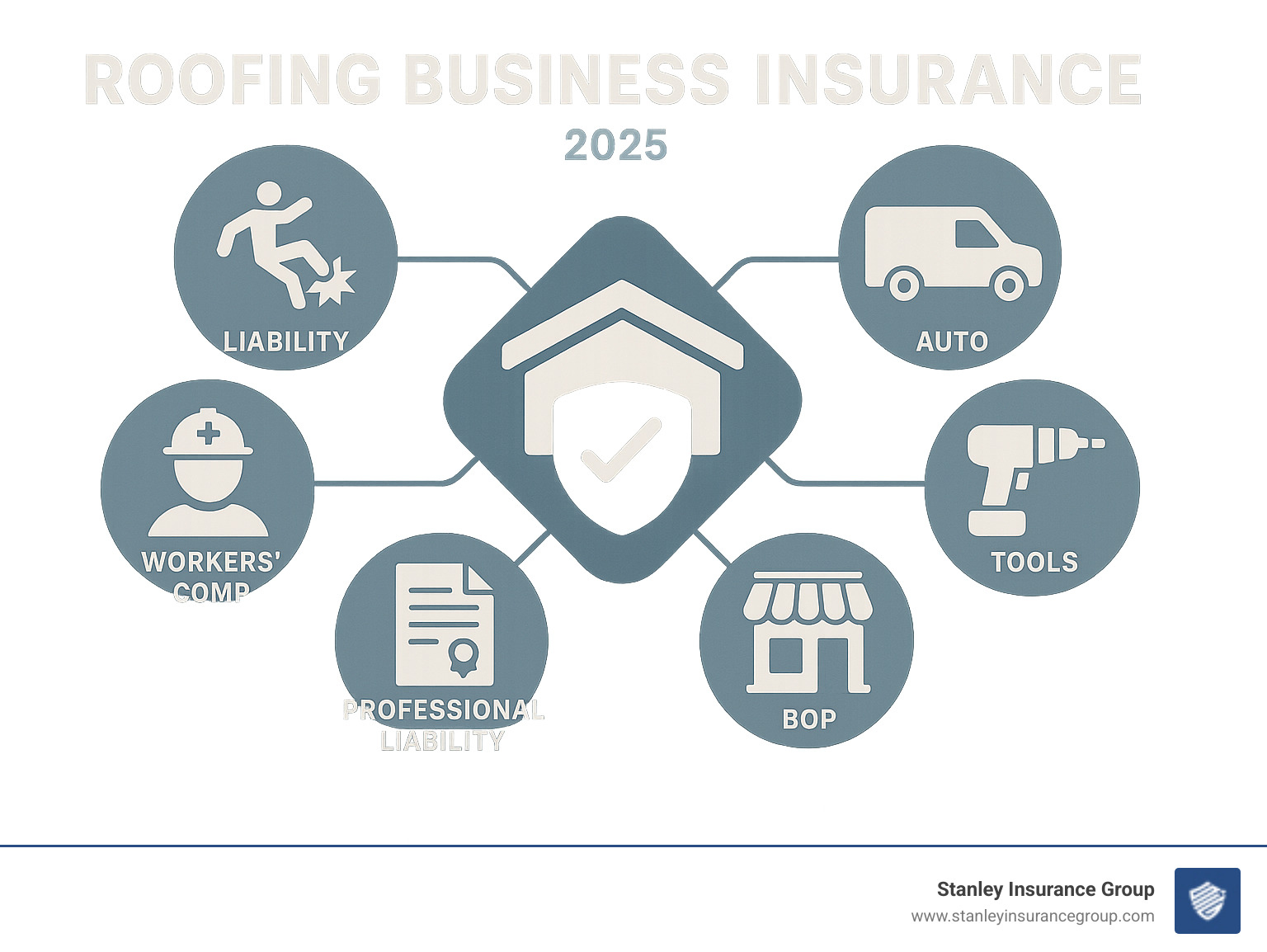
Roofing business insurance is a set of custom insurance policies that protect roofing contractors from the unique risks they face on the job—like accidents, property damage, employee injuries, lawsuits, and equipment theft. If you want a quick answer to what you need:
What does roofing business insurance cover?
- General liability: Covers third-party injuries and property damage
- Workers' compensation: Pays for employee injuries and lost wages
- Commercial auto: Insures work vehicles and equipment in transit
- Tools & equipment (inland marine): Protects your tools onsite and on the road
- Professional liability (E&O): Covers claims of faulty work or professional mistakes
- Business owner's policy (BOP): Bundles liability and property coverage for savings
Why is it important?
- Shields your business from costly lawsuits and claims
- Required by most states and clients before work begins
- Helps you land more jobs by proving you're insured and professional
- Keeps your team and assets protected from common roofing hazards
As the president of Stanley Insurance Group, I've guided Ohio contractors—just like you—through buying and managing roofing business insurance since 1984. My team and I believe in building lasting relationships, offering a concierge touch, and providing help in English or Spanish to protect your business, home, or family.
Essential Roofing Business Insurance Coverage Types
The roofing industry faces unique challenges that make comprehensive insurance coverage absolutely critical. According to the Bureau of Labor Statistics, roofing was among the riskiest occupations in 2019-2020, with a fatal work injury rate of 47 per 100,000 full-time equivalent workers. This sobering statistic highlights why we always recommend multiple layers of protection for our roofing clients.
At Stanley Insurance Group, we've seen how proper roofing business insurance can mean the difference between a minor setback and business closure. Our commercial lines specialist Amy works closely with roofing contractors across Ohio, Pennsylvania, Tennessee, North Carolina, South Carolina, and Florida to ensure they have the right coverage mix.
The core coverage types every roofing contractor needs include general liability, workers' compensation, commercial auto, professional liability, and property protection. Let's break down each one so you understand exactly what you're getting and why it matters.
General Liability Insurance for Roofers
General liability insurance is the foundation of any roofing contractor's insurance program. This coverage protects you when your work causes third-party property damage or bodily injury. For roofers, this is especially important because you're working on someone else's property with heavy materials and potentially dangerous tools.
Here's what general liability typically covers for roofing contractors:
Property Damage Protection
- Damage to a client's landscaping from falling debris
- Interior water damage from an accidentally opened roof during rain
- Damage to neighboring properties from loose materials
Bodily Injury Coverage
- A homeowner injured by falling roof tiles
- A passerby hurt by debris from your work site
- Injuries from unsecured equipment left on the property
Personal and Advertising Injury
- Libel claims from comparative advertising
- Copyright infringement in your marketing materials
- Invasion of privacy claims
Medical Payments
- Immediate medical expenses for minor injuries on your job site
- Coverage regardless of who's at fault
Legal Defense Costs
- Attorney fees for covered claims
- Court costs and settlements
- Investigation expenses
Most roofing contractors choose coverage limits between $1 million and $5 million, with 99% of policies sold featuring $1 million per occurrence and $2 million aggregate limits. The typical annual premium for general liability insurance starts around $2,000 but can range from $2,440 to $4,220 depending on your location and risk factors.
One crucial aspect of general liability for roofers is "completed operations" coverage. This protects you from claims that arise after your work is finished—like a roof leak that develops weeks later and causes interior damage. Without this coverage, you could face significant out-of-pocket expenses for problems that surface after project completion.
Workers Compensation Requirements
Workers' compensation insurance is required for roofing businesses in almost every U.S. state, regardless of whether you have employees. This isn't just a legal requirement—it's a financial lifeline that protects both your workers and your business.

What Workers' Compensation Covers:
- Medical expenses for work-related injuries
- Rehabilitation costs and physical therapy
- About two-thirds of the injured worker's regular salary
- Disability benefits for permanent injuries
- Death benefits for families of workers killed on the job
Why Homeowners Care About Your Workers' Comp:Here's something many contractors don't realize: if you don't carry workers' compensation insurance, homeowners could be held liable if one of your workers gets injured on their property. That's why smart homeowners always ask to see proof of workers' comp coverage before hiring a roofing contractor.
State-by-State Cost Variations:Workers' compensation rates vary dramatically by state. For example, our research shows:
- Georgia: $39,590 per $100,000 of payroll
- Alabama: $17,650 per $100,000 of payroll
- Texas: $7,410 per $100,000 of payroll
These variations reflect different state regulations, medical costs, and claim frequencies. In Minnesota, standard workers' compensation coverage is typically $500,000/$500,000/$500,000, covering workers up to $500,000 when the owner is liable.
Experience Modifiers and Premium Control:Your workers' compensation premium is heavily influenced by your experience modifier (ex-mod). A clean safety record keeps your ex-mod below 1.0, which reduces your premium. However, frequent claims can push your ex-mod above 1.0—and a 2.0 modifier means you're paying double the base rate.
Commercial Auto Insurance Protection
If you use vehicles for your roofing business—whether it's transporting materials, equipment, or workers—you need commercial auto insurance. Personal auto policies typically exclude business use, leaving you exposed to significant financial risk.
What Commercial Auto Covers:
- Vehicle damage from collisions
- Theft of work vehicles
- Liability for accidents involving your business vehicles
- Medical payments for injuries in your vehicles
- Uninsured/underinsured motorist protection
Coverage Considerations for Roofers:Commercial auto insurance for roofing contractors usually ranges from $1,500 to $3,000 annually per vehicle in states like Minnesota. The standard coverage recommendation is $1,000,000 Combined Single Limit for bodily injury and property damage.
Equipment in Transit:Many roofing contractors assume their commercial auto policy covers tools and materials being transported. However, you often need separate inland marine coverage for equipment and materials in transit. This is a common coverage gap that can leave you exposed to significant losses.
More info about Business Insurance
Top Roofing Business Insurance Providers and Policies

The roofing insurance market has evolved significantly since we started Stanley Insurance Group in 1984. Today's roofing contractors have access to specialized programs designed specifically for their unique risks, but navigating these options can be overwhelming without expert guidance.
The insurance industry for roofing contractors often operates through the excess and surplus (E&S) lines market due to the high-risk nature of the work. This means specialized carriers and programs that understand roofing risks better than standard commercial insurers.
Specialized Roofing Insurance Programs
Excess and Surplus Lines Programs:Many roofing contractors require specialized E&S coverage because standard commercial insurers view roofing as too risky. These programs offer:
- Higher risk tolerance for roofing operations
- Specialized endorsements for roofing-specific risks
- Flexibility in coverage terms and conditions
- Access to carriers that understand the industry
Specialized Coverage Features:Modern roofing insurance programs include endorsements and features that weren't available years ago:
Torch-Down and Hot-Tar Operations:Many standard policies exclude or limit coverage for torch-down roofing and hot-tar operations due to fire risks. Specialized programs offer coverage for these higher-risk activities with appropriate safety protocols.
Subcontractor Coverage:Unlike many commercial policies that exclude subcontracted work, specialized roofing programs often provide coverage with no limitations on the amount of subcontracted work. This is crucial since many roofing contractors rely heavily on subcontractors.
Drone Coverage:Most standard general liability policies exclude "unmanned aircraft," but roofing contractors increasingly use drones for inspections and marketing. Specialized programs can add drone coverage through endorsements.
Open Roof Coverage:This specialized coverage protects against weather damage when a roof is left exposed during work. If rain damages a client's interior because you had to leave a roof open overnight, this coverage pays for the repairs.
Weather Damage Endorsements:Roofing contractors face unique weather-related risks. Specialized endorsements can cover damage from sudden weather changes that occur during roofing projects.
Roofing Contractors Submission Guide
Business Owners Policy (BOP) Options
A Business Owners Policy (BOP) combines general liability and commercial property insurance into one convenient package, often at a lower cost than purchasing the coverages separately. For roofing contractors, a BOP can provide excellent value and comprehensive protection.
What's Included in a Roofing BOP:
- General liability coverage
- Commercial property insurance for your business premises
- Business interruption coverage
- Equipment breakdown coverage
- Crime coverage (optional)
BOP Benefits for Roofers:
- Cost savings through bundling
- Simplified policy management
- Coordinated coverage limits
- Single deductible for related claims
BOP Limitations:Not all roofing contractors qualify for BOP coverage. Factors that might disqualify you include:
- Very high revenue levels
- Specialized high-risk operations
- Poor loss history
- Unusual business operations
At Stanley Insurance Group, our team evaluates each contractor's specific situation to determine whether a BOP or separate policies provide better protection and value.
Roofing Insurance Costs and Pricing Factors
Understanding what drives roofing business insurance costs helps you make informed decisions and potentially reduce your premiums. Roofing contractors typically pay more for insurance than other trades due to the inherent risks of the work.
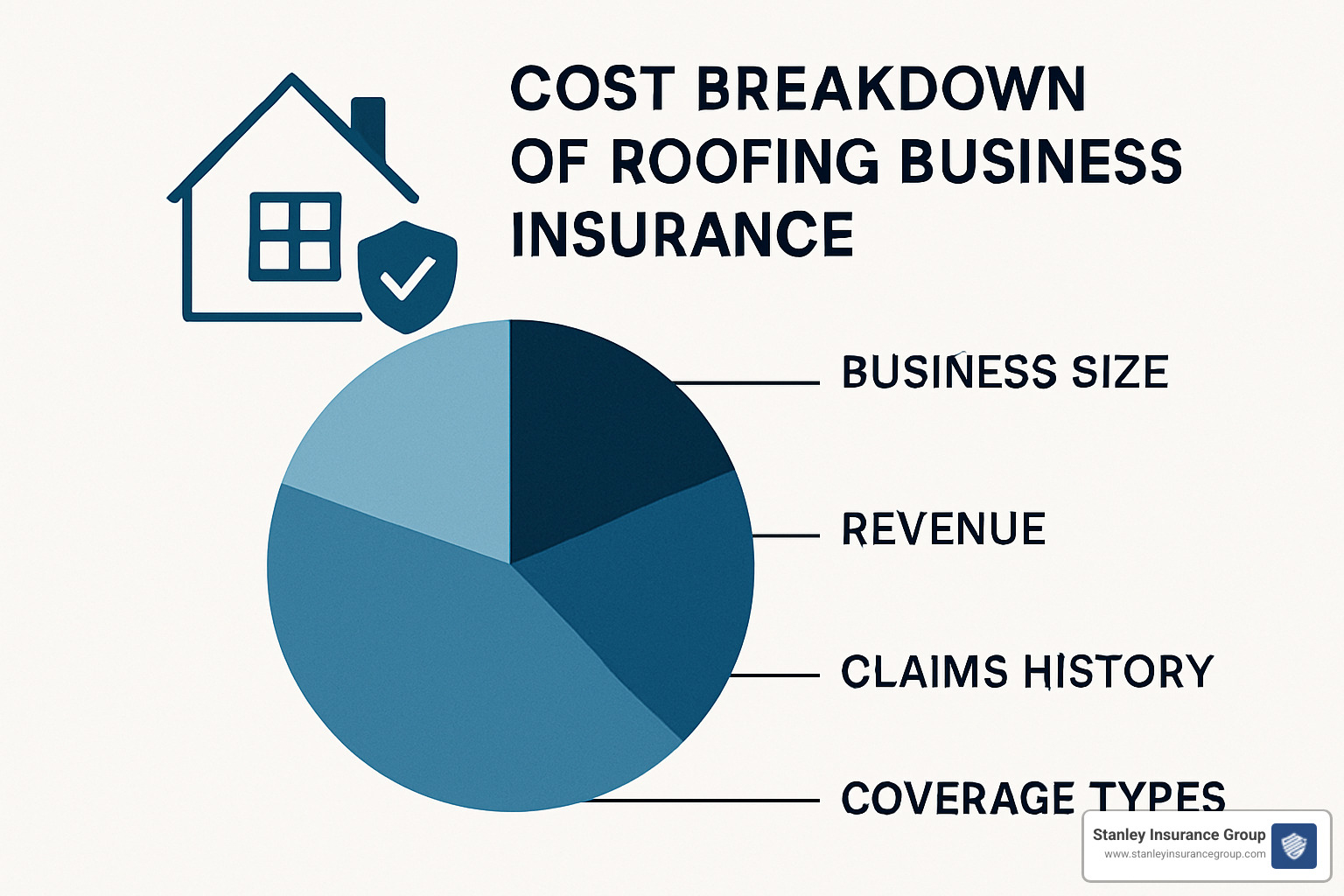
Primary Cost Factors:
Business Size and Revenue:Larger roofing companies with higher revenues typically pay more in premiums, but they also often get better rates per dollar of coverage due to economies of scale.
Number of Employees:Workers' compensation premiums are directly tied to your payroll, so more employees mean higher premiums. However, good safety records can help control these costs.
Types of Roofing Work:
- Residential roofing typically costs less to insure than commercial
- Steep-slope work may have different rates than flat roofing
- Specialized work like torch-down operations costs more to insure
Geographic Location:Insurance costs vary significantly by state and region due to:
- Different state regulations
- Varying medical costs
- Regional weather patterns
- Local court systems and legal environments
Claims History:Your loss history is one of the most significant factors in determining premiums. A clean record can result in substantial discounts, while frequent claims can double or triple your costs.
Coverage Limits and Deductibles:Higher coverage limits increase premiums, but the relationship isn't always linear. Sometimes doubling your limits costs less than 50% more in premium.
State-Specific Insurance Requirements
Insurance requirements for roofing contractors vary significantly by state. Some states require specific coverage types or minimum limits for licensing, while others leave it to market forces and client requirements.
Common State Requirements:
- Workers' compensation (required in almost all states)
- General liability (required for licensing in many states)
- Commercial auto (required for business-owned vehicles)
- Surety bonds (required in some states for contractor licensing)
Certificate of Insurance Requirements:Most clients require certificates of insurance before work begins. These certificates must show:
- Current coverage with no lapses
- Adequate coverage limits
- The client listed as an additional insured
- Waiver of subrogation (often required)
Licensing and Bonding:Some states require roofing contractors to post surety bonds as part of their licensing process. For example, California requires a $15,000 surety bond for contractor licensing.
Cost-Saving Strategies for Roofers
Safety Programs:Implementing and documenting formal safety programs can result in significant premium discounts. Many insurers offer discounts of 10-25% for contractors with written safety programs and regular training.
Experience Modifier Management:Keeping your workers' compensation experience modifier below 1.0 can save thousands of dollars annually. This requires:
- Prompt injury reporting
- Effective return-to-work programs
- Ongoing safety training
- Proper job classification
Bundling Discounts:Purchasing multiple policies from the same insurer often results in package discounts. We've seen clients save 10-15% by bundling their coverage.
Higher Deductibles:Accepting higher deductibles can significantly reduce premiums. However, make sure you can afford the deductible if you need to file a claim.
Risk Management:Proactive risk management—like regular equipment maintenance, ongoing training, and proper job site safety—can help prevent claims and keep premiums low.
Roofing Business Insurance Claims and Risk Management
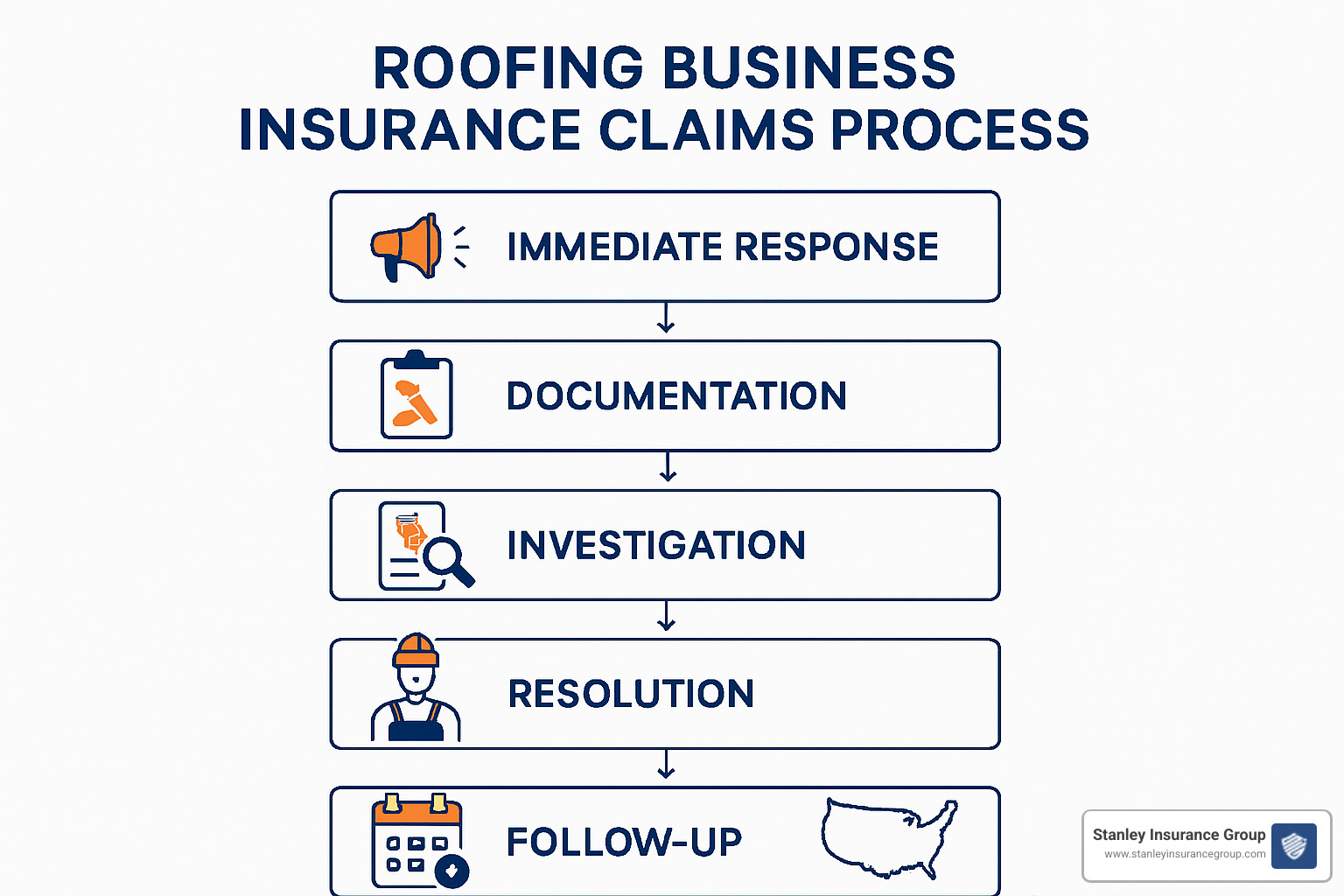
Understanding the claims process and implementing effective risk management strategies can make the difference between a minor setback and a business-threatening event. At Stanley Insurance Group, we've helped countless roofing contractors steer claims and implement risk management programs that protect their bottom line.
The Claims Process:
- Immediate Response: Report claims as soon as possible, ideally within 24 hours
- Documentation: Gather photos, witness statements, and incident reports
- Investigation: The insurer investigates the claim and determines coverage
- Resolution: Claims are settled through payment, repair, or legal defense
Common Documentation Requirements:
- Incident reports with detailed descriptions
- Photos of damage or accident scenes
- Witness contact information
- Police reports (if applicable)
- Medical records (for injury claims)
- Repair estimates and invoices
Common Roofing Insurance Claims
Based on our experience and industry data, here are the most common types of claims we see from roofing contractors:
Fall-Related Injuries:Falls account for one-third of construction-related deaths, with roofing being particularly dangerous. Common scenarios include:
- Workers falling from ladders or scaffolding
- Falls through skylights or weak roof sections
- Slips on wet or icy surfaces
Property Damage Claims:
- Interior water damage from opened roofs during rain
- Damage to landscaping from falling debris
- Broken windows or siding from dropped materials
- Damage to neighboring properties
Equipment and Tool Theft:Roofing contractors are frequent targets for equipment theft due to:
- Valuable tools left on job sites
- Equipment stored in vehicles overnight
- Portable equipment that's easy to steal and resell
Weather-Related Damage:
- Materials damaged by sudden weather changes
- Equipment blown off roofs during storms
- Damage from leaving roofs exposed overnight
Completed Operations Claims:These claims arise after work is finished and can include:
- Roof leaks that develop weeks or months later
- Structural damage from improper installation
- Mold or water damage from faulty work
Subcontractor Issues:
- Injuries to subcontractor employees
- Property damage caused by subcontractors
- Disputes over subcontractor work quality
Electronic Library of Construction Occupational Safety & Health
Certificates of Insurance and Client Requirements
Certificates of insurance (COIs) are essential documents that prove you have insurance coverage. Most clients require COIs before work begins, and understanding how to obtain and manage them is crucial for roofing contractors.
What COIs Include:
- Insurance company information
- Policy numbers and effective dates
- Coverage types and limits
- Additional insured information
- Waiver of subrogation (if required)
Client Requirements:Many clients have specific insurance requirements, including:
- Minimum coverage limits (often $1 million per occurrence)
- Additional insured status
- Primary and non-contributory language
- Waiver of subrogation
- 30-day notice of cancellation
Managing COI Requests:Modern insurance programs often include unlimited COI issuance at no additional cost. Many insurers now offer online portals or mobile apps that allow you to generate COIs instantly.
Best Practices for COIs:
- Keep digital copies of all COIs
- Set reminders for policy renewal dates
- Understand client requirements before bidding
- Maintain current contact information with your insurer
Frequently Asked Questions about Roofing Business Insurance
What types of insurance do roofing contractors need most?
The essential coverage types for roofing contractors are:
General Liability Insurance - This is your primary protection against third-party claims for property damage and bodily injury. It's often required for licensing and client contracts.
Workers' Compensation - Required in almost every state, this covers medical expenses and lost wages for injured employees.
Commercial Auto Insurance - Necessary if you use vehicles for business purposes, including transporting materials and equipment.
Tools and Equipment Coverage (Inland Marine) - Protects your valuable tools and equipment whether they're on job sites, in transit, or stored off-site.
Professional Liability (Errors & Omissions) - Covers claims related to faulty workmanship or professional mistakes.
Many contractors also benefit from a Business Owners Policy (BOP) that bundles general liability and property coverage for cost savings.
How much does roofing business insurance typically cost?
Roofing business insurance costs vary significantly based on multiple factors, but here are typical ranges we see:
- General Liability: Usually the largest expense, starting around $2,000 annually
- Workers' Compensation: Varies dramatically by state and can be your highest cost
- Commercial Auto: Typically $1,500-$3,000 per vehicle annually
- Tools and Equipment: Usually $250-$2,000 annually for small businesses
Factors That Affect Your Costs:
- Business size and annual revenue
- Number of employees
- Types of roofing work performed
- Geographic location
- Claims history and safety record
- Coverage limits and deductibles chosen
The total annual cost for comprehensive coverage typically ranges from $2,000 to $10,000 or more, depending on your specific situation. At Stanley Insurance Group, we work with you to find the right balance between comprehensive protection and affordable premiums.
Are there state-specific insurance requirements for roofers?
Yes, insurance requirements vary significantly by state. Here's what you need to know:
Workers' Compensation:
- Required in almost all states if you have employees
- Some states require coverage even for sole proprietors
- Rates and benefits vary dramatically by state
General Liability:
- Not typically required by law but often required for:
- Contractor licensing
- Client contracts
- Government projects
Commercial Auto:
- Required in most states for business-owned vehicles
- Coverage limits vary by state
Surety Bonds:
- Required in some states for contractor licensing
- Amounts vary (California requires $15,000, for example)
Additional Requirements:Some states have specific requirements for:
- Minimum coverage limits
- Certificate of insurance formats
- Additional insured requirements
- Waiver of subrogation language
Since we serve clients across Ohio, Pennsylvania, Tennessee, North Carolina, South Carolina, and Florida, our team at Stanley Insurance Group stays current on requirements in all these states. We can help ensure you meet all applicable requirements in your operating areas.
Conclusion
Protecting your roofing business with comprehensive insurance isn't just about meeting legal requirements—it's about ensuring your business can survive and thrive despite the inherent risks of the roofing industry. With roofing ranking among the most dangerous occupations and the potential for costly third-party claims, proper insurance coverage is essential for long-term success.
At Stanley Insurance Group, we've been helping contractors protect their businesses since 1984. Our independent agency status means we can shop multiple carriers to find you the best coverage at competitive rates. Whether you need basic liability coverage or a comprehensive program with specialized endorsements, our team—including commercial lines specialist Amy and our bilingual account specialists Ana and Sandra—is here to help.
We understand that every roofing contractor's situation is unique. That's why we take a consultative approach, working with you to identify your specific risks and coverage needs. As one of only 100 independent agents in the country with a partnership with GEICO, we have access to a wide range of coverage options and competitive rates.
Key Takeaways:
- Roofing business insurance is essential due to the high-risk nature of the work
- General liability and workers' compensation are the foundation of most programs
- Specialized coverage for tools, equipment, and roofing-specific risks is often necessary
- Working with an experienced independent agent can save you time and money
- Proper risk management can help control insurance costs and prevent claims
Don't let inadequate insurance coverage put your roofing business at risk. Contact Stanley Insurance Group today to discuss your insurance needs and get a comprehensive quote. With locations throughout Ohio and coverage in Pennsylvania, Tennessee, North Carolina, South Carolina, and Florida, we're here to provide the personalized service and expertise you deserve.
In the roofing business, it's not a matter of if something will go wrong—it's when. Make sure you're protected when that time comes.
Similar posts


