
Long Term Rental Insurance: A Landlord's Guide
Discover long term rental insurance essentials, coverage, costs & FAQs. Get the best quotes for your rental property today!
Why Long Term Rental Insurance Is the Foundation of Smart Property Ownership
Long term rental insurance — also called landlord insurance — is the specialized coverage property owners need when renting out a home, condo, or multi-unit building to tenants on an annual lease.
If you're comparing your options, here are the key points to know:
- What it covers: Property damage, liability, and loss of rental income.
- Who needs it: Any landlord renting to tenants on a long-term lease.
- Does home insurance work instead? No — standard home insurance is designed for owner-occupied homes only.
- Does tenant insurance replace it? No — tenants cover their belongings; you cover the structure.
- Typical property types covered: Single-family homes, condos, townhouses, and 1-4 unit buildings.
There are more than 11 million landlords in the U.S., and a new rental unit enters the market every 80 seconds. That's a lot of investment — and a lot of risk if the wrong policy (or no policy at all) is in place.
Renting out a property you own feels like a straightforward income stream. But one storm, one lawsuit, or one difficult tenant can quickly turn that income into a major financial loss without the right coverage.
That's exactly why understanding your landlord insurance options — before something goes wrong — is so important.
I'm Brandon Stanley, President of Stanley Insurance Group, a family-owned independent agency serving the Hilliard, Ohio area since 1984. Helping property owners find the right long term rental insurance to protect their investments is a core part of what we do every day. Let's walk through everything you need to know to compare your options with confidence.
Navigating the Essentials of Long Term Rental Insurance
When you transition from being a homeowner to a landlord, your risk profile changes overnight. You are no longer just protecting a roof over your head; you are protecting a business asset. Navigating long term rental insurance doesn't have to be a headache, but it does require knowing exactly what you're looking for.

Why Long Term Rental Insurance is Essential for Property Owners
If you own an investment property—whether it’s a single-family home, a townhouse, or a condo—standard homeowners insurance simply won't cut it. Most homeowners policies have "occupancy" clauses that require you to live in the home for coverage to remain valid. If you move out and a tenant moves in without you updating your policy, you could find yourself with a denied claim after a fire or storm.
Long term rental insurance provides the financial protection you need for properties rented out on an annual basis. It is designed to handle the specific risks of 1-4 unit residential buildings. This includes protection against catastrophic events like lightning, wind, and hail, but it also goes a step further by protecting your bank account if a tenant gets injured on your stairs and decides to sue.
For more details on how these policies work, you can explore our landlord insurance page. It’s also helpful to consult resources like the Insurance Information Institute to understand what type of insurance you need if you're renting out your home.
Landlord vs. Homeowners vs. Tenant Insurance
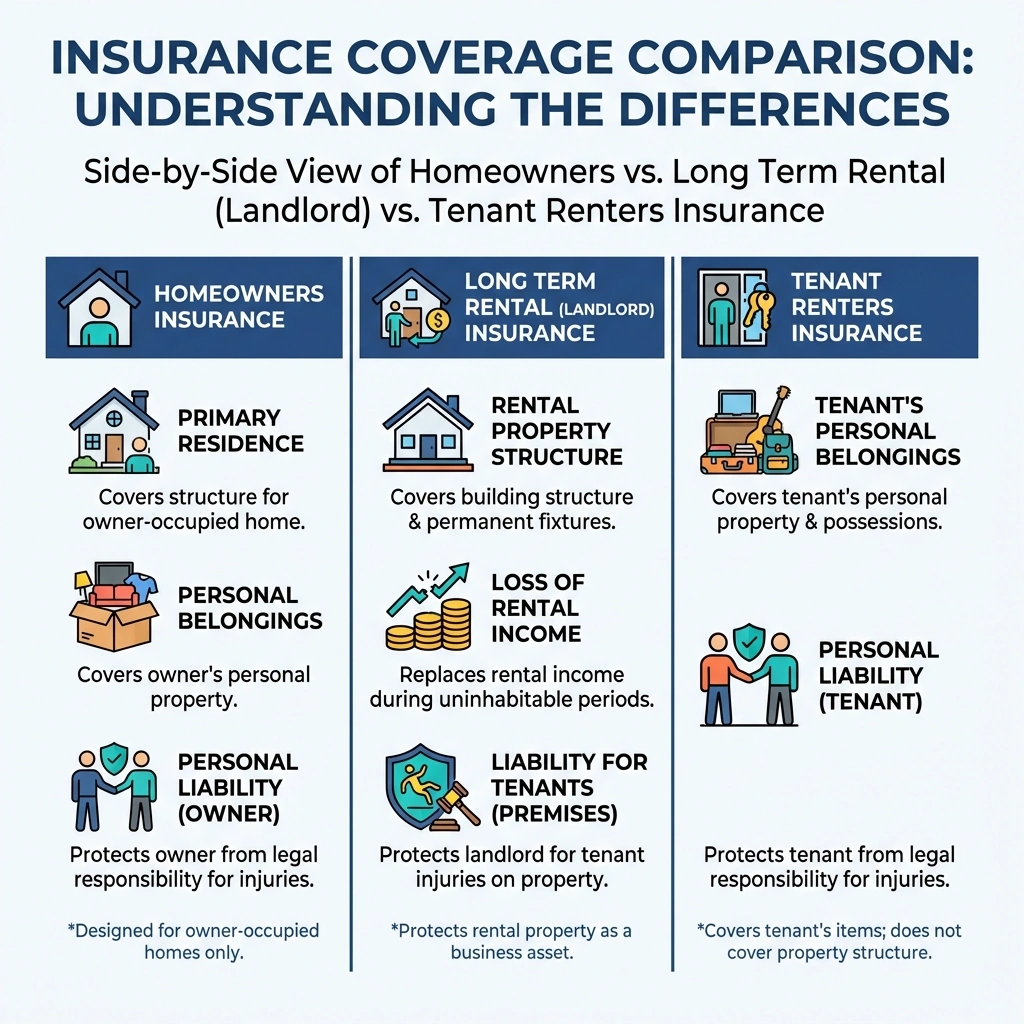
It is a common misconception that one policy covers everyone. In reality, a healthy rental arrangement requires a "tripod" of coverage:
- Homeowners Insurance: This is for your primary residence. It covers the building, your personal belongings (like your couch and clothes), and your personal liability.
- Landlord Insurance (Long Term Rental Insurance): This covers the building structure you own and your liability as a landlord. It does not cover the tenant’s stuff.
- Tenant Insurance (Renters Insurance): This is purchased by the person living in your unit. It covers their personal property and provides them with liability protection.
We often tell our clients in Ohio, Pennsylvania, and Tennessee that requiring renters insurance in the lease is one of the smartest moves a landlord can make. It ensures that if a tenant accidentally starts a kitchen fire, their insurance handles their displaced living expenses and damaged belongings, rather than them looking to you for a handout.
What Your Policy Covers (and What It Doesn’t)
Understanding the "guts" of your policy is the best way to avoid surprises during a claim. Most long term rental insurance policies are broken down into three primary categories: property damage, liability, and loss of income.
Protecting Your Assets from Damage and Liability
When you look at a quote, you'll see several different "Coverage" letters. Here is what they usually mean for a landlord:
- Coverage A (Dwelling): This is the big one. it covers the physical structure of the house, including the walls, roof, and foundation. If a tornado hits your rental in Dublin or Arlington, Coverage A is what pays to rebuild it.
- Coverage C (Personal Property): Since you don't live there, this is usually a small amount. It covers items you own that stay on-site, like a lawnmower, fridge, or stove.
- Coverage E (Liability): This is your shield against lawsuits. If a tenant or their guest trips on a loose carpet and breaks a leg, Coverage E pays for medical costs and legal settlements. In today's litigious world, we recommend high limits here.
- Loss of Rental Income: If a fire makes your property unrentable for six months, this coverage reimburses you for the rent you would have collected while the house is being repaired. It keeps your mortgage paid even when the tenant is gone.
For those managing a portfolio, you might want to read our guide on the best landlord insurance for multiple properties to see how to scale this protection. You can also find a quick guide to landlord insurance via Investopedia for a high-level overview.
Understanding Exclusions: From Wear and Tear to Tenant Belongings
Insurance is meant for "sudden and accidental" losses. It is not a maintenance plan. This is where many new landlords get frustrated.
Common Exclusions Include:
- General Wear and Tear: If the roof is 30 years old and starts leaking because it’s simply worn out, insurance won't pay for a new one.
- Maintenance Issues: A broken dishwasher or a furnace that simply stops working due to age is your responsibility, not the insurance company's.
- Intentional Damage: If a tenant gets angry and punches holes in every wall, many standard policies exclude "intentional acts" by a tenant.
- Tenant’s Personal Property: Your policy will never cover the tenant's $2,000 laptop or their antique china.
In states like Ohio, know the local rules. We've put together a resource answering can a landlord require renters insurance in Ohio to help you set the right expectations with your tenants.
Comparing Quotes: Costs and Savings Strategies
How much does long term rental insurance actually cost? While we can't give you an exact number without looking at your specific property, we can look at industry averages to give you a ballpark.
Factors Influencing Long Term Rental Insurance Rates
Several factors go into the "secret sauce" of insurance pricing:
- Property Type: Insuring a standalone house is generally more expensive than a condo. A house might cost around $900 annually, whereas a condo—where the HOA often covers the exterior shell—might only cost $400.
- Location: Properties in Florida or South Carolina may face higher premiums due to hurricane risks, while a rental in Columbus, OH might be more affected by hail or winter weather risks.
- Tenant History: Some insurers ask about your tenant screening process. High-quality, long-term tenants often lead to fewer claims and lower rates.
- Age of Systems: A home with a brand-new roof and updated electrical will always be cheaper to insure than a "fixer-upper" with 1970s wiring.
For more state-specific insights, check out our page on landlord insurance Ohio.
Popular Add-ons for Enhanced Protection
A basic policy is a great start, but many landlords choose "endorsements" (add-ons) to fill specific gaps:
- Sewer Backup: Standard policies often exclude damage caused by water backing up through drains or sump pumps. This is a very common claim in the Midwest!
- Equipment Breakdown: This can help cover the cost of repairing or replacing major appliances or HVAC systems if they suffer a mechanical failure.
- Vandalism & Malicious Acts: While "intentional damage" is often excluded, you can sometimes add a rider to cover vandalism by tenants or outsiders.
- Rental Income Protection: Ensure your "loss of use" coverage is sufficient to cover your full mortgage and taxes if the building is empty due to a claim.
Managing Complex Rental Situations
The rental market isn't as simple as it used to be. From the "Airbnb-ification" of suburbs to the rise of multi-generational living, your insurance needs to keep up with how you actually use your property.
Roommates, Partners, and Family Coverage
One of the most frequent questions we get at Stanley Insurance Group is: "Who is actually covered under this policy?"
- Immediate Family: Generally, if you are the landlord and your child or sibling is the tenant, they are often treated with more flexibility, but they still need their own liability protection.
- Romantic Partners: If a tenant's partner moves in, they usually need to be added to the tenant's renters insurance policy. For a landlord's policy, they are simply another occupant.
- Roommate Exclusions: Roommates are almost never automatically covered under one another's policies. Each roommate should ideally have their own renters insurance policy to avoid messy disputes over whose insurance pays for a stolen bike or a kitchen fire.
Requirements for Long-Term Airbnb and Vacation Rentals
If you are using Airbnb for "extended stays" (typically defined as stays longer than 28 days or 4 weeks), you are entering a grey area.
Airbnb provides AirCover, which offers some protection, but it has significant limitations. It often excludes personal belongings and can have a notoriously slow and complicated claims process. Furthermore, many "short-term" rental policies stop providing coverage once a guest stays longer than a month, as they are then legally considered a "long-term tenant."
If you are pivoting to long-term Airbnb stays, you likely need a dedicated long term rental insurance policy or a specific rider that acknowledges the "hybrid" nature of your rental business. This ensures you are protected against the higher risks of vacancy and turnover that come with even "extended" vacation rentals.
Frequently Asked Questions about Rental Property Coverage
Are roommates covered under my landlord policy?
No. Your landlord policy is there to protect your interests—the building and your liability. Roommates are not considered your immediate family and are not covered by your policy. They must carry their own renters insurance to protect their personal belongings and provide them with personal liability coverage.
Does landlord insurance cover damage caused by tenants?
It depends on the type of damage. If a tenant accidentally leaves the stove on and causes a fire, your policy will likely cover the repairs to the building. However, if a tenant's dog chews up the baseboards or if the tenant intentionally smashes a window, those are typically excluded as maintenance issues or intentional acts.
Is insurance required for long-term Airbnb stays?
While Airbnb doesn't strictly "require" you to have outside insurance to use their platform, relying solely on AirCover is a massive risk. For stays over 28 days, most insurance carriers view the occupant as a tenant. Without a long term rental insurance policy or a specific short-term-to-long-term rider, you could be left completely unprotected if a major claim occurs.
Conclusion: The Concierge Approach to Protecting Your Investment
At Stanley Insurance Group, we believe that insurance shouldn't be a "do-it-yourself" headache. Since '84, we have operated as an independent agency, which means we don't work for one big insurance company—we work for you. We have the "concierge touch," building real relationships with our clients in Ohio, Tennessee, and across the Southeast.
Whether you're talking to Amy about your commercial lines, or working with our Spanish-speaking specialists Ana and Sandra, you’re getting expert advice tailored to your life. Our team, including Kaisen, Ethan, and Chase, is dedicated to finding you the best rates by comparing options from multiple carriers. In fact, we are one of only 100 independent agents in the country with a partnership with Geico, giving us even more tools to help you save.
Don't leave your investment to chance. Protecting your rental property is about more than just a policy; it's about peace of mind.
Ready to protect your investment? Get a Landlord Insurance Quote from our team today and experience the Stanley Insurance Group difference.
Similar posts


