
Rev Up Your Savings: Auto Insurance Buying Tips
Discover expert buying auto insurance tips to save money, compare quotes, and choose the right coverage for every driver.
Understanding Auto Insurance: What You Need to Know
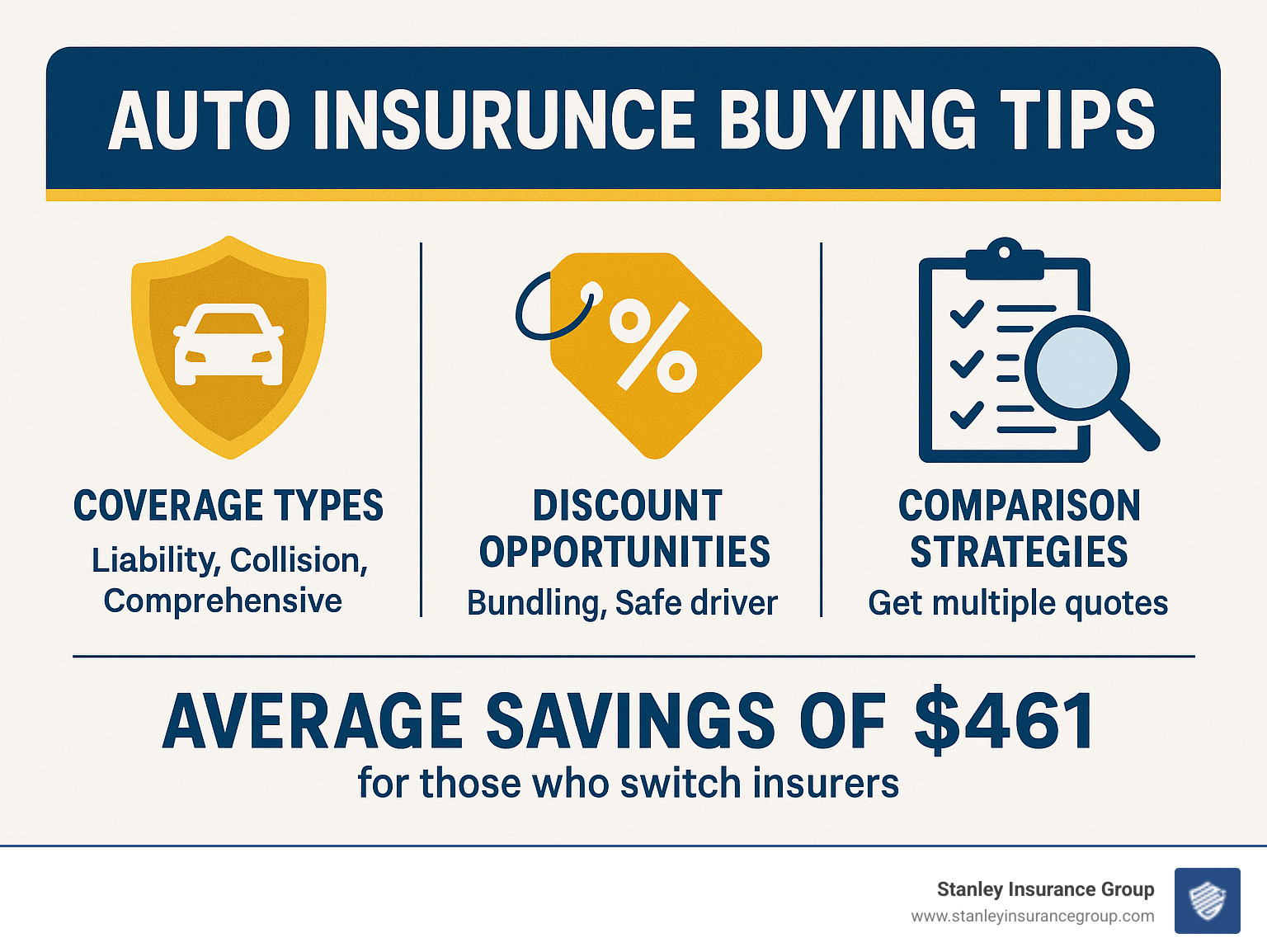
If you're looking for buying auto insurance tips, here's a quick overview of what you need to know:
- Compare at least 3 quotes with identical coverage levels
- Know your coverage needs beyond state minimums (liability, collision, comprehensive)
- Check for discounts (bundling, safe driver, multi-car, defensive driving)
- Consider deductible levels that balance premiums with out-of-pocket costs
- Buy insurance before picking up your new vehicle
- Review your policy annually to ensure adequate coverage at competitive rates
Buying auto insurance tips can save you hundreds of dollars while ensuring you have the right protection for your specific needs. Shopping for auto insurance might seem overwhelming with countless coverage options, discounts, and policy terms to steer. The average car insurance premium in the U.S. increased by 26% to $2,543 in 2024, making it more important than ever to shop smartly.
The good news? You don't have to sacrifice coverage to find an affordable policy. With the right approach, you can secure comprehensive protection that fits your budget.
I'm Brandon Stanley, President of Stanley Insurance Group, and I've been helping families find the right auto coverage since our agency was established in 1984, providing personalized buying auto insurance tips that save our clients money while ensuring proper protection.
Quick buying auto insurance tips definitions:
Buying Auto Insurance Tips #1: Know Your Coverage Options
Let's face it – auto insurance can feel like navigating a maze of jargon and options. But with premiums skyrocketing (a whopping 26% increase for many drivers in the past two years according to Consumer Reports), understanding what you're actually buying has never been more important.
"Most folks simply accept whatever coverage is offered without really knowing what they're getting," says Brandon from our team. "That's like buying a mystery box and hoping for the best!"
So before signing on that dotted line, let's break down your coverage options in plain English:
Essential coverage glossary
Liability Coverage forms the backbone of your policy (and it's required in most states). Think of it as your financial shield when you're at fault in an accident. It comes in two flavors:
- Bodily Injury Liability covers medical bills, lost wages, and legal costs if you injure someone else.
- Property Damage Liability pays for fixing other people's stuff you damage (usually their car).
Collision Coverage is your vehicle's safety net after an accident, whether you caused it or not. Backed into a pole at the grocery store? Collision has your back.
Comprehensive Coverage handles all those "what if" scenarios that aren't actual collisions – theft, hail damage, fire, or that deer that jumped out of nowhere.
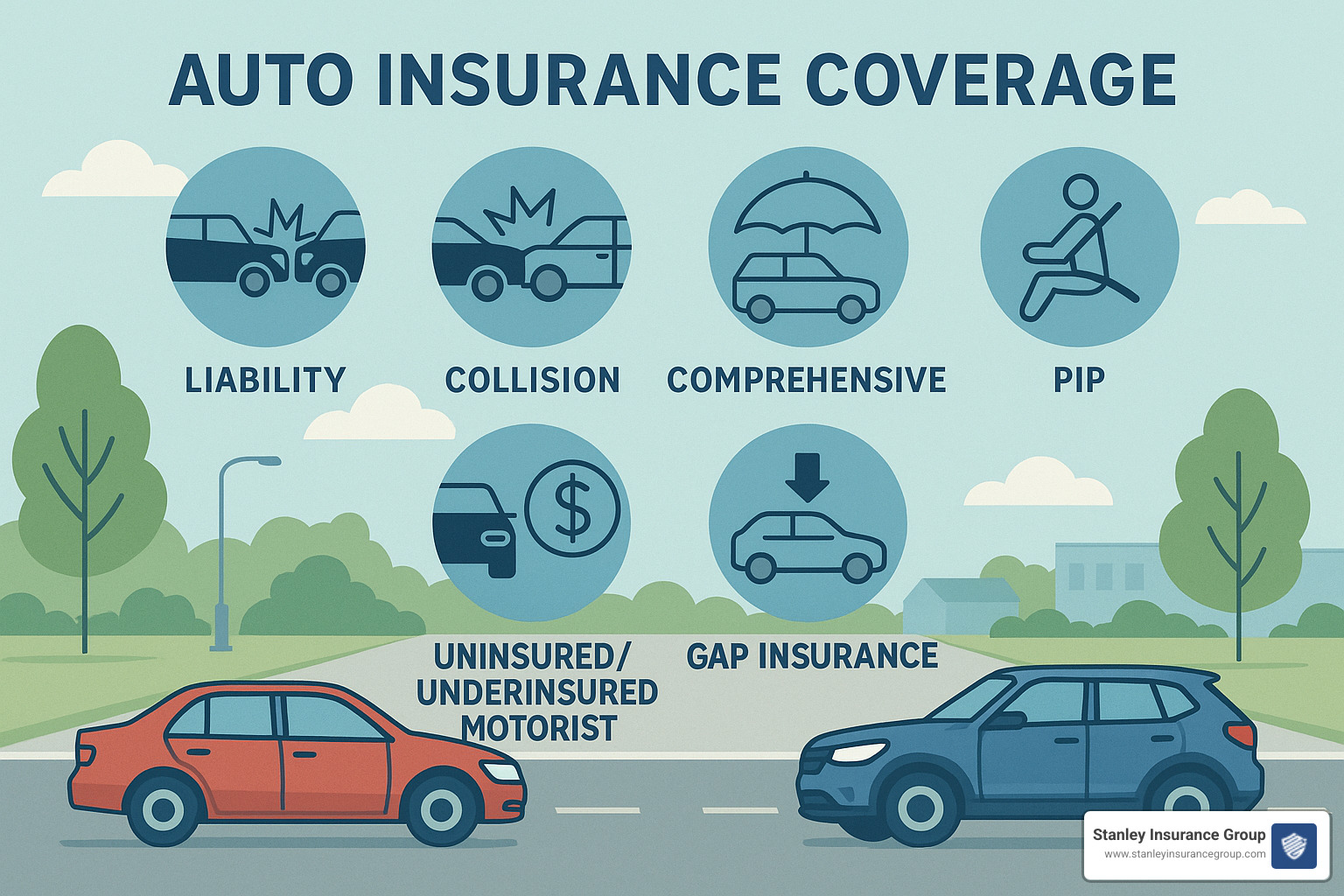
Personal Injury Protection (PIP) covers medical expenses for you and your passengers regardless of who caused the accident. It's mandatory in no-fault states.
"If you don't have health insurance, consider increasing your PIP coverage to handle potential medical bills," advises Amy, our Commercial Lines specialist at Stanley Insurance Group. "Your personal situation should always influence your coverage choices."
Uninsured/Underinsured Motorist Coverage (UM/UIM) protects you when the other driver doesn't have enough (or any) insurance. With roughly 14% of drivers on American roads uninsured according to scientific research from the Insurance Information Institute, this coverage isn't just nice to have – it's practically essential.
Gap Insurance covers the difference between what you owe on your loan/lease and what your car is actually worth if it's totaled. Without it, you could be making payments on a car you no longer have!
If you're leasing or financing your vehicle, your lender will likely require both comprehensive and collision coverage until you've paid off the loan. This isn't just them being difficult – it protects their investment in your vehicle.
At Stanley Insurance Group (proudly serving Ohio since '84), we take the time to explain these options in everyday language. Our independent agents work with you to determine what coverage makes sense for your specific situation – no cookie-cutter policies here!
Tip #2: Calculate How Much Coverage You Really Need
Have you ever wondered if the minimum required insurance is actually enough? It's a bit like buying the smallest umbrella during rainy season – it might work for a light drizzle, but you'll get soaked in a downpour.
"Choosing the minimum required liability limits may not provide sufficient protection," cautions our Associate Agent Ethan. "For example, Virginia's minimum 30/60/20 liability might leave a driver $60,000 short if three people each incur $50,000 in medical bills in an accident."
Think about that for a moment – a moderate accident could leave you personally responsible for tens of thousands of dollars beyond what your insurance covers. That's why calculating your actual coverage needs is one of the most important buying auto insurance tips you'll ever receive.
How much liability coverage is recommended?
Most insurance professionals recommend liability limits of at least 100/300/100, which breaks down to:
- $100,000 bodily injury coverage per person
- $300,000 bodily injury coverage per accident
- $100,000 property damage coverage per accident
These higher limits aren't just arbitrary numbers – they reflect the real costs of accidents in today's world. Medical bills can quickly soar into six figures, and damaging someone's luxury vehicle or causing property damage can easily exceed state minimums.
For families with homes, savings, or other assets, these recommended limits provide a crucial buffer between an accident and financial hardship. And if you've worked hard to build substantial assets, we often suggest adding an umbrella policy for $1 million or more in additional protection.
"Maintain a clean driving record for at least 3–5 years to qualify for accident-forgiveness discounts," suggests Chase, one of our Associate Agents at Stanley Insurance Group. "This extra layer of protection can prevent a single mistake from dramatically increasing your premiums."
Buying auto insurance tips for high-risk & teen drivers
We've been helping high-risk and teen drivers find appropriate coverage since '84, and we understand the challenges these situations present. If tickets, accidents, or a DUI have pushed you into the high-risk category, don't despair – you have options.
First, shop multiple companies since some insurers specialize in higher-risk drivers. If you're still struggling to find coverage, consider state-assigned risk pools as a temporary solution. Many drivers benefit from taking a defensive driving course, which can sometimes offset points on your record. Most importantly, focus on gradually rebuilding your record, as each year of safe driving improves your insurance prospects.
"Adding a teen driver to your policy can increase your premium by $1,000 to $2,000 or more per year," notes Sandra, one of our Spanish-speaking Account Specialists. However, there are ways to make this more manageable. Good student discounts reward teens maintaining a B average or better. Driver training courses often translate to lower rates, while your vehicle choice matters significantly – insuring teens on safer, more modest vehicles costs less than adding them to a sports car policy. For families where teens drive infrequently, occasional driver status might be available.
At Stanley Insurance Group, we take pride in our concierge approach to finding the right coverage. While online calculators might give you a rough estimate, our independent agents can provide personalized recommendations based on your specific situation, assets, and risk tolerance. Since 1984, we've been helping families across Ohio, Pennsylvania, Tennessee and beyond find that perfect balance between protection and affordability.
Tip #3: Compare Quotes Like a Pro
One of the most valuable buying auto insurance tips I can share is to shop around. It's eye-opening to learn that 30% of policyholders switched insurers in the past five years, walking away with median annual savings of $461. That's real money back in your pocket!
"It's a misconception that insurers reward customer loyalty," reveals a Consumer Reports study. In fact, staying with the same company for years might actually cost you more due to something called "price optimization"—where insurers gradually increase rates for customers they believe won't bother shopping around. A bit sneaky, isn't it?
How to compare effectively:
When you're ready to compare quotes, think like a pro. Use identical coverage levels across all quotes—same liability limits, same deductibles, same optional coverages. This creates a true apples-to-apples comparison.
Look beyond just the price tag. A bargain policy from a financially unstable company isn't much of a bargain if they can't pay your claim. Check financial strength ratings from AM Best or Standard & Poor's, customer satisfaction scores from J.D. Power, and complaint ratios from the National Association of Insurance Commissioners (NAIC).
Your shopping method matters too. Independent agents like us at Stanley Insurance Group offer access to multiple carriers and personalized advice custom to your specific situation. Direct insurers sell their own policies online or by phone, while captive agents represent just one insurance company. Online marketplaces aggregate quotes from multiple insurers but typically lack the personal touch.
"Independent agents provide more flexibility than captive agents," notes Kaisen, our Associate Agent. "We can shop multiple carriers to find the best fit for your specific situation, whether you're in Ohio, Pennsylvania, Tennessee, or any of our service areas."
Since 1984, Stanley Insurance Group has been building relationships with both clients and carriers. We're particularly proud to be among only 100 independent agents in the country with a partnership with Geico. This gives our clients unique access to a wide range of carriers while enjoying the concierge-level service that only comes from an established local agency.
Buying auto insurance tips for safe online shopping
If you're venturing into online quote comparison, keep these safety tips in your back pocket:
Protect your personal information carefully. Be cautious about sharing your Social Security number or driver's license before you're ready to buy. Many quote systems will perform soft credit pulls, which is normal but should be clearly disclosed. Always verify the insurer's legitimacy by confirming their licensing with the Ohio Department of Insurance or your state's regulatory body.
A clever trick? Use a separate email address for insurance quotes to manage the inevitable follow-up communications without flooding your primary inbox.
"Use an insurance agent to understand state requirements and lienholder demands," advises Ana, our Spanish-speaking Account Specialist. This personalized guidance is particularly valuable for those new to a state or buying their first policy. At Stanley Insurance Group, we pride ourselves on offering this guidance in both English and Spanish, ensuring everyone gets the information they need in the language they're most comfortable with.
Comparing quotes isn't just about finding the cheapest price—it's about finding the right coverage from a reputable company at a fair price. That's what we've been helping our clients do since '84.
Tip #4: Slash Premiums with Deductibles & Discounts
Let's face it – nobody wants to pay more for car insurance than they have to. The good news? You don't have to accept the first price you're quoted. With a few smart moves, you can trim those premiums without sacrificing the protection you need.

Deductible math 101
Your deductible is simply what comes out of your pocket before insurance kicks in after a claim. It's one of the most powerful levers you have to control your premium costs.
Think of it this way: bumping your deductible from $500 to $1,000 could shave 20-25% off your annual premium – that's about $464 to $525 in savings for the average driver.
"Ensure you can afford your deductible before raising it," Chase from our team wisely cautions. "Those savings look great on paper, but you need to be comfortable with paying that higher amount if you actually need to file a claim."
Let's do some quick math together:
- If raising your deductible saves you $500 a year in premiums
- You'd break even after just one year without claims
- Every claim-free year after that puts real money back in your pocket
This is why we sit down with our clients at Stanley Insurance Group to find that sweet spot where your deductible and premium work together for your specific financial situation.
Discount opportunities you shouldn't miss
Here's where things get interesting – bundling your policies can be a goldmine, typically saving around $348 annually when you combine auto with home or renters insurance. Since 1984, we've been helping clients stack these discounts to maximize their savings.
Safe driver discounts are another big win, with clean records typically earning you 10-25% off. Been accident-free for years? You deserve to pay less! And don't overlook defensive driving courses – investing a few hours can save you around $233 per year. That's a pretty nice hourly rate for your time!
Tech-savvy? Consider telematics or usage-based insurance programs. These little devices or apps monitor your driving habits and can save careful drivers a median of $120 yearly, with some seeing savings up to $931. As Ethan on our team often tells clients, "It's like getting paid to drive the way you already do."
Other discounts worth exploring include low mileage breaks for driving under 10,000 miles yearly, vehicle safety feature discounts for anti-theft devices and advanced safety systems, good student discounts (10-25% off for maintaining a B average or better), and multi-car discounts when you insure several vehicles on one policy.
"Many consumers leave money on the table simply because they don't ask about all available discounts," notes Sandra, one of our Spanish-speaking Account Specialists. At Stanley Insurance Group, we pride ourselves on explaining every possible saving opportunity – in English or Spanish – to clients throughout Columbus, Hilliard, Dublin, and all across Ohio.
Our independent agency status gives us a unique advantage in finding these savings. We can compare options across multiple carriers, including our special partnership with Geico (something only 100 independent agents nationwide can offer), to find the perfect balance of coverage and affordability for your specific situation.
Want to learn more about maximizing your insurance dollars? Check out our detailed guide on Ways to Save on Insurance for even more buying auto insurance tips that can keep money in your pocket where it belongs.
Tip #5: Time Your Policy Around Cars & Life Events
Timing really is everything when it comes to insurance, especially when you're buying a new set of wheels. I've seen too many excited car buyers suddenly panic at the dealership when asked for proof of insurance!
"Get quotes and shop for insurance before stepping foot on the dealership lot," recommends Amy, our Commercial Lines specialist. This simple buying auto insurance tips can save you both stress and money when you're about to drive home in your new car.
Here's why timing matters so much:
Dealerships expect you to handle your own insurance arrangements. "Dealership staff assume buyers have coverage and will not add a new car to your policy for you," notes a recent industry survey. That responsibility is entirely yours.
While your existing policy might offer a grace period for new vehicles, this typically only lasts between 24 hours to 14 days (check your specific policy). Don't risk that coverage gap!
You need proof of insurance to legally drive off the lot. Without it, that exciting moment of getting your new keys could turn into an awkward waiting game.
Buying auto insurance tips during a car purchase

Pro tip: Ask for the VIN (Vehicle Identification Number) of your intended purchase before finalizing the sale. With this number in hand, we can have your insurance ready the moment you complete the paperwork. Most insurers, including those we work with at Stanley Insurance Group since '84, can email you a temporary ID card immediately after payment.
This preparation ensures you can confidently drive your new purchase home without worry. As your concierge independent agents, we handle these details so you can focus on enjoying your new vehicle.
Life events that affect your insurance
Life doesn't stand still, and neither should your insurance coverage. Major life changes often signal the perfect time to review your auto policy:
When you're moving, even just across town, your rates could change significantly. One study found that moving from Scottsdale to Phoenix increased test premiums by 8% (approximately $200). Your address affects your risk profile in ways you might not expect.
Marriage or divorce doesn't just change your relationship status—it impacts your insurance too. Married drivers typically qualify for lower rates, while divorce might mean adjusting who's covered on your policy.
Adding drivers, especially teenagers, can dramatically change your premium. But our team can help find the right balance of coverage and discounts to keep costs manageable.
A job change might mean a different commute distance, which directly affects your mileage and potentially your rates. Less driving often means less risk and lower premiums.
Even credit score improvements can lower your insurance costs in most states, as insurers use credit as a factor in determining rates.
"Notify your insurer of life changes (marriage, new teen driver, commute changes)," advises our team at Stanley Insurance Group. Being proactive about these updates ensures you're properly covered and may even qualify you for new discounts.
For our Spanish-speaking clients, Ana and Sandra are always ready to walk you through these important transitions in your preferred language. That's the advantage of working with a local, independent agency that's been serving Ohio families since 1984—we understand that insurance needs to adapt to your life, not the other way around.
Tip #6: Review, Switch & Stay Protected
Insurance isn't something you can just set up and forget about. Life changes, and so should your coverage. Taking time to review your policies annually keeps you properly protected while potentially saving you hundreds of dollars.
"I've seen clients who stayed with the same company for 20 years suddenly save over $800 when they finally shopped around," says Ethan, one of our Associate Agents at Stanley Insurance Group. This happens because many insurers gradually increase rates for loyal customers—a practice called "price optimization"—betting you won't notice or bother to switch.
Consumer Reports and other advocacy groups consistently recommend shopping your coverage every 2-3 years to ensure competitive rates. Your circumstances change, insurance company appetites shift, and new discounts become available that you might qualify for.
When reviewing your policy, pay special attention to your declarations page. This critical document summarizes your coverage limits, deductibles, and premium charges. A quick review might reveal you're paying for coverage you no longer need or have gaps in protection that should be addressed.
When and how to switch insurers
If you find a better rate elsewhere, switching companies is usually straightforward, but timing matters:
Start your new policy before ending the old one. "Set your new policy start date before canceling your existing coverage," advises Kaisen, our Associate Agent. "Even a single day without insurance can be classified as a coverage lapse, potentially raising your rates for years to come."
Get written confirmation of your new coverage. Before canceling your existing policy, make sure you have documentation proving your new insurance is active. This typically comes in the form of an insurance ID card and declarations page.
Follow proper cancellation procedures. Each insurer has specific requirements for cancellation. Some require written notice, while others accept cancellations by phone. Don't assume your new insurance company will handle this for you unless they specifically confirm they're doing so.
Request your refund. If you've paid in advance for your policy term, you're entitled to a prorated refund for the unused portion. This refund should be processed automatically, but it's worth confirming the amount and timing.
"The most common mistake we see is people assuming their coverage is fine because nothing has changed in their life," notes Amy from our Commercial Lines department. "But even without life changes, the insurance market itself is constantly evolving."
At Stanley Insurance Group, we've been helping clients in Columbus, Hilliard, Dublin, and throughout Ohio manage their insurance needs since 1984. Our concierge approach means we handle the review process for you, reaching out annually to ensure your coverage still matches your needs and remains competitively priced.
For clients who speak Spanish, our bilingual team members Ana and Sandra can guide you through the review process in your preferred language, making sure you fully understand your coverage options. As one of only 100 independent agencies nationwide with a Geico partnership, we offer unique access to a broad range of carriers while providing the personalized service only a local agency can deliver.
Want more insights about finding the best coverage in our home state? Check out our guide to Top Tips for Finding the Best Car Insurance in Ohio for location-specific buying auto insurance tips.
Frequently Asked Questions about Buying Auto Insurance
How do deductibles affect my premium?
Your deductible and premium have a see-saw relationship—when one goes up, the other comes down. It's one of the most powerful buying auto insurance tips to understand.
"I always tell clients to think of deductibles as their 'skin in the game,'" says Chase from our team. "When you're willing to shoulder more risk with a higher deductible, the insurance company rewards you with lower premiums."
Raising your deductible from $500 to $1,000 typically slashes your annual premium by 20-25%. For many drivers, that means pocketing an extra $40-50 each month. However, this savings comes with a responsibility: you need to be financially prepared to cover that higher out-of-pocket amount if you have a claim.
We recommend setting aside your deductible amount in an emergency fund—that way, you're enjoying the premium savings while still being prepared if the unexpected happens. This balanced approach gives you the best of both worlds without compromising your financial security.
Do I need gap insurance if I'm leasing?
If you're leasing a vehicle, gap insurance isn't just a good idea—it's practically essential. This is one of those buying auto insurance tips that can save you thousands of dollars in a worst-case scenario.
Amy, our Commercial Lines specialist, explains it this way: "The moment you drive a new car off the lot, it depreciates—sometimes by as much as 20% in the first year. But your lease payments are based on the original value. Without gap coverage, that creates a financial 'gap' you'd be responsible for if the car is totaled."
Standard insurance only pays the actual cash value of your vehicle at the time of loss. With leased vehicles, that amount is often significantly less than what you still owe on your lease. Gap insurance covers this difference, protecting you from potentially owing thousands on a car that no longer exists.
This protection is particularly valuable in the early years of your lease when the gap between your car's value and your lease balance is widest. It's a small premium increase for substantial peace of mind.
What's the best way to insure a teen driver?
Adding a teen driver to your policy is one of those milestones that makes parents reach for their wallets. The reality is that teens are statistically riskier drivers, and premiums reflect that risk.
"When parents hear their premium might jump by $1,000 to $2,000 annually after adding their teen, I can almost hear their hearts skip a beat," says Sandra, our Spanish-speaking Account Specialist. "But there are ways to soften that blow."
Rather than purchasing a separate policy (which is almost always more expensive), adding your teen to your existing policy with these smart strategies can help manage costs:

Assign your teen as the primary driver on your least expensive vehicle. Insurance companies typically match the highest-risk driver with the highest-risk (usually most expensive) car unless you specify otherwise.
Good student discounts can trim 10-15% off that premium increase. Most insurers require a B average or better, so those study sessions literally pay off.
Driver training courses do more than teach better driving—they can qualify your teen for additional discounts. At Stanley Insurance Group, we can point you toward approved courses that insurers recognize.
Distant student discounts apply if your teen is attending college more than 100 miles from home without a car. This can reduce their portion of the premium while they're away.
Telematics programs that monitor driving habits can be particularly beneficial for teens who drive safely. These programs reward good driving behaviors with discounts that grow over time.
Since 1984, we've been helping families in Columbus, Hilliard, Dublin, and throughout our service areas steer the challenges of insuring teen drivers. Our bilingual team members can walk you through all available options in English or Spanish, ensuring you find the right balance of protection and affordability.
Conclusion
Finding the right auto insurance doesn't have to feel like navigating a maze without a map. By following these buying auto insurance tips, you can secure the protection you need while keeping your wallet happy.
The auto insurance landscape is constantly changing—with premiums rising nationwide and coverage options evolving. That's why it's so important to stay informed and proactive about your coverage. Review your policy at least once a year, or whenever you experience a major life change like moving, getting married, or adding a new driver to your household.
Remember to keep your insurance documents somewhere easily accessible, whether that's a dedicated folder in your filing cabinet or securely stored digital copies. You never know when you might need to reference your policy details or provide proof of insurance in a hurry.
Taking advantage of discounts isn't just a one-time opportunity—new discounts become available as your circumstances change. That safe driver discount might not have been available to you three years ago, but with a clean record now, you could qualify for significant savings.
At Stanley Insurance Group, we've been guiding families through their insurance journeys since '84. Our concierge approach means we handle the complexities while you enjoy the peace of mind that comes with proper coverage. As independent agents, we can compare options across multiple carriers—including our special partnership with Geico that only 100 independent agencies nationwide can offer.
Whether you're in Columbus, Hilliard, Dublin, or anywhere throughout Ohio, Pennsylvania, Tennessee, North Carolina, South Carolina, or Florida, our team is ready to provide personalized guidance. Our bilingual team members Ana and Sandra ensure our Spanish-speaking clients receive the same exceptional service in their preferred language.
Don't let rising premiums or confusing coverage options steal your peace of mind. Contact Stanley Insurance Group today to find how our independent agency advantage can help you find the perfect auto policy custom to your unique needs and budget.
Stay informed on our blog for more insurance insights and updates that help protect what matters most to you and your family.
Similar posts


